
Objective: To evaluate whether a wearable inertial sensor (WIS) can detect and characterize morning bradykinesia (MB) in patients with Parkinson’s disease (PD).
Background: Morning bradykinesia (MB) is a frequent and disabling manifestation in PD, characterized by marked motor impairment upon awakening before the first effective levodopa dose. Objective quantification of MB remains limited, and wearables may allow objective identification of motor patterns associated with this phenomenon.
Method: Cross-sectional, retrospective, multicentric study including PD patients attending movement disorders outpatient clinics. Participants wore a WIS for one week to monitor motor fluctuations (MFs) and reported whether they experienced MB. WIS data were processed to generate a bradykinesia estimation based on gait’s quality [1,2]. For each recording day, the first 60 minutes after the start of the daily record were defined as the “morning” period and compared with the remainder of the day. Mean, maximum, and minimum values of the movement signal were calculated for both periods, and differences between morning and daytime values were analyzed. Comparative analyses were performed between patients that reported no MB and the sensor confirmed its absence [No-MB; Fig 1A] and PD patients that reported MB and the sensor confirmed its presence [MB; Fig 1B].
Results: Sensor-derived metrics showed consistent and significant differences across multiple movement signal parameters [table 1]. Forty-nine patients were included (No-MB n=19; MB n=30). Patients with MB exhibited lower morning movement signal values (7.01 ± 1.41 vs 8.79 ± 1.46; p<0.001) and lower mean movement signal during the remainder of the day (7.53 ± 1.43 vs 8.75 ± 1.21; p=0.003). Maximum and minimum morning signal values were also reduced in the MB group (max mean morning 8.15 ± 1.92 vs 10.16 ± 1.51, p<0.001; min mean morning 6.18 ± 1.39 vs 7.61 ± 1.56, p=0.003). In addition, the difference between morning and daytime activity was greater in patients with MB (−0.54 ± 0.73 vs 0.05 ± 1.00; p=0.034) [Fig 2].
Conclusion: WIS can identify objective motor patterns compatible with MB in PD. These findings support the potential role of wearable technology for continuous monitoring of early-morning motor impairment and may facilitate more precise identification and management of this disabling complication.
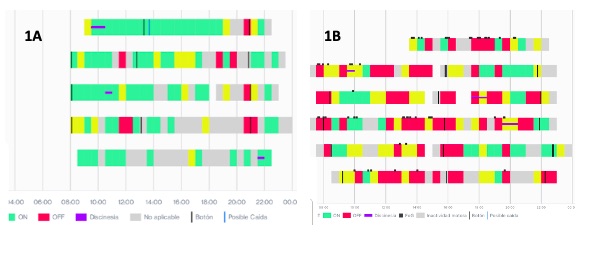
Fig 1
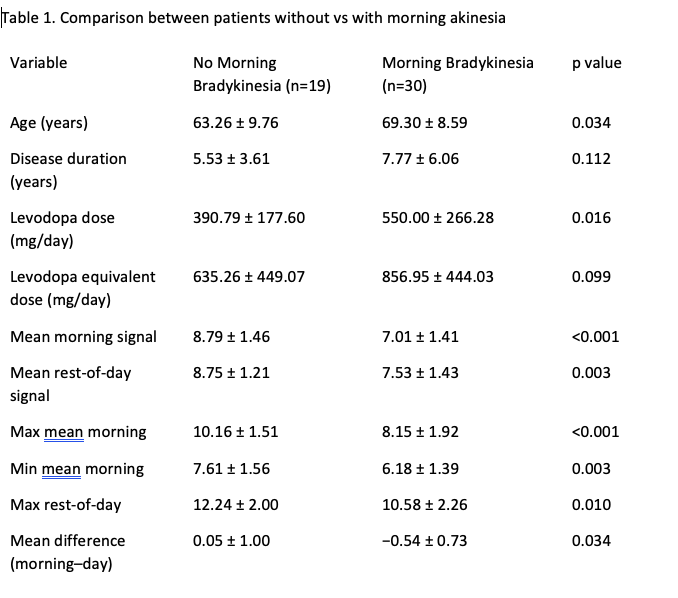
Table 1
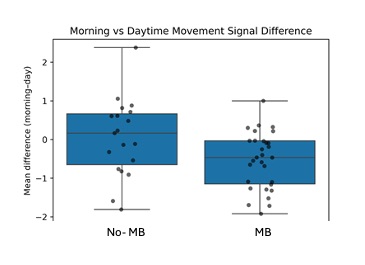
Fig 2
References: 1. Samà A, Pérez-López C, Rodríguez-Martín D, Català A, Moreno-Aróstegui JM, Cabestany J, et al. Estimating bradykinesia severity in Parkinson’s disease by analysing gait through a waist-worn sensor. Comput Biol Med. 2017;84. doi:10.1016/j.compbiomed.20
2. Rodríguez-Martín D, Cabestany J, Pérez-López C, Pie M, Calvet J, Samà A, Capra C, Català A, Rodríguez-Molinero A. A new paradigm in Parkinson’s disease evaluation with wearable medical devices: a review of STAT-ON™. Front Neurol. 2019;10:1197. https://doi.org/10.3389/fneur.2019.01197
To cite this abstract in AMA style:
N. Caballol, A. ávila, A. Planas-Ballvé, A. Peral, P. Lombardo, A. Pérez-Soriano, A. Bayés, P. Quispe, S. Belmonte, J. Hernández-Vara, D. Cerdan, I. Cabo, N. López-Ariztegui, T. Delgado, J. Herreros-Rodríguez, D. Santos-García, C. Cores-Bartolomé, G. Jarasunas-Cardozo, J. Casanova-Mollà, C. Pérez-López. Objective detection of morning bradykinesia in Parkinson’s Disease using a wearable inertial sensor [abstract]. Mov Disord. 2026; 41 (suppl 1). https://www.mdsabstracts.org/abstract/objective-detection-of-morning-bradykinesia-in-parkinsons-disease-using-a-wearable-inertial-sensor/. Accessed October 1, 2026.« Back to 2026 International Congress
MDS Abstracts - https://www.mdsabstracts.org/abstract/objective-detection-of-morning-bradykinesia-in-parkinsons-disease-using-a-wearable-inertial-sensor/