
Category: Technology
Objective: To evaluate factors influencing responsiveness to a wearable vibration-based neuromodulation device (WALK) for Freezing of Gait in individuals with Parkinson’s disease.
Background: Freezing of gait (FOG) remains one of the most disabling symptoms in Parkinson’s disease (PD), contributing substantially to falls, loss of independence, and reduced quality of life. Addressing FOG effectively is central to improving mobility and daily functioning in people with PD. Wearable neuromodulation approaches have emerged as promising non-pharmacological strategies to improve gait. However, variability in treatment response remains poorly understood. Here, we report findings from a study using a novel wearable device, WALK, which delivers stimulation to quadriceps and hamstrings, and examined clinical features that distinguish responders from non-responders.
Method:
We conducted an analysis of 13 individuals with PD+FOG (11 responders, 2 non-responders) evaluated in the OFF-medication state. Participants performed a standard mobility protocol including sit-to-stand, straight walking, turning, doorway passage and narrow space walking, with and without an arithmetic dual task. FOG severity was quantified using a task-based observational scale under two conditions: without stimulation (baseline) and with active WALK stimulation. Responders were defined as participants exhibiting improvement in FOG severity scores.
Results:
Responders exhibited an average improvement of 9.45 points, while non-responders showed no measurable improvement; no participants worsened in this cohort. The largest gains were observed during sit-to-stand transitions, doorway passage, and dual-task cluttered maze walking (p<0.05). In 7 of 12 tasks, responders shifted from severe to mild FOG with WALK stimulation. Clinically, responders were more often in H&Y stage 3 with longer disease duration, whereas non-responders were typically stage 4 with shorter disease duration.
Conclusion:
Wearable based neuromodulation through the WALK device is effective in alleviating freezing of gait. Disease stage and disease duration appear to influence responsiveness to vibration-based neuromodulation for FOG in individuals with Parkinson’s disease.
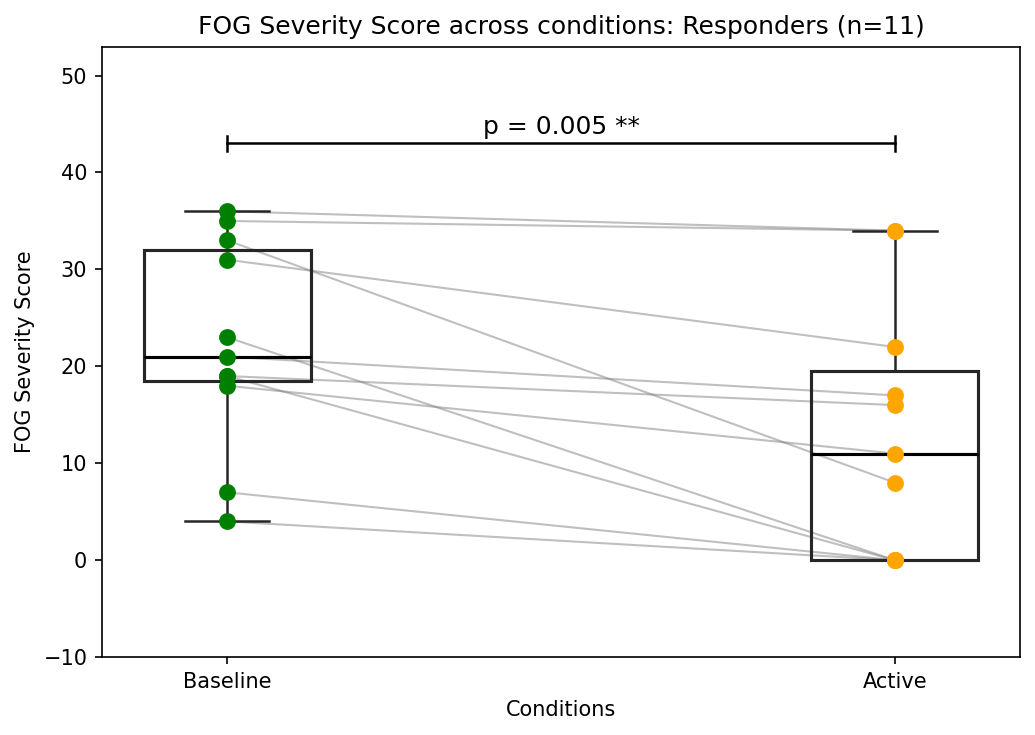
Mean FOG severity across conditions
To cite this abstract in AMA style:
A. Desai, R. Rajput. Personalized Factors Influencing Technological Solutions for Mobility – Insights from A Wearable Device in Parkinsons Disease [abstract]. Mov Disord. 2026; 41 (suppl 1). https://www.mdsabstracts.org/abstract/personalized-factors-influencing-technological-solutions-for-mobility-insights-from-a-wearable-device-in-parkinsons-disease/. Accessed October 1, 2026.« Back to 2026 International Congress
MDS Abstracts - https://www.mdsabstracts.org/abstract/personalized-factors-influencing-technological-solutions-for-mobility-insights-from-a-wearable-device-in-parkinsons-disease/