
Category: Parkinson's Disease (Other)
Objective: To measure vibrotactile stimuli response with the NUSHU X sneaker in Parkinson’s disease (PD).
Background: Gait disturbances in PD are complex and difficult to treat, often refractory to dopaminergic therapy. The NUSHU X sneaker (Magnes AG) allows for continuous gait analysis, with vibrotactile stimuli serving as a potential treatment for gait disturbances.
Method: Gait metrics in participants with PD were evaluated at baseline, Week 6, and Week 12. At each visit, participants completed MDS-UPDRS III, 10m walk and Timed Up and Go (TUG) assessments while wearing the NUSHU X sneaker without vibration, along with 1-minute continuous gait analysis. With vibrational mode turned on, participants then walked approximately 300m, after which 1-minute continuous gait and TUG were reassessed.
Results: Six participants completed visits from Baseline to Week 12. Participants were all male with a mean age of 66.5 years (±9.89), disease duration of 8.9 years (±6.87), with baseline MDS-UPDRS III 32.5 (±9.54), and 10m walk test 0.91m/s (±0.11). Baseline TUG increased from 12.67s (3.44) without vibration to 13.50s (2.74) with vibration. At Week 12, the mean MDS-UPDRS III score improved to 25.50 (±11.15), though two participants altered PD medications between visits. Changes in TUG remained similar: 12.33s (0.52) without vibration, increasing to 13.50s (2.07) with vibration. Change in continuous gait metrics from Baseline to Week 12 without vs with vibration were (Figure 1): stride length +0.0046 m (p=0.93), velocity -0.0017 m/s (p=0.96), stride duration +0.0027s (p=0.96), strike angle -0.2880° (p=0.86), heel clearance +0.0040cm (96.19%, p=0.53), and swing vs stance ratio -0.0128 (p=0.46).
Conclusion: Across participants, the average change in gait metrics without vs with vibration remained relatively constant from Baseline to Week 12. Largest effects were seen in heel clearance and stride duration, but some metrics (such as stride velocity) worsened. Vibration mode decreased average participant standard deviation across most measures at Baseline, suggesting improved gait stability. However, this effect was not sustained at Week 12 (Figure 2). Limitations include short duration of wear-time confined to clinic visits, gait metric analysis limited to the first 60 sec, and concomitant medication alterations.
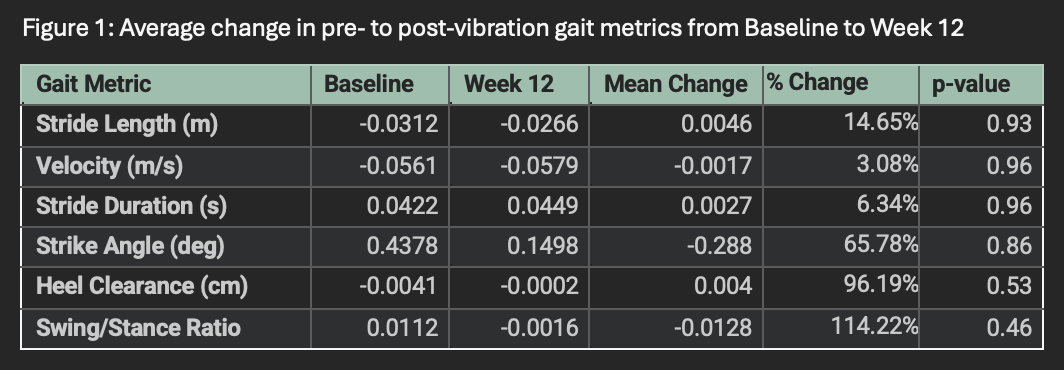
Average change pre- to post-vibration: Wk0 – Wk12
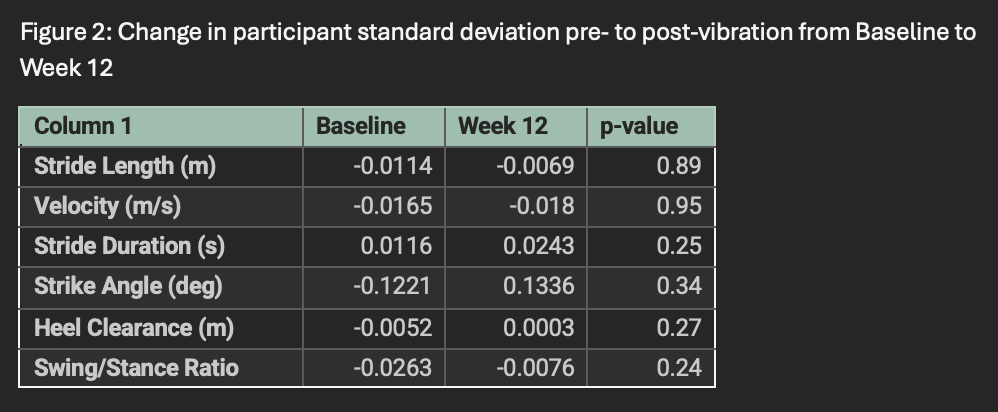
StDev change pre- to post-vibration: Wk 0 – Wk 12
To cite this abstract in AMA style:
D. Kashyap, K. Nicholson, B. Katz, C. Snajdr-Trinch, M. Mcmichael, N. Hellmers, HY. Ooi, H. Sarva, A. Yoo. Pilot Study of Vibrotactile Gait Cueing with the NUSHU X Sneaker in Parkinson’s Disease [abstract]. Mov Disord. 2026; 41 (suppl 1). https://www.mdsabstracts.org/abstract/pilot-study-of-vibrotactile-gait-cueing-with-the-nushu-x-sneaker-in-parkinsons-disease/. Accessed October 1, 2026.« Back to 2026 International Congress
MDS Abstracts - https://www.mdsabstracts.org/abstract/pilot-study-of-vibrotactile-gait-cueing-with-the-nushu-x-sneaker-in-parkinsons-disease/