
Objective: To assess the role of local field potential (LFP) as an acute biomarker of maximal tolerable stimulation (MTS) in dystonia patients.
Background: Dystonia is the third most prevalent movement disorder, characterized by involuntary muscle contractions [1]. Deep Brain Stimulation (DBS) can effectively reduce dystonia symptoms, but programming remains challenging due to individualized stimulation needs, delayed clinical responses, and variable outcomes [2-10]. While effective stimulation reduces dystonia, imbalanced stimulation titration can worsen symptoms [11-17]. LFP features have been linked with dystonia severity in acute settings [18-21], indicating potential utility for guiding DBS programming and clinical decision making.
Method: Continuous real-time globus pallidus internus (GPi) LFP recordings (BrainSense Streaming) were obtained from 3 patients with generalized dystonia (1 idiopathic; 2–3 with TOR1A:p.303delE mutation) during DBS programming. LFP power spectral density (PSD) and changes in dystonia severity (Burke–Fahn–Marsden Dystonia Rating Scale (BFMDRS) Movement subscale) were recorded during carefully titrated stimulation amplitude adjustments made under clinician guidance. MTS was empirically defined by individual tolerance to stimulation adjustments. Data was analyzed retrospectively using Matlab(2024b), after gaining informed consent.
Results: Stepwise increases in stimulation amplitude up to MTS led to increased power across multiple canonical frequency bands in all 3 cases, corresponding with clinical overstimulation measured by BFMDRS [figure1, table1]. LFP power during MTS was significantly higher compared to baseline values [figure2]. Subsequent reduction of stimulation amplitude below MTS resulted in overall decrease in LFP power. Linear mixed modelling shows that stimulation amplitude and LFP power positively correlate with dystonia severity in all 3 instances [figure3], both separately (mA:4.039, LFP power:2.912), and jointly (mA:LFP power:0.986).
Conclusion: These findings suggest that LFP features can be putative indicators of dystonia severity. Although increased LFP band power correlated with clear clinical worsening in these patients, not all dystonia patients will show immediate signs of worsening. Increased LFP band power during increasing stimulation amplitude may represent a biomarker for patients at-risk of manifesting delayed clinical worsening.
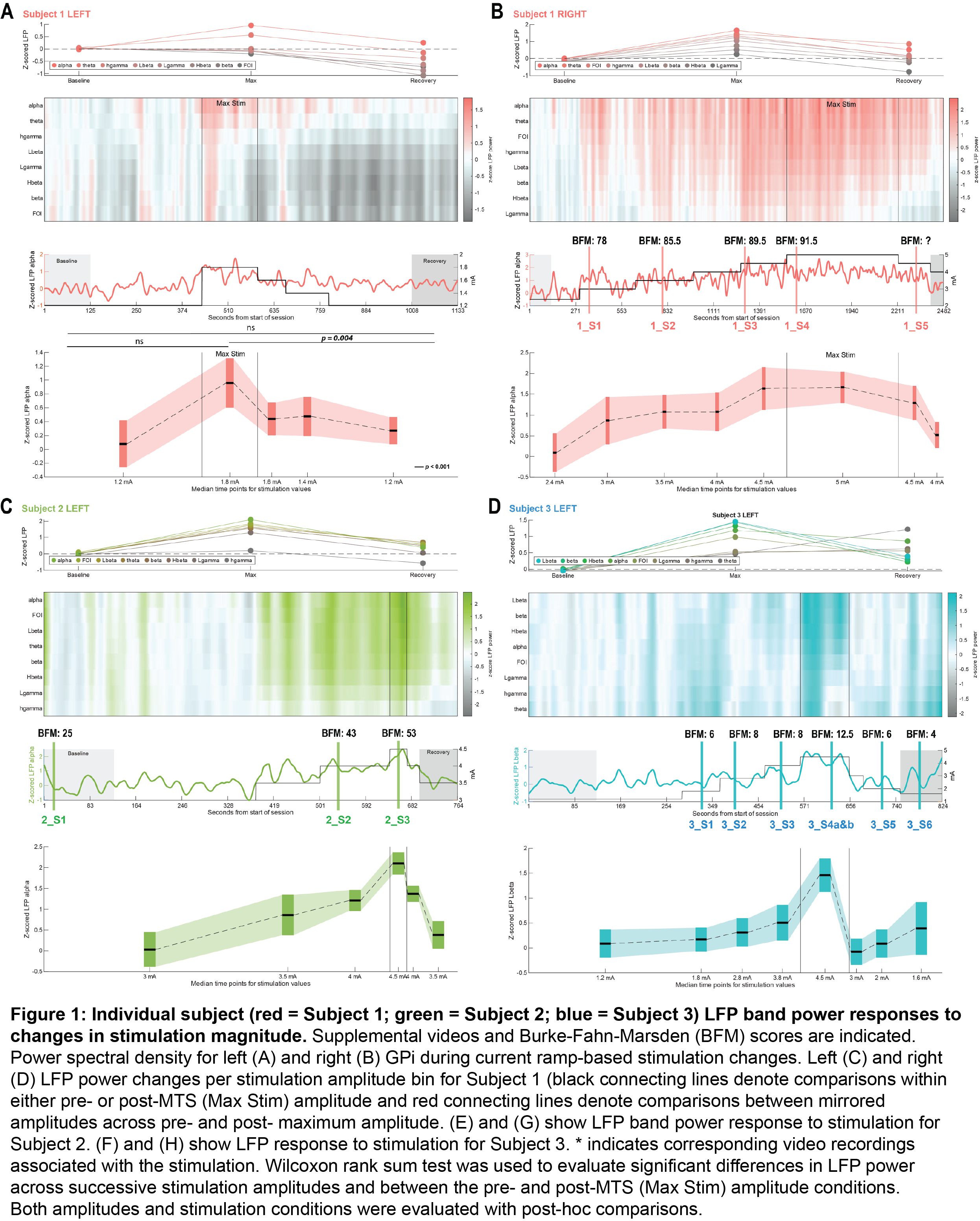
figure1
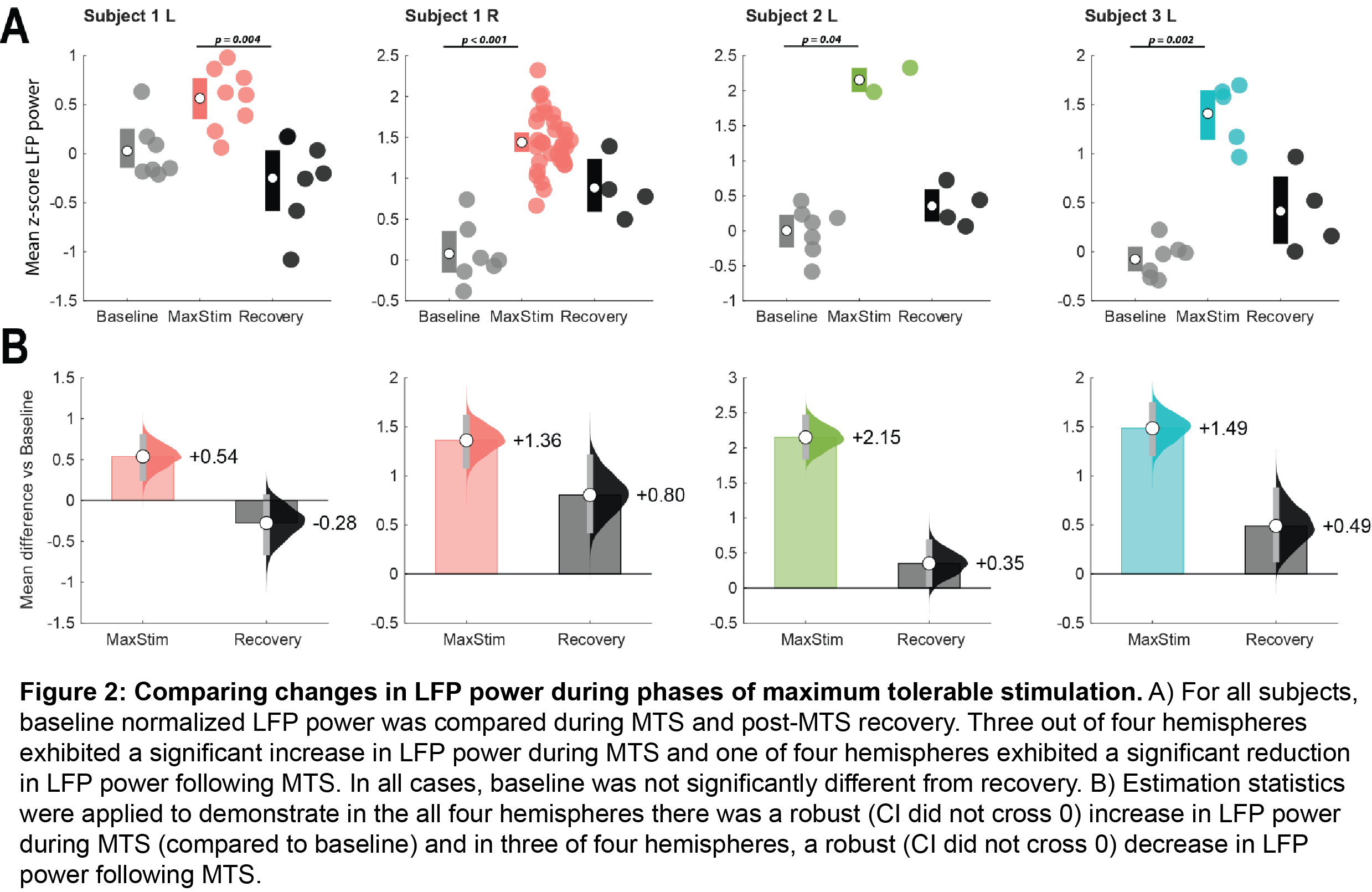
figure2
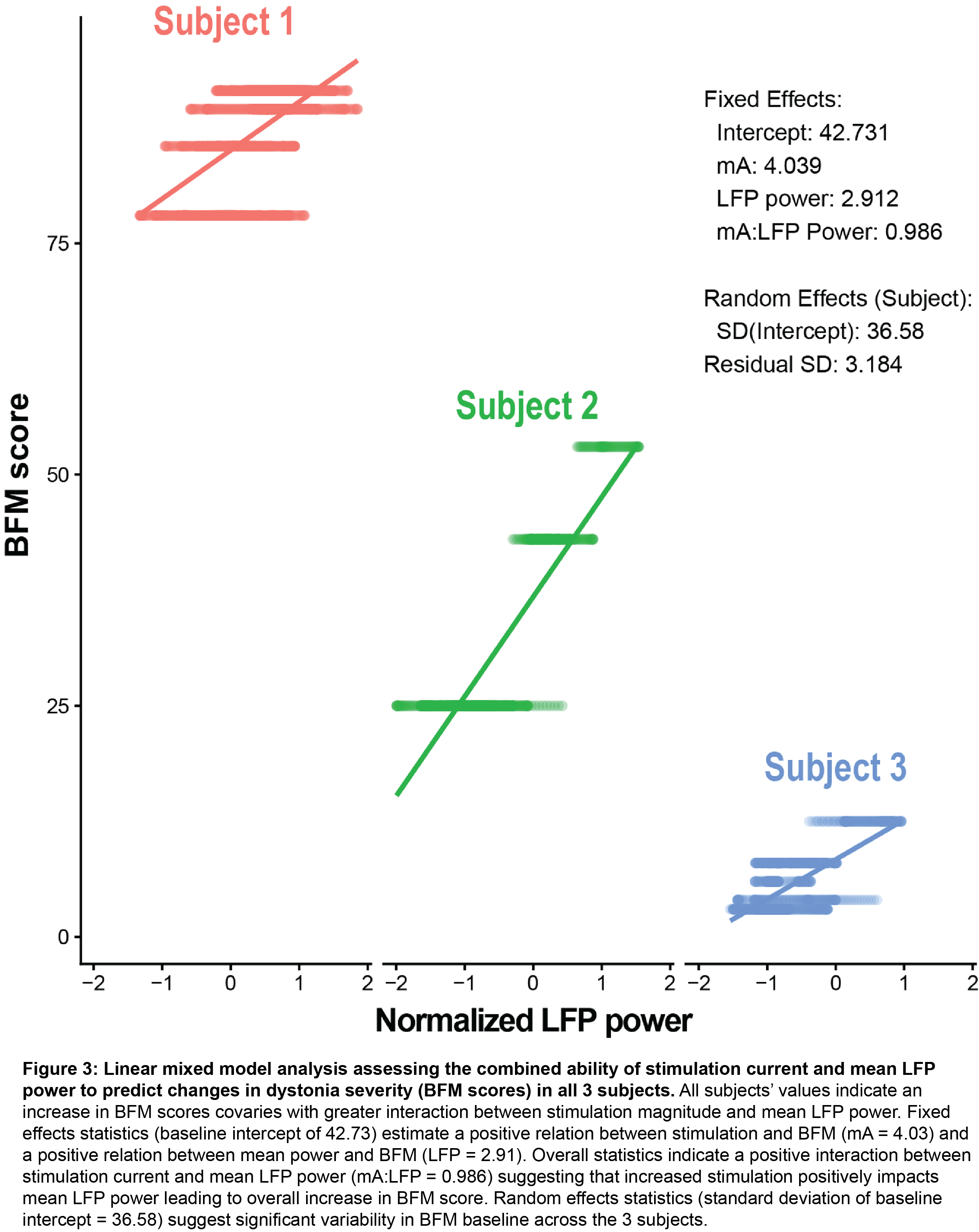
figure3
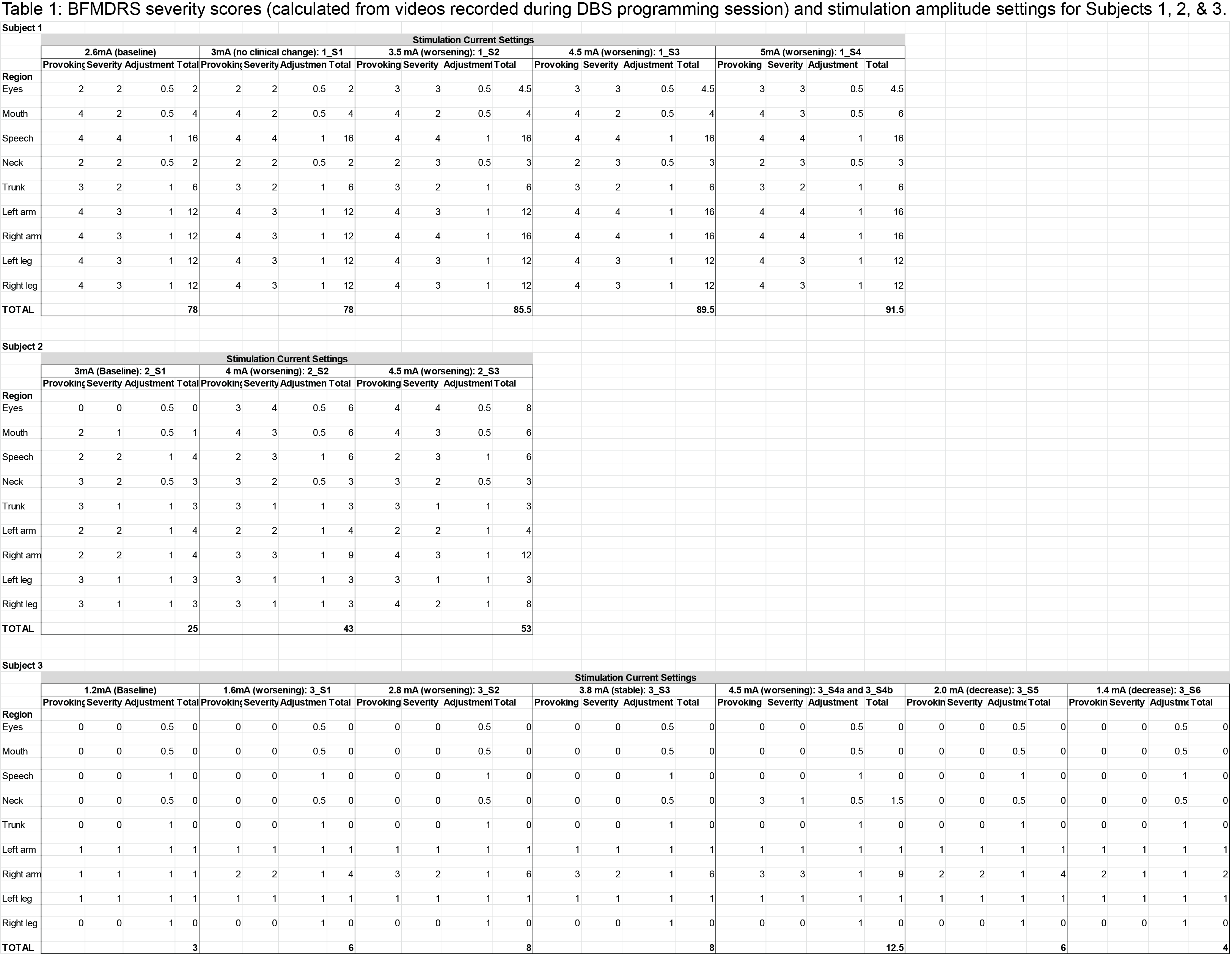
table1
References: 1. Defazio G. The epidemiology of primary dystonia: current evidence and perspectives. Eur J Neurol. 2010 Jul;17 Suppl 1:9-14. doi: 10.1111/j.1468-1331.2010.03053.x. PMID: 20590802.
2. Markun LC, Starr PA, Air EL, Marks WJ Jr, Volz MM, Ostrem JL. Shorter disease duration correlates with improved long-term deep brain stimulation outcomes in young-onset DYT1 dystonia. Neurosurgery. 2012 Aug;71(2):325-30. doi: 10.1227/NEU.0b013e318258e21b. PMID: 22811083.
3. Panov F, Gologorsky Y, Connors G, Tagliati M, Miravite J, Alterman RL. Deep brain stimulation in DYT1 dystonia: a 10-year experience. Neurosurgery. 2013 Jul;73(1):86-93; discussion 93. doi: 10.1227/01.neu.0000429841.84083.c8. PMID: 23615098.
4. Lumsden DE, Kaminska M, Gimeno H, Tustin K, Baker L, Perides S, Ashkan K, Selway R, Lin JP. Proportion of life lived with dystonia inversely correlates with response to pallidal deep brain stimulation in both primary and secondary childhood dystonia. Dev Med Child Neurol. 2013 Jun;55(6):567-74. doi: 10.1111/dmcn.12117. Epub 2013 Mar 1. PMID: 23452222.
5. Gelineau-Morel R, Kruer MC, Garris JF, Abu Libdeh A, Barbosa DAN, Coffman KA, Moon D, Barton C, Zea Vera A, Bruce AB, Larsh T, Wu SW, Gilbert DL, O’Malley JA. Deep Brain Stimulation for Pediatric Dystonia: A Review of the Literature and Suggested Programming Algorithm. J Child Neurol. 2022 Oct;37(10-11):813-824. doi: 10.1177/08830738221115248. Epub 2022 Sep 2. PMID: 36053123; PMCID: PMC9912476.
6. Tisch S, Rothwell JC, Limousin P, Hariz MI, Corcos DM. The physiological effects of pallidal deep brain stimulation in dystonia. IEEE Trans Neural Syst Rehabil Eng. 2007 Jun;15(2):166-72. doi: 10.1109/TNSRE.2007.896994. PMID: 17601185.
7. Ruge D, Tisch S, Hariz MI, Zrinzo L, Bhatia KP, Quinn NP, Jahanshahi M, Limousin P, Rothwell JC. Deep brain stimulation effects in dystonia: time course of electrophysiological changes in early treatment. Mov Disord. 2011 Aug 15;26(10):1913-21. doi: 10.1002/mds.23731. Epub 2011 May 5. PMID: 21547950; PMCID: PMC3174341.
8. Tisch S. Deep brain stimulation in dystonia: factors contributing to variability in outcome in short and long term follow-up. Curr Opin Neurol. 2022 Aug 1;35(4):510-517. doi: 10.1097/WCO.0000000000001072. Epub 2022 Jul 5. PMID: 35787538.
9. Tsuboi T, Cif L, Coubes P, Ostrem JL, Romero DA, Miyagi Y, Lozano AM, De Vloo P, Haq I, Meng F, Sharma N, Ozelius LJ, Wagle Shukla A, Cauraugh JH, Foote KD, Okun MS. Secondary Worsening Following DYT1 Dystonia Deep Brain Stimulation: A Multi-country Cohort. Front Hum Neurosci. 2020 Jun 25;14:242. doi: 10.3389/fnhum.2020.00242. PMID: 32670041; PMCID: PMC7330126
10. Jethwa A, Mink J, Macarthur C, Knights S, Fehlings T, Fehlings D. Development of the Hypertonia Assessment Tool (HAT): a discriminative tool for hypertonia in children. Dev Med Child Neurol. 2010 May;52(5):e83-7. doi: 10.1111/j.1469-8749.2009.03483.x. PMID: 20540176.
11. Berman, B. D., P. A. Starr, W. J. Marks, Jr., and J. L. Ostrem. 2009. ‘Induction of bradykinesia with pallidal deep brain stimulation in patients with cranial-cervical dystonia’, Stereotact Funct Neurosurg, 87: 37-44.
12. Tisch, S., L. Zrinzo, P. Limousin, K. P. Bhatia, N. Quinn, K. Ashkan, and M. Hariz. 2007. ‘Effect of electrode contact location on clinical efficacy of pallidal deep brain stimulation in primary generalised dystonia’, J Neurol Neurosurg Psychiatry, 78: 1314-9.
13. Reese R, Reich MM, Falk D, Deuschl G, Mehdorn HM, Volkmann J. Intraoperative Thresholds for Capsular Stimulation Are Reliable for Chronic Pallidal Deep Brain Stimulation in Dystonia. Stereotact Funct Neurosurg. 2017;95(2):79-85. doi: 10.1159/000452674. Epub 2017 Feb 16. PMID: 28199993.
14. Cagle, J. N., J. K. Wong, K. A. Johnson, K. D. Foote, M. S. Okun, and C. de Hemptinne. 2021. ‘Suppression and Rebound of Pallidal Beta Power: Observation Using a Chronic Sensing DBS Device’, Front Hum Neurosci, 15: 749567.
15. Lofredi, R., U. Scheller, A. Mindermann, L. K. Feldmann, J. K. Krauss, A. Saryyeva, G. H. Schneider, and A. A. Kühn. 2023. ‘Pallidal Beta Activity Is Linked to Stimulation-Induced Slowness in Dystonia’, Mov Disord, 38: 894-99
16. Lange, F., D. L. Guarin, S. Mosert, B. Karrasch, J. Roothans, B. Weigl, P. Navratil, C. Daniels, T. Odorfer, G. Brandt, P. Mahlknecht, J. K. Krauss, J. Runge, A. A. Kühn, G. Deuschl, J. Volkmann, R. Peach, and M. M. Reich. 2025. ‘Bradykinesia induced by pallidal neurostimulation in dystonia: clinical risk factors and anatomical mapping’, NPJ Parkinsons Dis, 11: 308.
17. Steigerwald, Frank, Cordula Matthies, and Jens Volkmann. 2019. ‘Directional Deep Brain Stimulation’, Neurotherapeutics, 16: 100-04.
18. Geng X, Quan Z, Zhang R, Zhu G, Nie Y, Wang S, et al. Subthalamic and pallidal oscillations and their couplings reflect dystonia severity and improvements by deep brain stimulation. Neurobiol Dis. 2024;199:106581. Epub 20240625. doi: 10.1016/j.nbd.2024.106581. PubMed PMID: 38936434.
19. Lofredi R, Feldmann LK, Krause P, Scheller U, Neumann WJ, Krauss JK, et al. Striato-pallidal oscillatory connectivity correlates with symptom severity in dystonia patients. Nat Commun. 2024;15(1):8475. Epub 20241001. doi: 10.1038/s41467-024-52814-4. PubMed PMID: 39349466; PubMed Central PMCID: PMC11442513
20. Zhang R, Nie Y, Dai W, Wang S, Geng X. Balance between pallidal neural oscillations correlated with dystonic activity and severity. Neurobiol Dis. 2023;183:106178. Epub 20230601. doi: 10.1016/j.nbd.2023.106178. PubMed PMID: 37268239.
21. Balachandar A, Vogt LM, Mithani K, Coleman SC, Ebden M, Leblanc-Miller A, et al. Status dystonicus is a distinct state characterized by pallidal beta-band activity. Nat Commun. 2025;16(1):9352. Epub 20251022. doi: 10.1038/s41467-025-64416-9. PubMed PMID: 41125573; PubMed Central PMCID: PMC12546768.
To cite this abstract in AMA style:
P. Bisarad, M. Pascual, J. Kelbert, S. Chinander, R. Gelineau-Morel, C. Gorodetsky, A. Hewitt, T. Larsh, N. Lucente, J. O'Malley, L. van Derwerf, J. Hauptman, T. Sanger, F. Ponce, M. Kruer, J. Thompson. Power Spectral Density Increases Covary with Clinical Overstimulation During Dystonia Deep Brain Stimulation Programming [abstract]. Mov Disord. 2026; 41 (suppl 1). https://www.mdsabstracts.org/abstract/power-spectral-density-increases-covary-with-clinical-overstimulation-during-dystonia-deep-brain-stimulation-programming/. Accessed October 1, 2026.« Back to 2026 International Congress
MDS Abstracts - https://www.mdsabstracts.org/abstract/power-spectral-density-increases-covary-with-clinical-overstimulation-during-dystonia-deep-brain-stimulation-programming/