
Category: Parkinsonism (Other)
Objective: To characterize longitudinal progression of motor and neuropsychological symptoms in PBC and to identify predictors of disease prognosis
Background: Primary Brain Calcification (PBC) is a rare neurodegenerative disorder characterized by bilateral calcium deposition in the basal ganglia, featuring movement disorders and cognitive or neuropsychiatric manifestations. Quantitative longitudinal data describing disease progression are scarce [1-4]
Method: 83 probable PBCs underwent standardized neurological/neuropsychological assessments with quantitative scales (Table1). Prospective follow-up lasted 3.5±2 years combined with retrospective clinical data for 9±4 years. Statistical analyses: correlation tests, Kaplan–Meier-curves, linear-mixed-models/hinge-LMM aligned to symptom onset, multivariate models
Results: Neurological symptoms were documented in 64 patients. Movement disorders, mainly parkinsonism, were the most frequent manifestation (63%). Cognitive deficits/MCI occurred in 48% of cases, predominantly affecting language; psychiatric features (43%) mainly entailed mood disorders. Combined motor and cognitive/neuropsychiatric features occurred in 37% (Fig.1). Clinical phenotype (parkinsonism, cerebellar signs, cognitive decline) predicted functional outcome (ADL/falls/assistance-need; p=0.01). Age was the main risk factor for symptom occurrence (p=0.004); mean onset age was 53.3 years, with neuropsychiatric symptoms appearing about 10 years earlier (p=0.002). A genetic diagnosis was obtained in 46% of cases, predominantly involving MYORG and SLC20A2 (Fig.2), and influenced symptom penetrance and progression. Progression occurred in 63%: longitudinal analysis (Fig.3) showed significant (p<0.01) worsening in UPDRS-III (+1.7/y), SARA (+0.7/y), MoCA (−0.6/y) and BDI-II (+1.1/y); dystonia/tremor showed minimal changes. Faster progression was observed in MYORG mutation carriers (UPDRS-III +3.6/y; SARA +1.7/y; p=0.01). Scores’ sum better correlated with number of motor symptoms. Cognitive decline was independent of genotype
Conclusion: PBC has different disease trajectories and phenotypes. This study contributes to define prognostic factors to better predict disease prognosis and improve patients’ management.
Data partially submitted as abstract for EAN2026
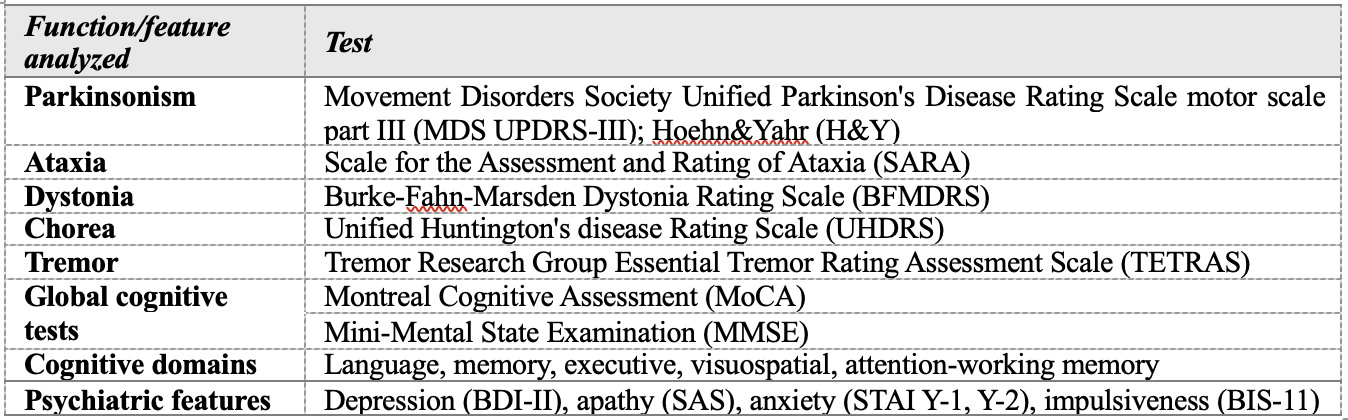
Table 1. Clinical assessment
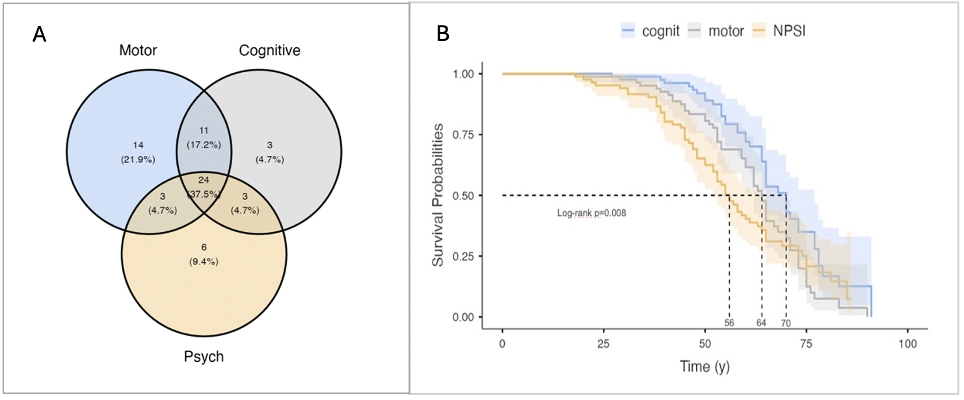
Fig.1 Symptoms and survival curves
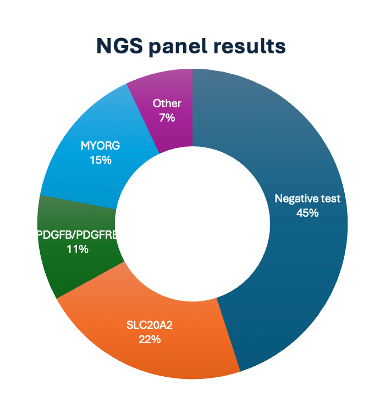
Fig.2 Genetic results
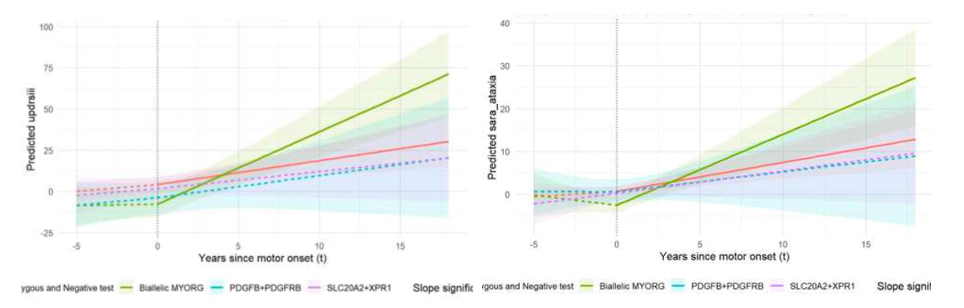
Fig.3 Longitudinal progression
References: [1] Luo W, Cen Z, Koek H, et al. Primary Brain Calcification: An International Consensus on Nomenclature, Diagnosis, Evaluation, and Management. Mov Disord. Published online December 4, 2025. doi:10.1002/mds.70140
[2] Carecchio M, Mainardi M, Bonato G. The clinical and genetic spectrum of primary familial brain calcification. J Neurol. 2023;270(6):3270-3277. doi:10.1007/s00415-023-11650-0
[3] Balck A, Schaake S, Kuhnke NS, et al. Genotype-Phenotype Relations in Primary Familial Brain Calcification: Systematic MDSGene Review. Mov Disord. 2021;36(11):2468-2480. doi:10.1002/mds.28753
[4] Sennfält S, Gustavsson P, Malmgren H, et al. Novel findings in a Swedish primary familial brain calcification cohort. J Neurol Sci. 2024;460:123020. doi:10.1016/j.jns.2024.123020
To cite this abstract in AMA style:
G. Bonato, D. Gasparini, F. Pistonesi, C. Bertolin, L. Salviati, A. Antonini, M. Carecchio. Quantifying longitudinal clinical trajectories of disease progression and prognosis in Primary Brain Calcification, the Padua PBC-cohort experience [abstract]. Mov Disord. 2026; 41 (suppl 1). https://www.mdsabstracts.org/abstract/quantifying-longitudinal-clinical-trajectories-of-disease-progression-and-prognosis-in-primary-brain-calcification-the-padua-pbc-cohort-experience/. Accessed October 1, 2026.« Back to 2026 International Congress
MDS Abstracts - https://www.mdsabstracts.org/abstract/quantifying-longitudinal-clinical-trajectories-of-disease-progression-and-prognosis-in-primary-brain-calcification-the-padua-pbc-cohort-experience/