
Objective: To evaluate cost-effective, interpretable methods for identifying elevated risk for Parkinson’s disease using real-world wearable accelerometry and self-reported health data.
Background: Mobility changes may emerge years before the clinical diagnosis of PD and may provide early indicators of risk. Wearable accelerometers provide continuous measures of real-world mobility that may capture subtle motor changes preceding diagnosis. However, the clinical utility of such data depends in part interpretable models that clarify which factors contribute to risk.
Method: We analyzed data from 17,062 older women (age: 72.0 ± 5.7 years) in the Women’s Health Study who wore a hip accelerometer for 7 days. Cox-based survival models were trained using standard demographic variables (e.g. age, BMI), self-reported health status and physical activity, accelerometer derived features reflecting walking-related movement dynamics and quantifying deviations from an ideal constant-velocity walking trajectory, and their combinations. Models were evaluated for prediction of incident PD over up to 11.5 years of follow-up (n=157) using time-dependent concordance indices with 5-fold cross-validation.
Results: Interpretable generalized additive models (GAMs) matched or outperformed deep learning alternatives (e.g., TabICL) while providing transparent feature contributions (Table 1). Standard demographic variables alone yielded near-chance discrimination for PD risk (C-idx ≈ 0.50). Adding self reported health status and physical activity improved prediction (0.662 ± 0.032), while incorporating accelerometer-derived measures of walking-related movement dynamics further improved performance (0.744 ± 0.030). The most informative accelerometer-derived predictors reflected reduced variability in movement amplitude, suggesting more constrained locomotor patterns prior to clinical diagnosis (Figure 1). Among self-report features, items reflecting depressed mood and reduced physical functioning were consistently prominent.
Conclusion: These findings provide additional evidence that mobility changes occur years before the diagnosis of PD. Further, they demonstrate that combining self-reported health with real-world mobility measures from a 1-week hip-worn accelerometer can identify older women at increased risk of Parkinson’s disease and highlight the potential of mobility metrics to capture subtle locomotor changes preceding diagnosis.
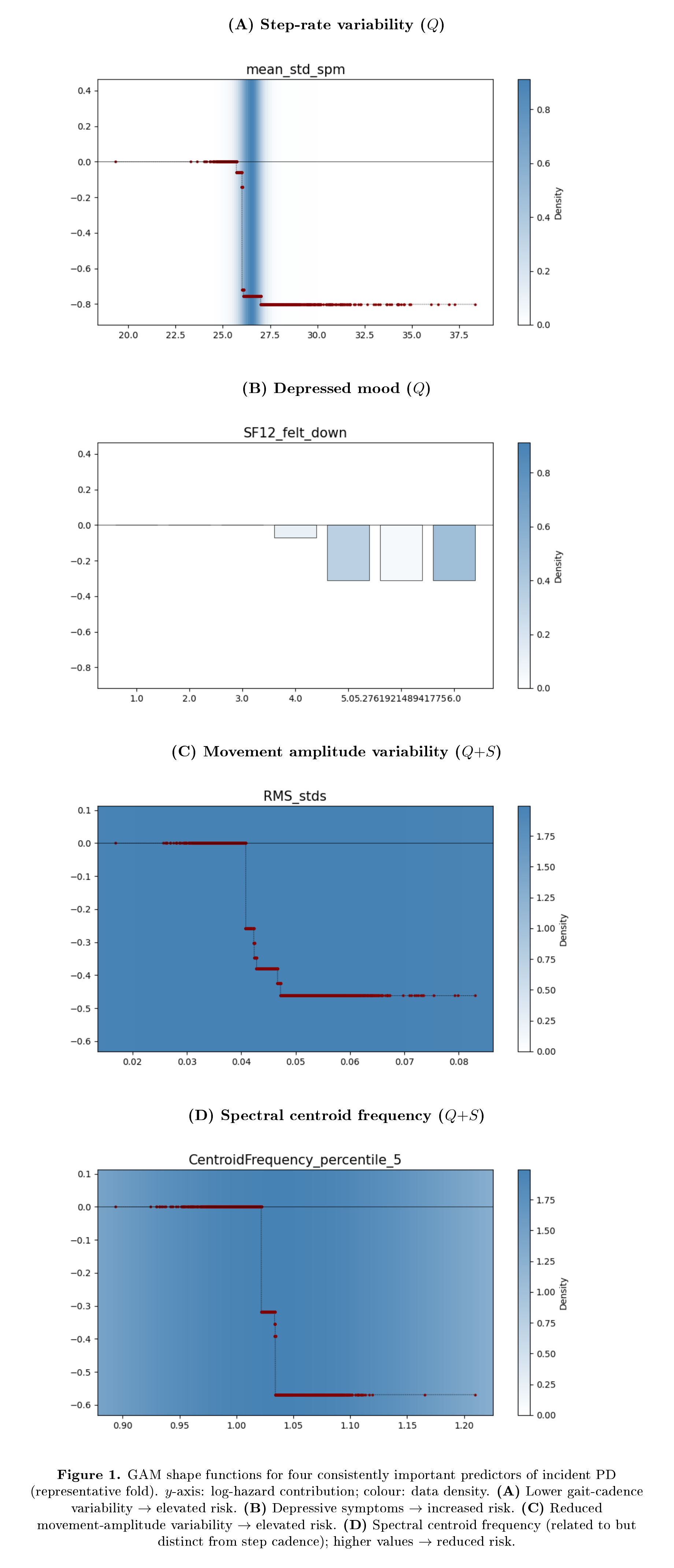
GAM functions for 4 important predictors of PD
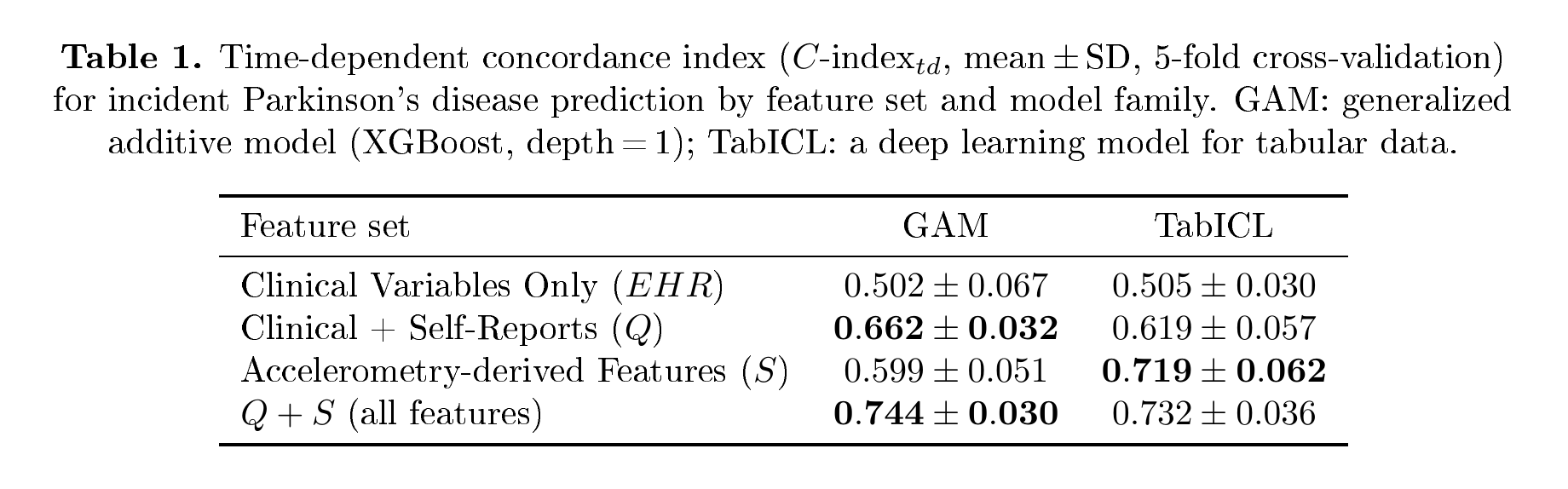
Time-dependent concordance index for PD prediction
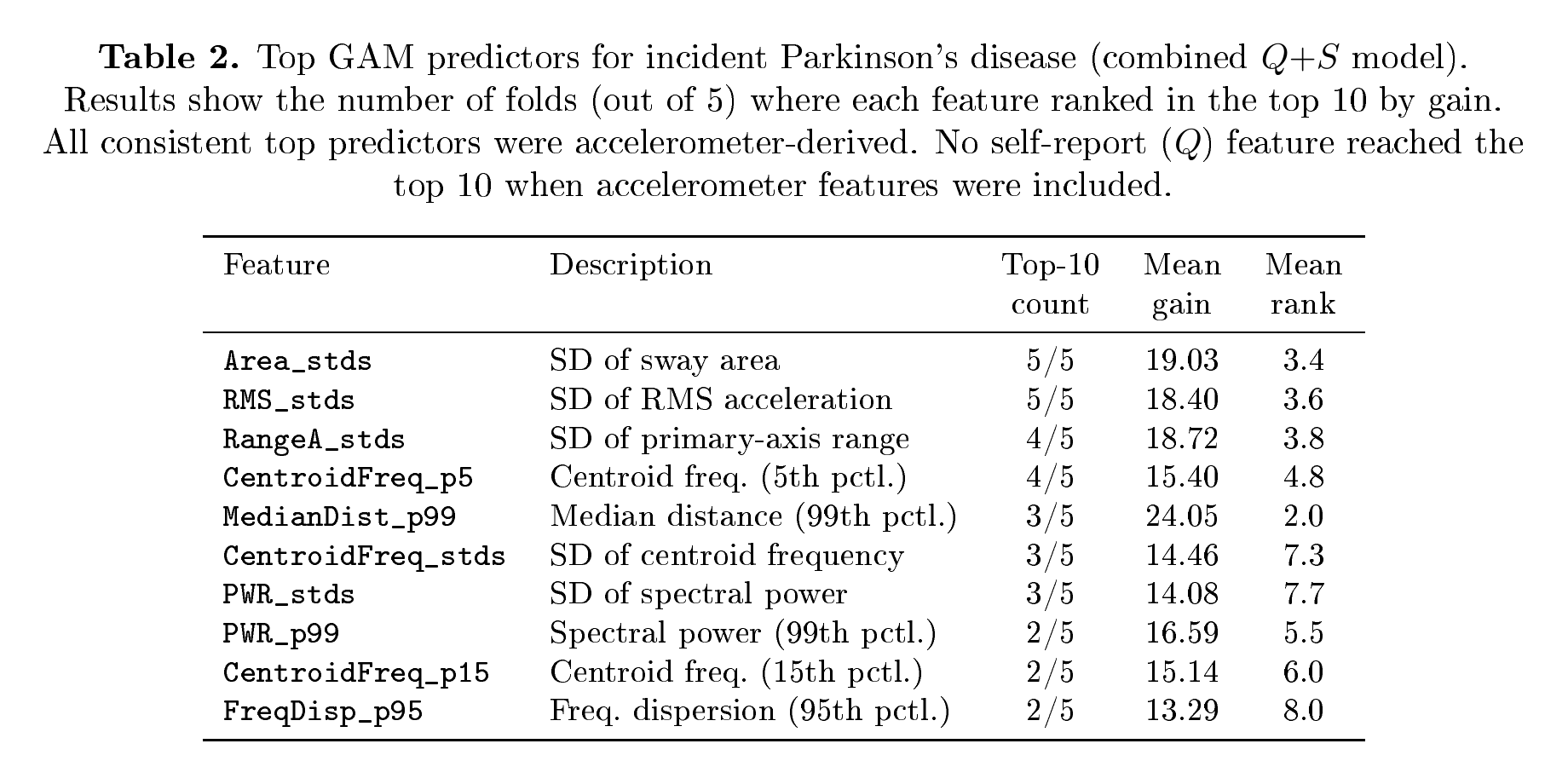
Top GAM predictors for incident PD (Q+S model)
References: Jingang Qu, David Holzmüller, Gaël Varoquaux, and Marine Le Morvan. Tabicl: A tabular foundation model for in-context learning on large data. arXiv preprint arXiv:2502.05564, 2025.
To cite this abstract in AMA style:
Y. Udi, P. Wayne, IM. Lee, P. Rist, A. Salomon, E. Gazit, J. Hausdorff, R. Gilad-Bachrach. Real-World Mobility Measures Reveal Early Indicators of Parkinson’s Disease Risk in Older Women [abstract]. Mov Disord. 2026; 41 (suppl 1). https://www.mdsabstracts.org/abstract/real-world-mobility-measures-reveal-early-indicators-of-parkinsons-disease-risk-in-older-women/. Accessed October 1, 2026.« Back to 2026 International Congress
MDS Abstracts - https://www.mdsabstracts.org/abstract/real-world-mobility-measures-reveal-early-indicators-of-parkinsons-disease-risk-in-older-women/