
Category: Parkinson’s Disease: Clinical Trials
Objective: Gait disorder is a hallmark of Parkinson’s disease (PD), with mounting evidence linking gait to cognitive function in PD patients and eye movements serving as a validated cognitive biomarker. However, no studies have concurrently explored the associations of gait disorder, eye movements and cognitive function in PD, and this study investigates their correlations by analyzing gait spatiotemporal parameters in PD patients.
Background: PD features typical early gait impairments tied to disease status, which aid diagnosis and staging with machine learning. Cognitive impairment is common in PD, and gait disorders are closely linked to cognitive deficits and frontal lobe activity. Ocular movement metrics are potential cognitive biomarkers for PD and correlate with gait disorders, yet their interconnections with cognitive function remain unclear. This study uses an AI approach to capture gait and ocular movement parameters, combining them with patients’ MoCA scores to explore the relationships among the three.
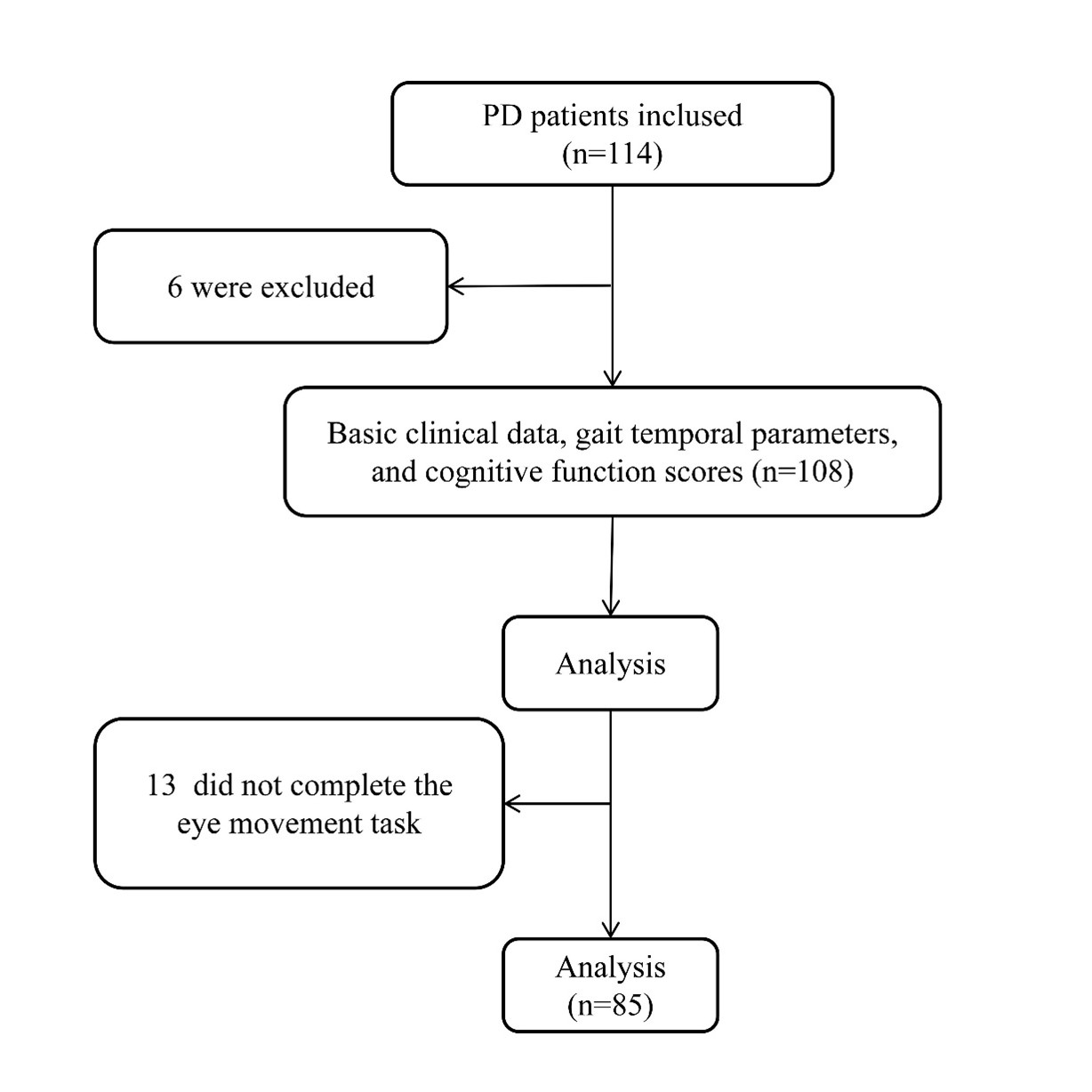
Method: 108 PD patients were enrolled, with their motor and non-motor symptoms assessed via scales; all completed objective gait analysis, AI-captured eye movement tasks, the TUG test and MoCA. Correlation analyses of gait spatiotemporal parameters with clinical data, eye movement metrics and MoCA scores were conducted, along with a mediation effect model of eye movement and gait parameters with MoCA as the mediator.
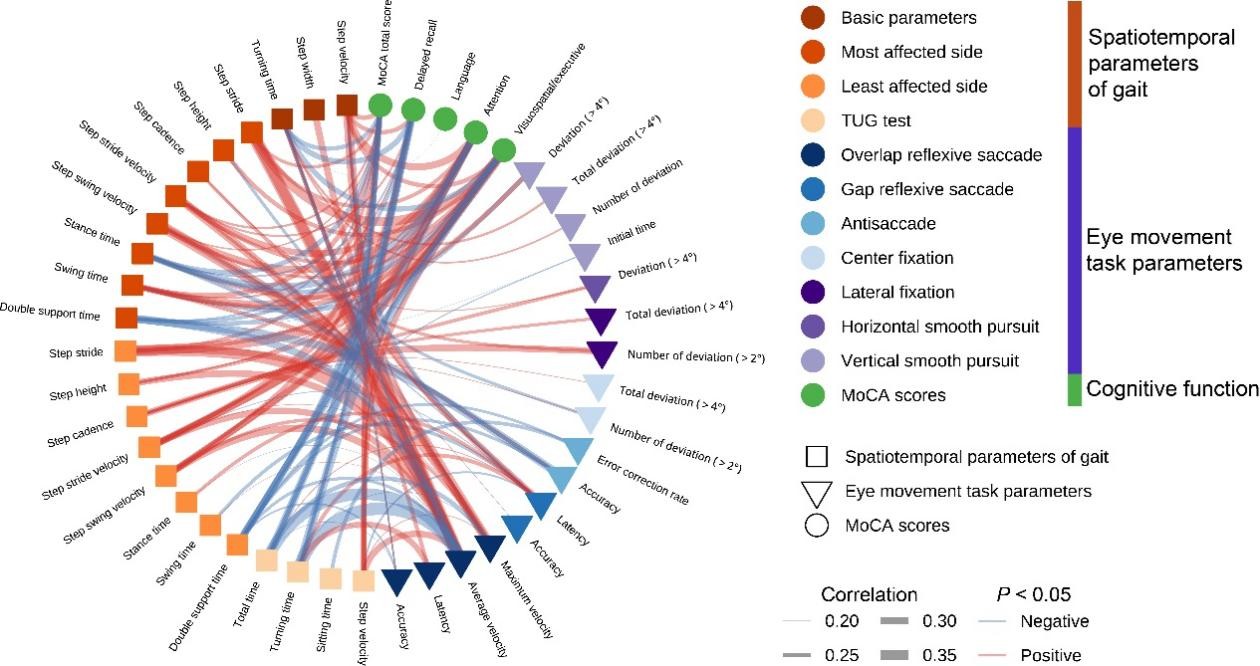
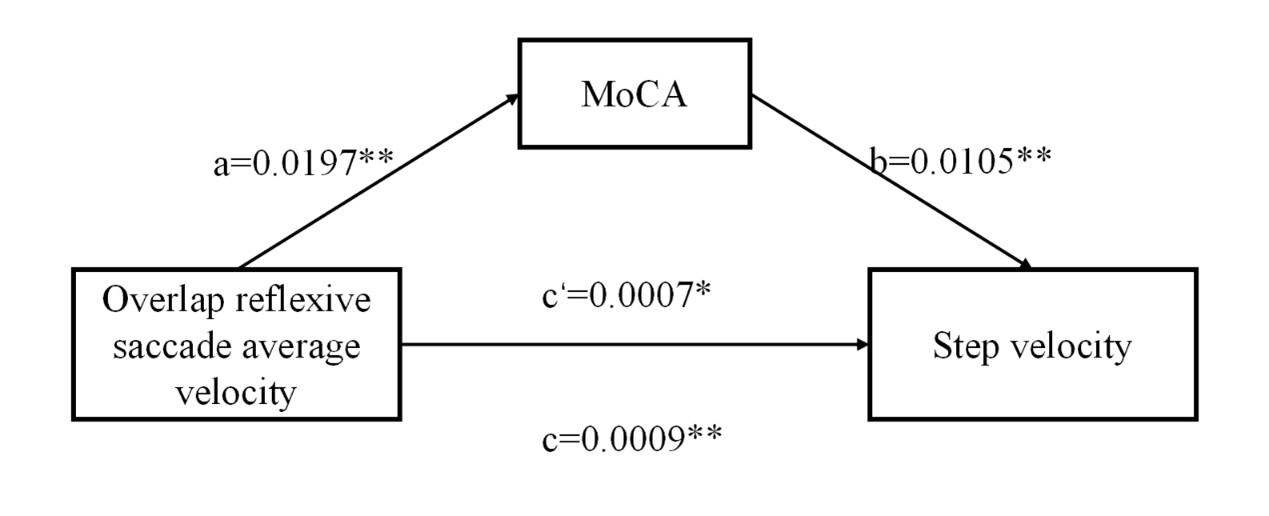
Results: PD gait performance was negatively correlated with age, disease severity, levodopa equivalent dose, and multiple clinical scores, but positively associated with education, eye movement performance, and MoCA scores.Multiple linear regression showed that mean speed of overlap reflexive saccade independently predicted step velocity (β=0.201, P=0.04), while better visuospatial–executive function was associated with shorter TUG turn time (β=−0.258, P=0.049).MoCA partially mediated the relationship between eye movements and gait difficulty, with 77.78% direct and 22.22% indirect effects.
Conclusion: Eye movements, cognitive function and gait performance were positively correlated in PD patients. Cognitive function plays a partial mediating effect between eye movements and gait disorder in PD patients, which provides new evidence and ideas for exploring the pathological mechanisms and targeted treatment strategies of gait disorder in PD.
1
2
3
To cite this abstract in AMA style:
J. Cheng, JZ. Hu, XY. Cheng, CJ. Mao. Relationship between automatic analysis of gait disorder and eye movement capture by AI and cognitive function in Parkinson’s disease [abstract]. Mov Disord. 2026; 41 (suppl 1). https://www.mdsabstracts.org/abstract/relationship-between-automatic-analysis-of-gait-disorder-and-eye-movement-capture-by-ai-and-cognitive-function-in-parkinsons-disease/. Accessed October 1, 2026.« Back to 2026 International Congress
MDS Abstracts - https://www.mdsabstracts.org/abstract/relationship-between-automatic-analysis-of-gait-disorder-and-eye-movement-capture-by-ai-and-cognitive-function-in-parkinsons-disease/