
Category: Parkinson’s Disease: Clinical Trials
Objective: This study aimed to evaluate the 12-month safety and preliminary efficacy of NCR201 transplantation in idiopathic PD patients, providing a proof-of-concept for universal cell therapy under a minimized immunosuppressive regimen.
Background: Cell replacement therapy offers hope of a long-term, disease-modifying treatment for Parkinson’s disease (PD). However, optimizing the yield of midbrain dopaminergic neurons and minimizing immunogenicity remain critical challenges. We developed clinical-grade hypoimmune iPSC-derived dopaminergic progenitor cells (iDAPs) and initiated a clinical trial (NCT06583291) to address these barriers in idiopathic PD (Figure1).
Method: The clinical-grade hypoimmune iDAPs (Product ID: NCR201) were manufactured under GMP conditions using standardized iPSC banks. Comprehensive assays were performed to ensure cell identity, purity, and safety.
7 eligible patients underwent robot-assisted bilateral putaminal transplantation of 4 million NCR201 cells. A minimized immunosuppressive regimen was maintained for 6–12 months postoperatively. Clinical and safety evaluations were performed at baseline and predefined follow-up intervals.
Results: NCR201 consists of high purity >90% iDAPs (FOXA2+), and achieved high yield >80% of mDA (TH+) after transplantation. Preclinical GLP studies confirmed safety and low immunogenicity.
In the clinical study, all 7 patients completed the 12-month follow-up. The surgical procedure and immunosuppressive regimen were well tolerated. No NCR201-related AEs were observed. At 12 months, the mean MDS-UPDRS III score decreased from 55.3 to 31.6 in OFF state and from 37.3 to 28.3 in ON state. The mean daily OFF time was reduced by 6.12 hours, while Good ON time increased by 4.8 hours (Figure2). Improvements in non-motor symptoms were noted as early as Day 28 (Figure3). [18F]-FP-CIT PET imaging showed a significant increase in striatal signal intensity providing objective evidence of successful graft engraftment and functional dopaminergic maturation (Figure4).
Conclusion: This clinical result demonstrated that the NCR201 cell replacement therapy achieved functional engraftment in 7 idiopathic PD patients, leading to rapid, substantial, and sustained improvements in both motor and non-motor symptoms. As the first hypoimmune iDAPs product entering clinical trial, these findings showed early promise of NCR201 as a transformative treatment for PD.

The manufacturing of NCR201 products.
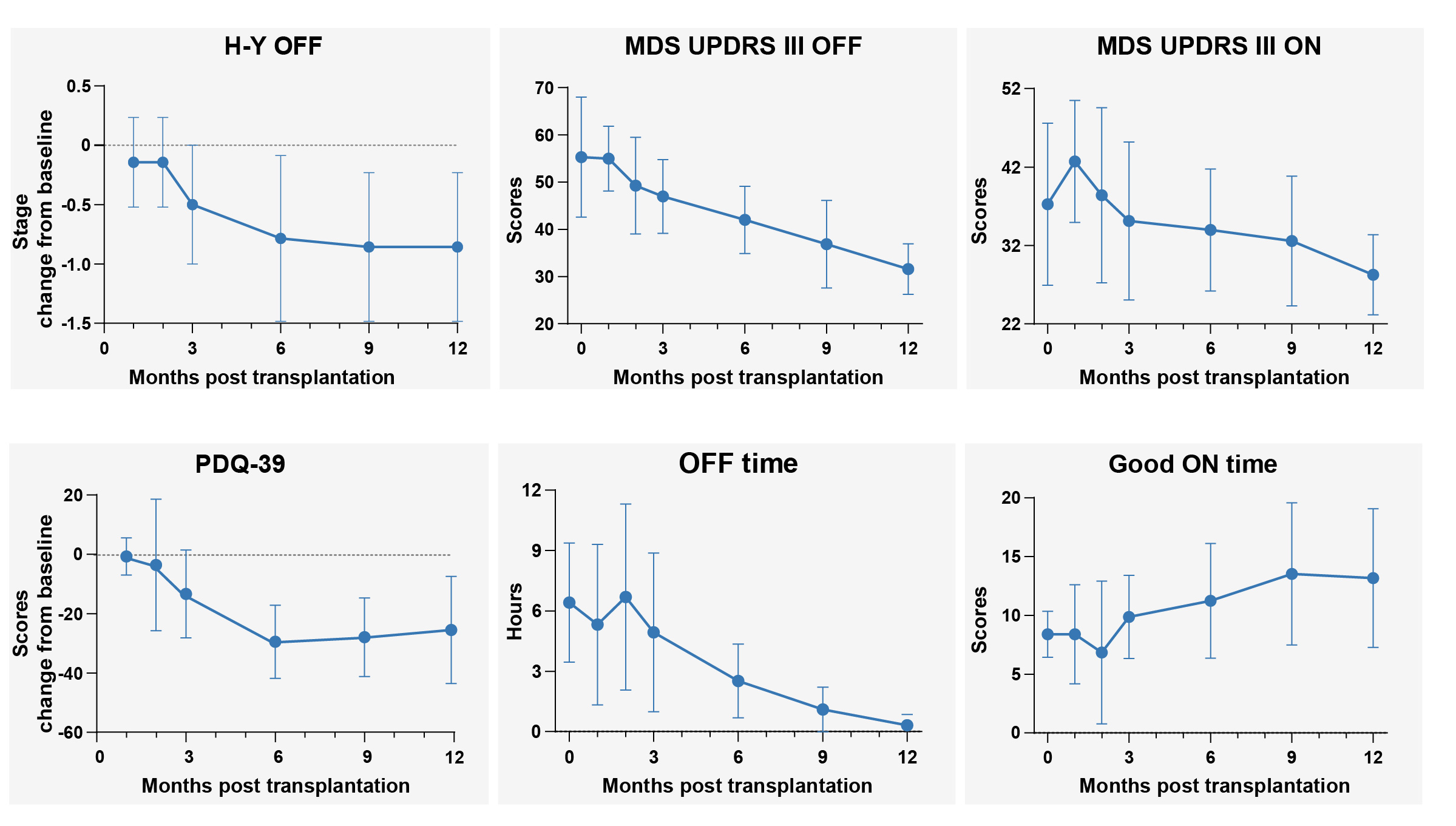
Clinical motor and life quality assessment.
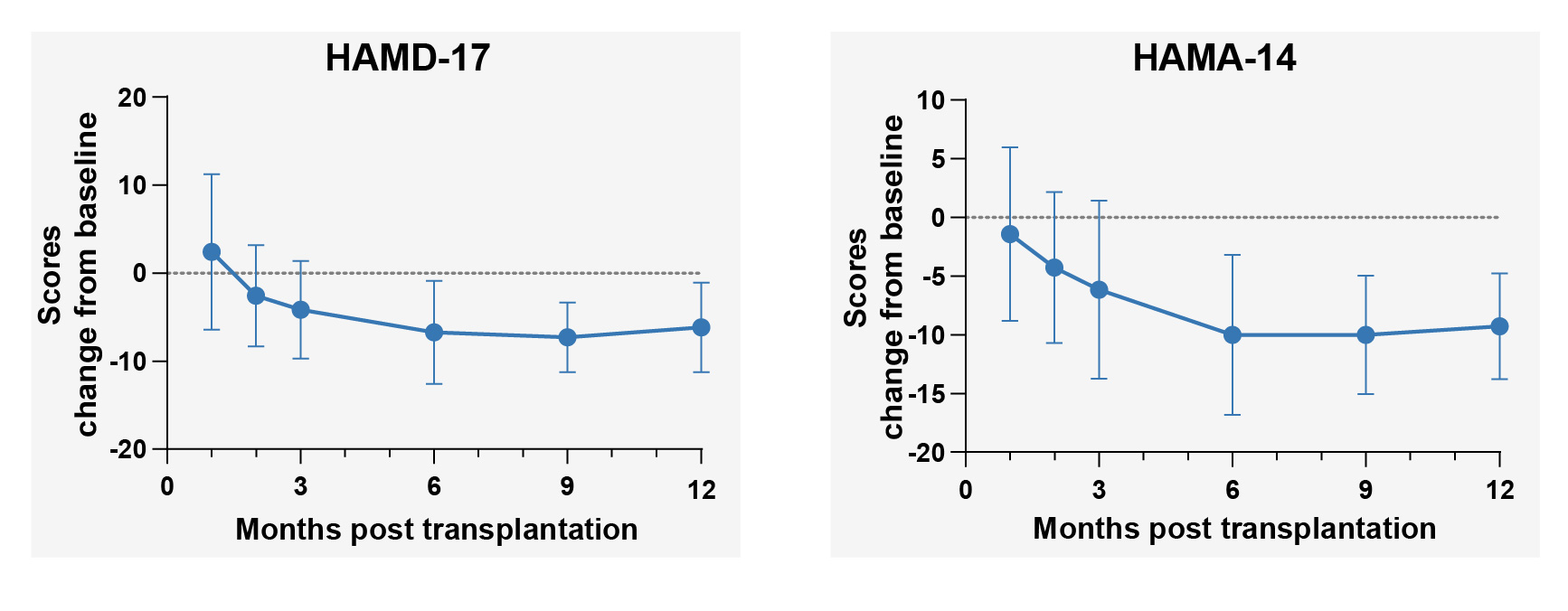
Clinical non-motor assessment.
![[18F]-FP-CIT PET uptake signal in the striatum.](https://www.mdsabstracts.org/wp-content/uploads/2026/09/0988_1474_000418_4.jpg)
[18F]-FP-CIT PET uptake signal in the striatum.
To cite this abstract in AMA style:
J. Shi, J. Yu, C. Han, A. Chen, L. Jiao, R. Qian. Robot-Assisted Transplantation of Hypoimmune iPSC Derived Dopaminergic Progenitor Cells for Idiopathic Parkinson’s Disease [abstract]. Mov Disord. 2026; 41 (suppl 1). https://www.mdsabstracts.org/abstract/robot-assisted-transplantation-of-hypoimmune-ipsc-derived-dopaminergic-progenitor-cells-for-idiopathic-parkinsons-disease/. Accessed October 1, 2026.« Back to 2026 International Congress
MDS Abstracts - https://www.mdsabstracts.org/abstract/robot-assisted-transplantation-of-hypoimmune-ipsc-derived-dopaminergic-progenitor-cells-for-idiopathic-parkinsons-disease/