
Objective: To review the safety data of opicapone (OPC) after 10 years of worldwide marketing experience.
Background: OPC, a third-generation COMT inhibitor, is approved as adjunctive therapy to preparations of levodopa/DDCI in adult patients with Parkinson’s disease (PD) and end-of-dose motor fluctuations who cannot be stabilized on those combinations. OPC marketing authorization was first granted in the European Union on 24 June 2016 and launched in October 2016. It is currently marketed in more than 20 countries worldwide.
Method: Data on OPC was collected until 15 January 2026. Patient exposure was estimated based on worldwide ex-factory sales cumulatively and it was assumed that all amounts delivered were entirely dispensed, administered and were used at 1 dosage pill per day, accordingly to indication. Therapy exposure by country was then calculated based on patient-months (units divided by 30 days), rather than in number of treated patients. Safety data was retrieved from products’ global safety database including spontaneous, literature reports, health authorities and non-interventional studies.
Results: Over the 10-year period, estimated exposure was 6.030.119 patient-month, corresponding to 502.509 patient-year. Highest exposure in patient months occurred in Germany (1,9M), Japan (1,17M) and Spain (0,89M). A total of 10.603 adverse events (AEs) were reported. Of these, 8.823 (83%) were non-serious and 1.780 (17%) serious. The most frequently reported System Organ Class (SOC) were “Nervous system disorders”, “Psychiatric disorders” and “General disorders and administration site conditions”. The 10 most reported AEs were “Dyskinesia”, “Hallucination”, “Nausea”, “Dizziness”, “Hallucination, visual”, “Constipation”, “Tremor” “Somnolence”, “Dysphagia”, and “Muscle rigidity”.
Conclusion: During the 10 years of marketing utilization, OPC use showed a wide global distribution with a substantial cumulative exposure exceeding 500,000 patient-year. Most events were non-serious and consistent with the established safety profile and known complications of PD or dopaminergic therapy. These findings support the sustained favorable benefit–risk profile of opicapone in routine clinical practice worldwide.
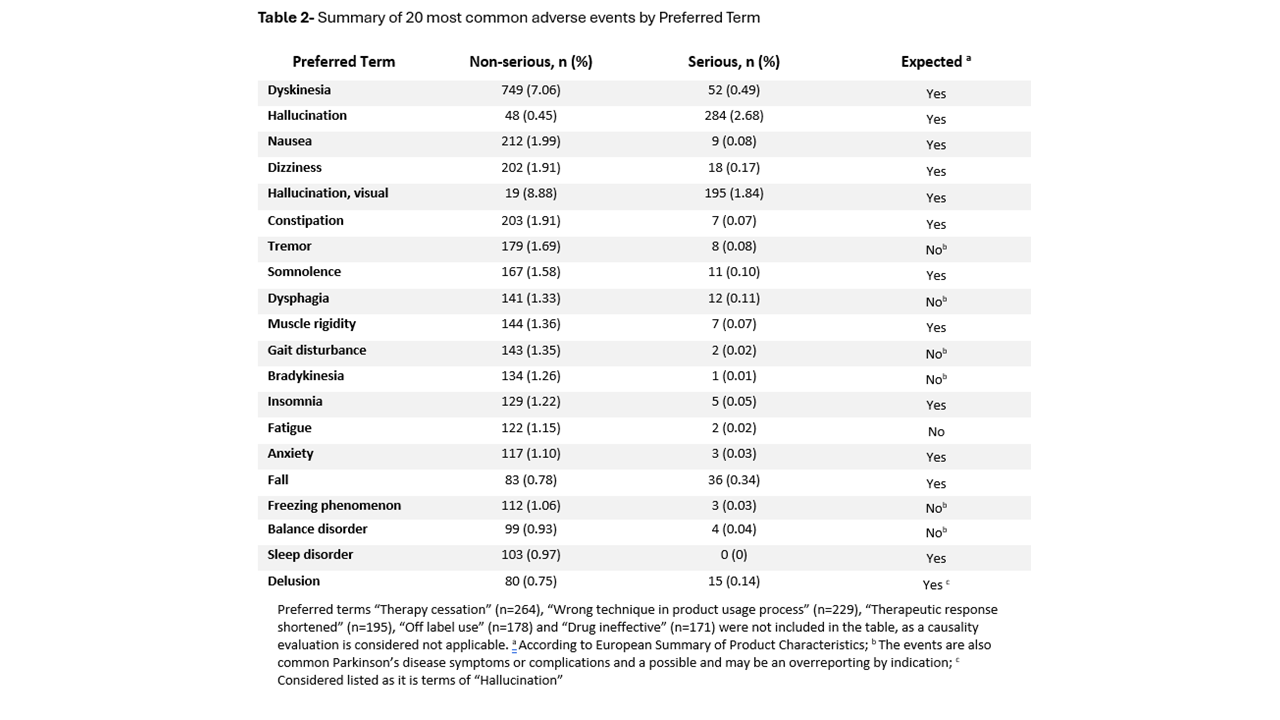
Table 2
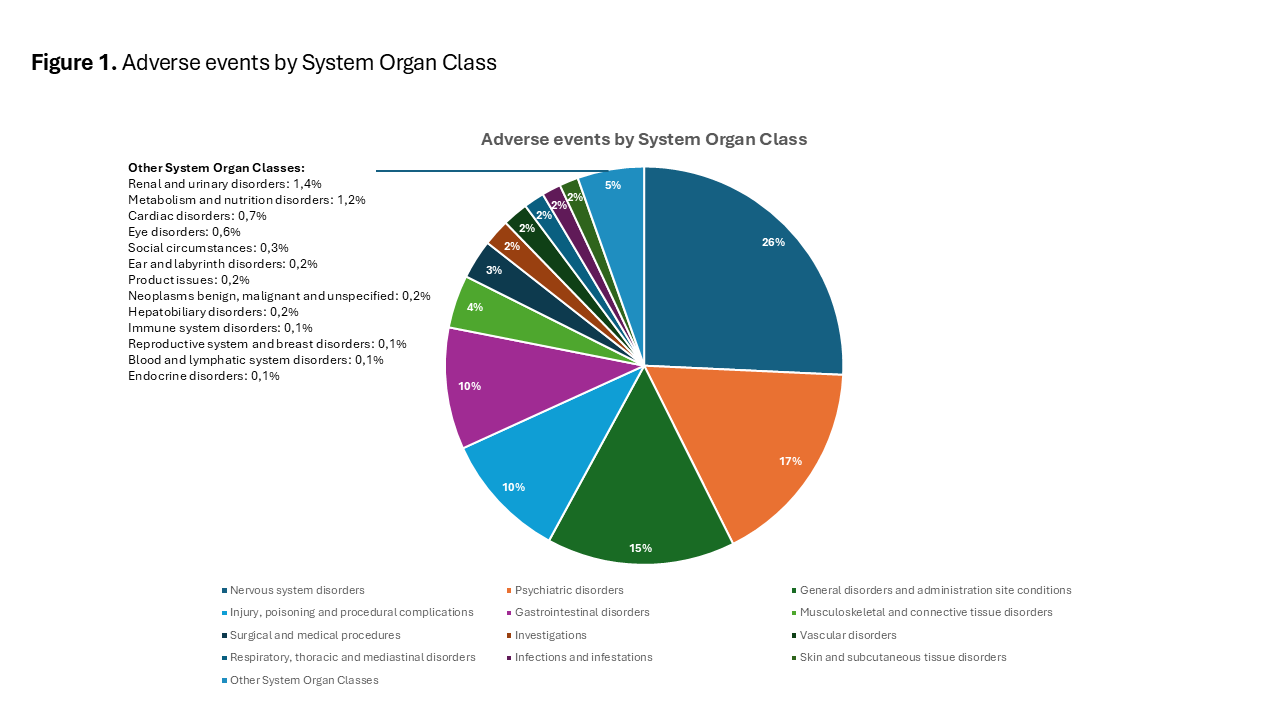
Figure 1
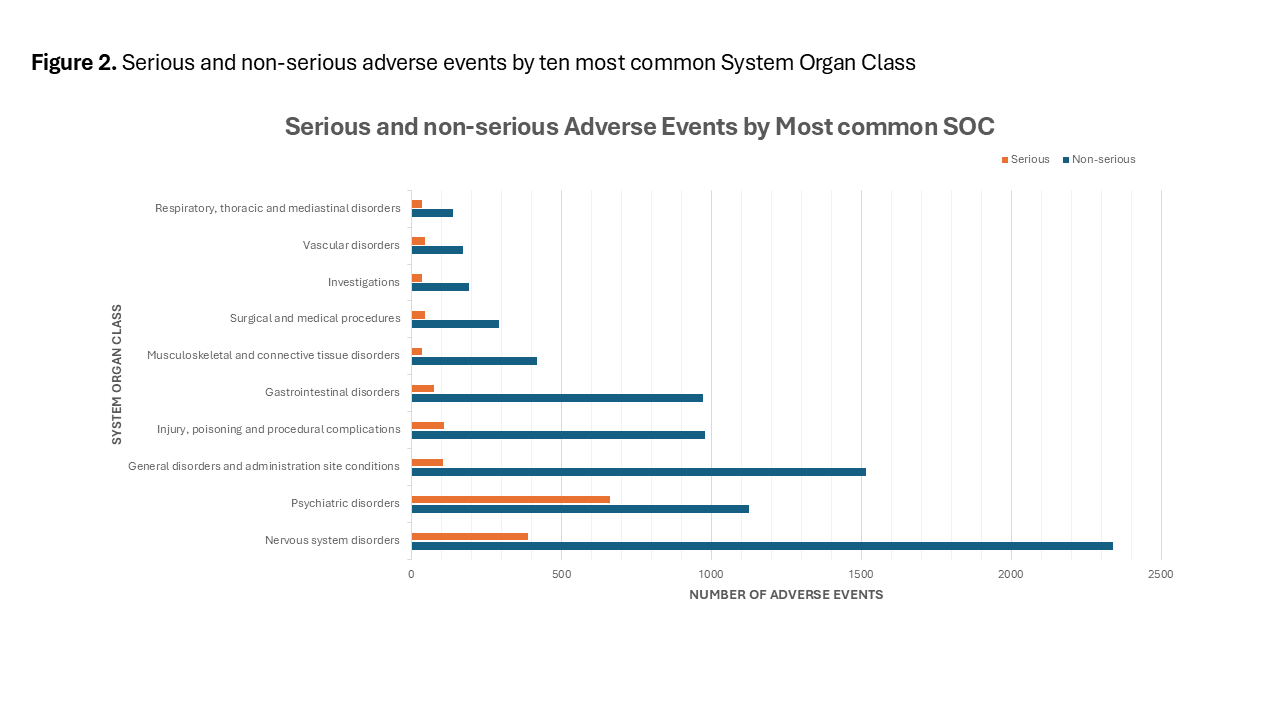
Figure 2
To cite this abstract in AMA style:
M. Vale, D. Lopes, H. Brigas, J. Holenz. Safety of Opicapone After 10 Years of Post-Marketing experience Worldwide [abstract]. Mov Disord. 2026; 41 (suppl 1). https://www.mdsabstracts.org/abstract/safety-of-opicapone-after-10-years-of-post-marketing-experience-worldwide/. Accessed October 1, 2026.« Back to 2026 International Congress
MDS Abstracts - https://www.mdsabstracts.org/abstract/safety-of-opicapone-after-10-years-of-post-marketing-experience-worldwide/