
Objective: To determine whether video-based digital biomarkers derived from standardized motor tasks are sensitive to longitudinal progression in Parkinson’s disease (PD).
Background: Bradykinesia is a hallmark sign of PD, but monitoring its progression over time is challenging because clinical assessments are affected by inter- and intra-rater variability. Computer vision can extract objective and fine-grained motor features from video-recorded motor tasks, but their sensitivity to longitudinal progression remains largely unexplored.
Method: We analyzed 5,999 videos from 415 individuals with early-stage PD in the Personalized Parkinson Project (mean disease duration: 31.11 ± 17.24 months). Videos were recorded during MDS-UPDRS part 3 finger-tapping and leg-agility tasks at baseline, 1-year, and 2-year follow-up, in both the OFF and ON states. Using a previously validated pipeline [1], Interpretable video-based features were extracted across four domains: hypokinesia (movement amplitude), bradykinesia (tapping cycle duration), sequence effect (across-task decrement), and hesitation-halts (interruptions and variability) [2]. Linear mixed-effects models were used to quantify sensitivity to disease progression and dopaminergic medication effects, and to compare digital biomarkers with corresponding clinical ratings.
Results: Across both the finger-tapping and leg-agility tasks, hesitation–halt measures demonstrated significant longitudinal worsening over two years in both the ON and OFF states, with larger sensitivity compared to clinical ratings [Figure 1]. Most sequence-effect measures remained stable. Hypokinesia measures significantly worsened for the leg-agility task, but not for finger-tapping. Unexpectedly, the bradykinesia measure improved over time in both tasks. This improvement was associated with worsening in hypokinesia, suggesting a shift toward faster but smaller movements longitudinally. Hesitation–halt features were less sensitive to this timing–amplitude trade-off, suggesting their potential robustness as progression markers.
Conclusion: Interpretable computer vision-derived measures, particularly those capturing hesitation-halts, provide sensitive measures of longitudinal motor progression in early-stage PD and outperform current clinical ratings. These findings support their potential as objective outcome measures for longitudinal disease monitoring in clinical trials and care.
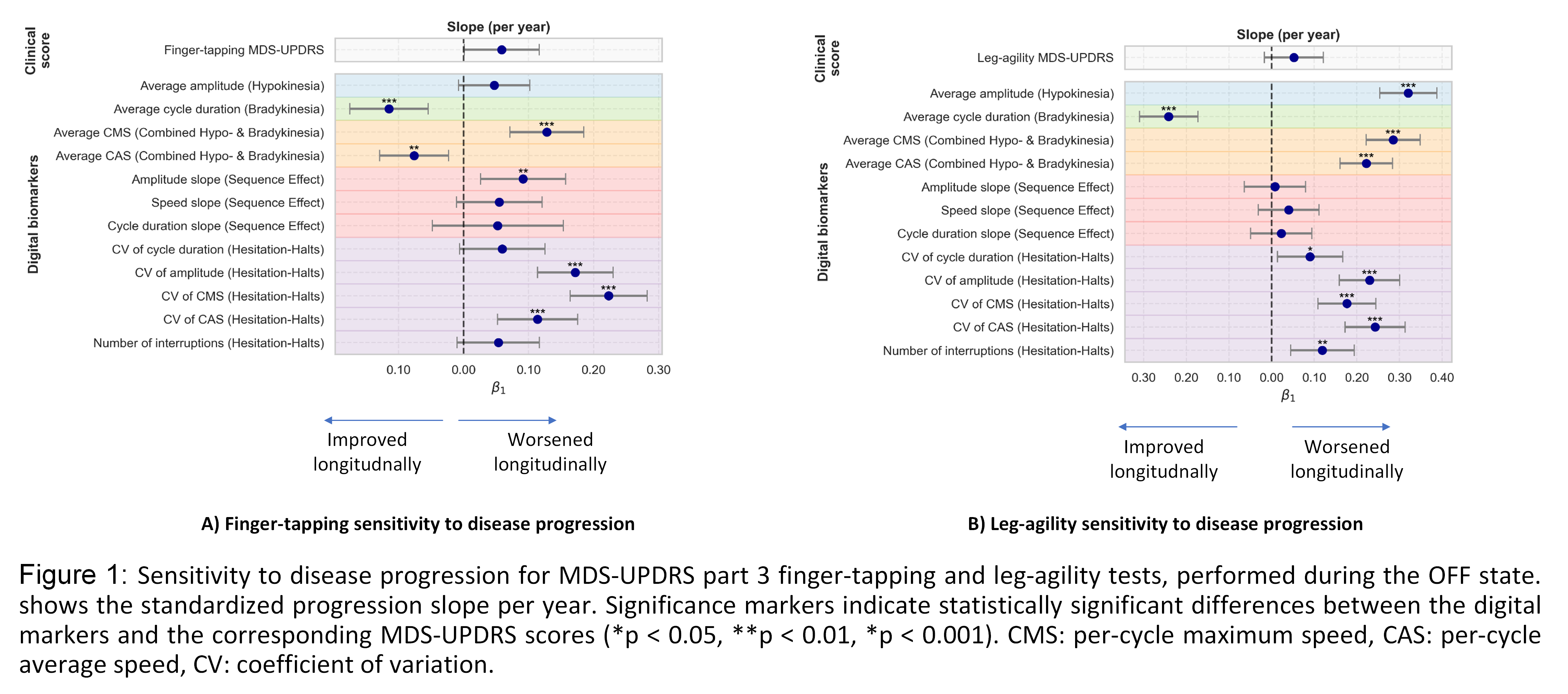
Figure 1
References: 1. Zarrat Ehsan, T., Tangermann, M., Güçlütürk, Y. et al. Interpretable and granular video-based quantification of motor characteristics from the finger-tapping test in Parkinson’s disease. npj Parkinsons Dis. (2026). https://doi.org/10.1038/s41531-026-01307-w
2. Bologna, M., Espay, A.J., Fasano, A., Paparella, G., Hallett, M. and Berardelli, A. (2023), Redefining Bradykinesia. Mov Disord, 38: 551-557. https://doi.org/10.1002/mds.29362
To cite this abstract in AMA style:
T. Zarrat Ehsan, M. Tangermann, B. Bloem, L. Evers. Sensitivity of AI-Derived Video-Based Digital Biomarkers to Motor Progression in Parkinson’s Disease [abstract]. Mov Disord. 2026; 41 (suppl 1). https://www.mdsabstracts.org/abstract/sensitivity-of-ai-derived-video-based-digital-biomarkers-to-motor-progression-in-parkinsons-disease/. Accessed October 1, 2026.« Back to 2026 International Congress
MDS Abstracts - https://www.mdsabstracts.org/abstract/sensitivity-of-ai-derived-video-based-digital-biomarkers-to-motor-progression-in-parkinsons-disease/