
Objective: To determine whether baseline sensor-derived gait pattern scores provide superior prognostic value compared with baseline dopamine transporter (DAT) imaging for predicting longitudinal gait deterioration and rapid motor progression in Parkinson’s disease (PD).
Background: PD exhibits substantial heterogeneity in motor progression, making early prognostic stratification clinically challenging [1]. DAT imaging reflects nigrostriatal dopaminergic loss but primarily serves as a static marker and may not adequately capture future functional decline. In contrast, dynamic gait performance reflects the integrated function of distributed motor networks and may provide prognostic information beyond dopaminergic imaging [2].
Method: Twenty-three people with PD underwent baseline 18F-FP-CIT positron emission tomography (PET) imaging and repeated wearable sensor–based gait assessments at baseline and follow-up. High-dimensional gait features across multiple tasks and body segments were reduced using principal component analysis (PCA), generating domain-level gait pattern scores dominated by jerk (PC1) and variability (PC2). Gait progression was quantified as changes in gait scores (Δgait) between baseline and follow-up. Rapid motor progression was defined using an anchor-based approach combining an increase in Hoehn and Yahr stage and ΔUPDRS-III ≥ 1.5. Linear regression, logistic regression (LR), and random forest (RF) models were used to compare the prognostic value of baseline DAT measures and gait pattern scores.
Results: Baseline DAT uptake showed limited explanatory power for longitudinal gait changes and did not reliably predict rapid motor progression in the result of linear regression. In contrast, baseline gait pattern scores demonstrated good predictive performance (Area under the curve, AUC 0.80–0.88) for rapid progression in the results of LR and RF models [Table 1]. Variability- and jerk-dominant gait components, particularly during turning and fast walking, were strongly associated with worsening motor severity, disease stage progression, and fall-related outcomes [Figure 1].
Conclusion: These findings may support gait-based digital biomarkers as sensitive, functionally meaningful tools for prognostic assessment beyond static dopaminergic imaging [1, 3].
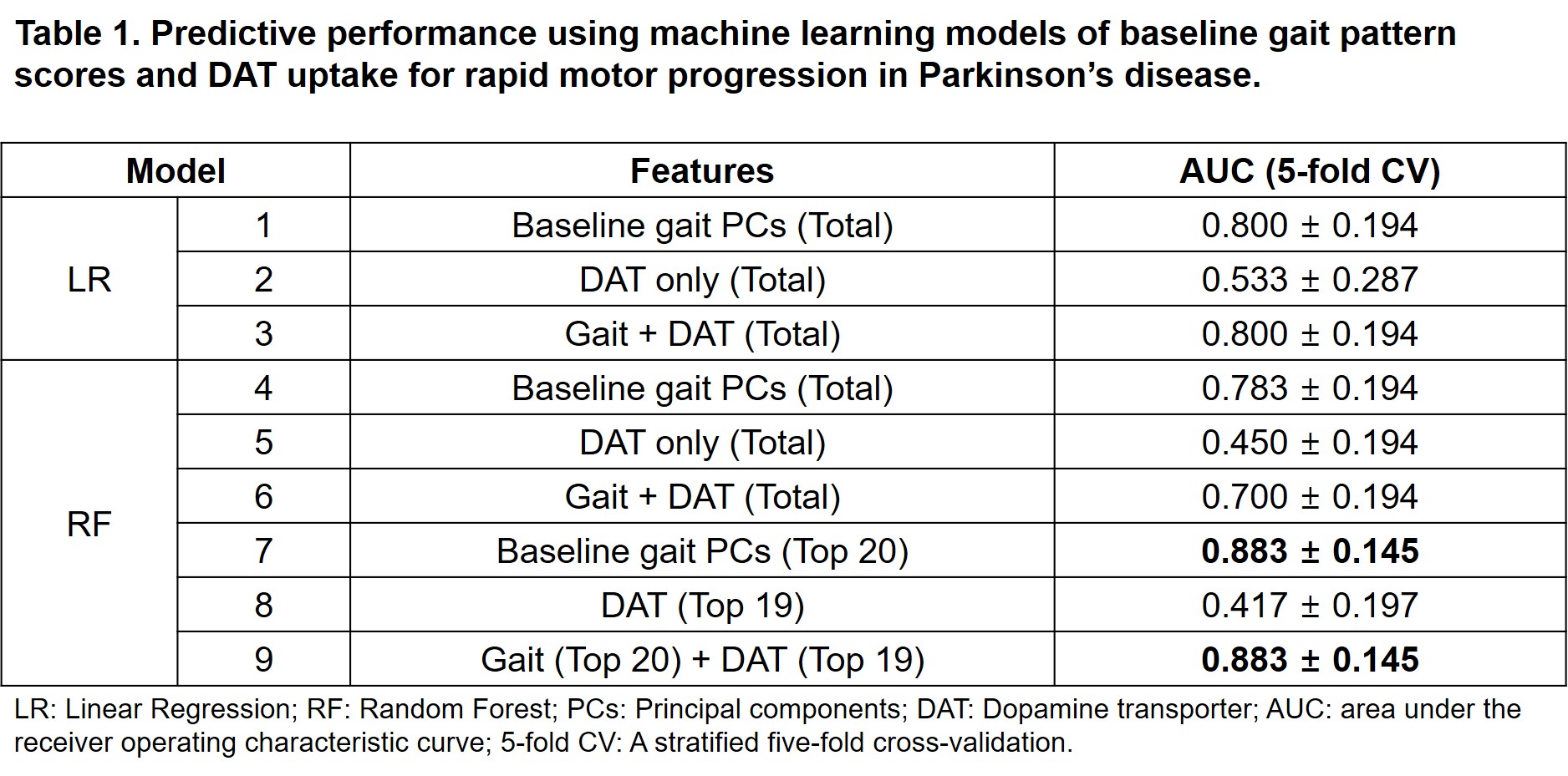
Table 1
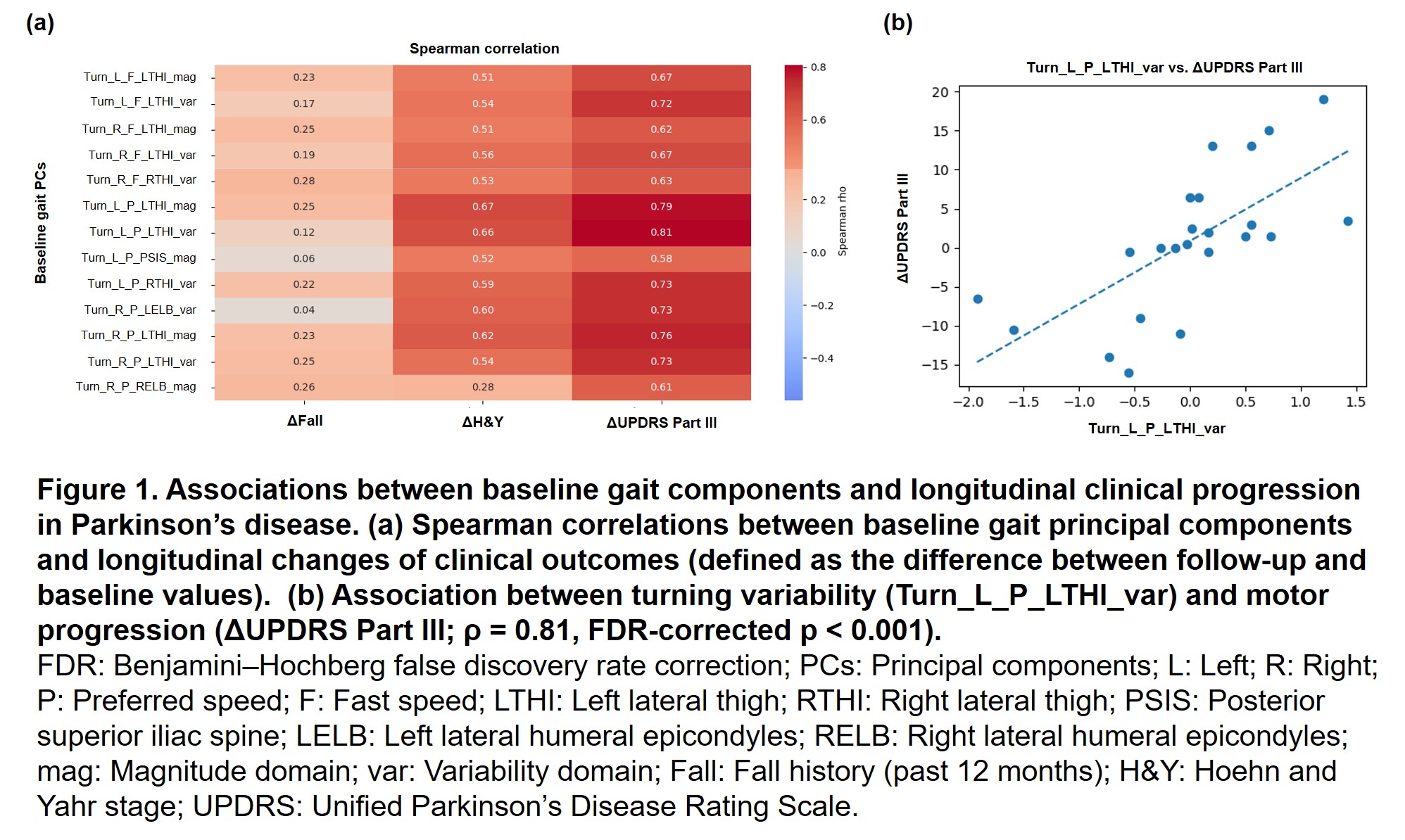
Figure 1
References: [1] Yoo, H. S., Kim, H. K., Lee, H. S., Yoon, S. H., Na, H. K., & Kang, S. W. et al. (2024). Predictors associated with the rate of progression of nigrostriatal degeneration in Parkinson’s disease. Journal of Neurology, 271(8), 5213-5222.
[2] Hanff, A. M., McCrum, C., Rauschenberger, A., Aguayo, G. A., Pauly, C., & Jónsdóttir, S. R. et al. (2025). Sex-specific progression of Parkinson’s disease: A longitudinal mixed-models analysis. Journal of Parkinson’s Disease, 15(4), 805-818.
[3] Raschka, T., To, J., Hähnel, T., Sapienza, S., Ibrahim, A., & Glaab, E. et al. (2025). Objective monitoring of motor symptom severity and their progression in Parkinson’s disease using a digital gait device. Scientific Reports, 15(1), 25541.
To cite this abstract in AMA style:
H. Park, C. Youm, B. Kim, J. Hwang, M. Kim, S. Cheon, Y. Jeong, B. Jin. Sensor-Derived Gait Patterns Predict Motor Progression in Parkinson’s Disease Beyond Baseline Dopamine Transporter Imaging [abstract]. Mov Disord. 2026; 41 (suppl 1). https://www.mdsabstracts.org/abstract/sensor-derived-gait-patterns-predict-motor-progression-in-parkinsons-disease-beyond-baseline-dopamine-transporter-imaging/. Accessed October 1, 2026.« Back to 2026 International Congress
MDS Abstracts - https://www.mdsabstracts.org/abstract/sensor-derived-gait-patterns-predict-motor-progression-in-parkinsons-disease-beyond-baseline-dopamine-transporter-imaging/