
Category: Parkinson’s Disease: Clinical Trials
Objective: To evaluate the feasibility, adherence, acceptability, and safety of a long-term, fully remote, gamified physical activity intervention in adults with objectively confirmed hyposmia, and to explore effects on digital, clinical, and biological measures.
Background: Hyposmia, defined as impaired odour identification on standardised testing, is common in mid- and later life and may result from ageing, post-infectious change, chronic sinonasal disease, or neurological conditions such as Parkinson’s disease (PD). Reduced olfaction may affect appetite, motivation, and physical activity. Regular exercise benefits vascular, metabolic, sleep, mood, and cognitive health, but it is unclear if adults with objectively confirmed hyposmia can initiate and sustain long-term unsupervised exercise.
Method: Slow-SPEED UK is an 18-month, double-blind, randomised feasibility trial. Adults ≥40 years with hyposmia (≤15th percentile, age- and sex-adjusted 40-item University of Pennsylvania Smell Identification Test) and ≤7,000 mean daily steps during a 4-week run-in are randomised 1:1 to a higher-dose intervention (100% step increase) or active control (10% increase). Participants use the Slow-SPEED app integrated with wrist-worn accelerometry and heart-rate monitoring, delivering masked, progressively titrated weekly step targets with behavioural prompts and gamified feedback (FIG 1). The primary endpoint is change in mean daily step count over an 18-month period. Feasibility outcomes include recruitment, retention, adherence, data completeness, engagement, and adverse events. Secondary measures include activity intensity, gait, balance, motor and non-motor metrics, mood, sleep, quality of life. Participants are invited for optional blood and skin biosampling to enable exploratory profiling of biological markers potentially relevant to physical activity response and PD risk.
Results: In 110 participants, between-group differences in longitudinal step-count trajectories will be estimated alongside exploratory changes in behavioural, digital, clinical, and biomarker measures.
Conclusion: Slow-SPEED UK aims to establish the practical and methodological foundations for scalable, long-term remote physical activity trials. As part of the wider Slow-SPEED International collaboration, it will contribute to a coordinated framework for prevention-focused brain health and PD research.
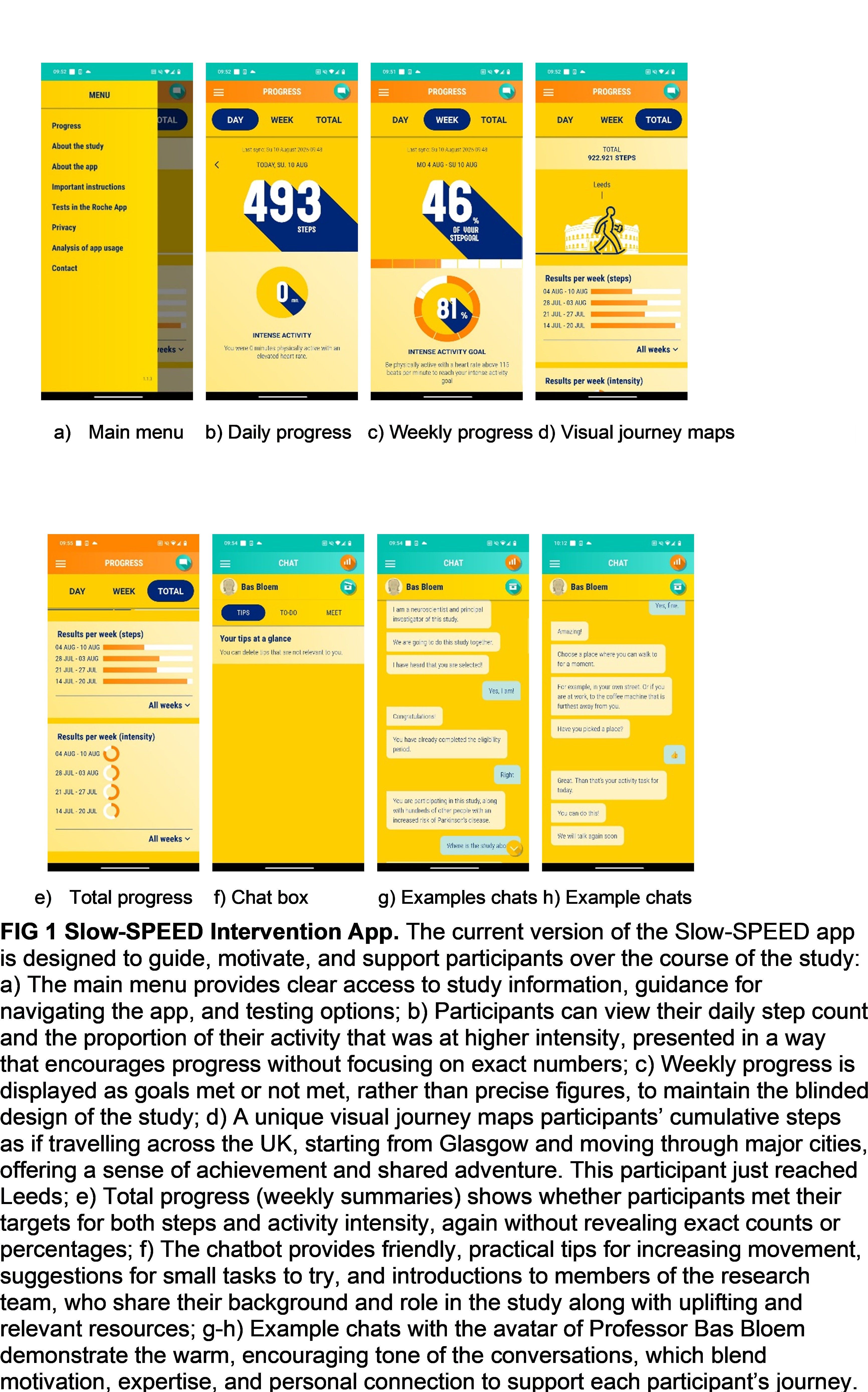
FIG 1 Slow-SPEED Intervention App
To cite this abstract in AMA style:
V. Azoidou, T. Oosterhof, E. Mitchell, B. Bloem, C. Philpott, S. Darweesh, A. Noyce. Slow-SPEED UK: A Double-Blind Randomised Feasibility Trial of a Remote Gamified Physical Activity Programme in Adults with Hyposmia [abstract]. Mov Disord. 2026; 41 (suppl 1). https://www.mdsabstracts.org/abstract/slow-speed-uk-a-double-blind-randomised-feasibility-trial-of-a-remote-gamified-physical-activity-programme-in-adults-with-hyposmia/. Accessed October 1, 2026.« Back to 2026 International Congress
MDS Abstracts - https://www.mdsabstracts.org/abstract/slow-speed-uk-a-double-blind-randomised-feasibility-trial-of-a-remote-gamified-physical-activity-programme-in-adults-with-hyposmia/