
Objective: To evaluate the diagnostic performance of the University of Pennsylvania Smell Identification Test (UPSIT) in differentiating Parkinson’s disease (PD) from essential tremor (ET) using published PubMed-indexed studies.
Background: Hyposmia is a common nonmotor feature of PD and is typically absent or mild in ET. Olfactory testing, particularly UPSIT, has emerged as an accessible, noninvasive adjunct to improve diagnostic accuracy, especially in early tremor‑predominant presentations where clinical overlap is frequent.
Method: A systematic review and meta-analysis was performed using PubMed‑indexed articles only. Inclusion criteria were: (1) studies employing UPSIT, (2) direct comparison between PD and ET, and (3) sufficient data to extract sensitivity and specificity. Studies assessing other parkinsonian syndromes were excluded. Diagnostic accuracy measures were extracted from eligible publications and aggregated from the data compiled. MetaDTA was utilized for data synthesis. HSROC curves were generated to summarize the sensitivity and specificity of each study.
Results: Seven studies met the inclusion criteria, comprising 454 PD patients and 239 ET patients [Figure 1]. Pooled analysis demonstrated a sensitivity of 78% (95% CI: 74–82%) [Figure 2] for detecting PD‑associated olfactory dysfunction and a specificity of 91% (95% CI: 86–94%) [Figure 3] for distinguishing PD from ET. Most studies reported specificity ≥90%, indicating the strong discriminatory value of UPSIT in the differential diagnosis of tremor. Variability in sensitivity was observed, likely reflecting disease stage and cutoff definition. Most studies showed a high risk of bias due to nonrandom patient selection and unblinded olfactory testing.
Conclusion: UPSIT demonstrates high specificity and moderate sensitivity for differentiating PD from ET, supporting its role as a practical adjunct in the diagnostic evaluation of tremor syndromes. Marked olfactory impairment strongly favors PD over ET, particularly when motor features are equivocal. UPSIT should be interpreted in conjunction with clinical assessment and alongside biomarkers rather than as a standalone diagnostic tool.
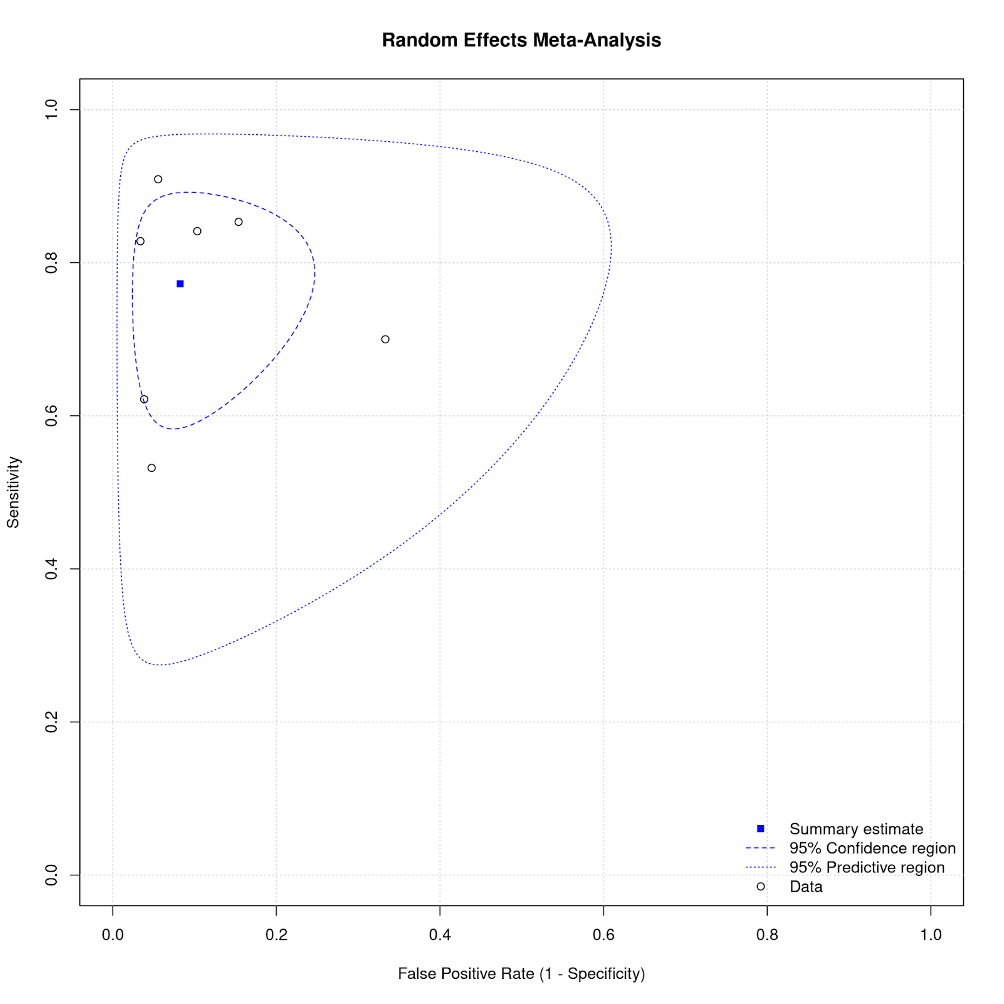
Figure 1.
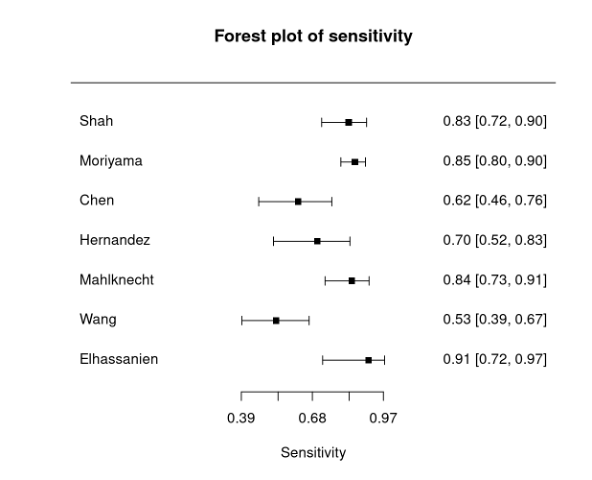
Figure 2.
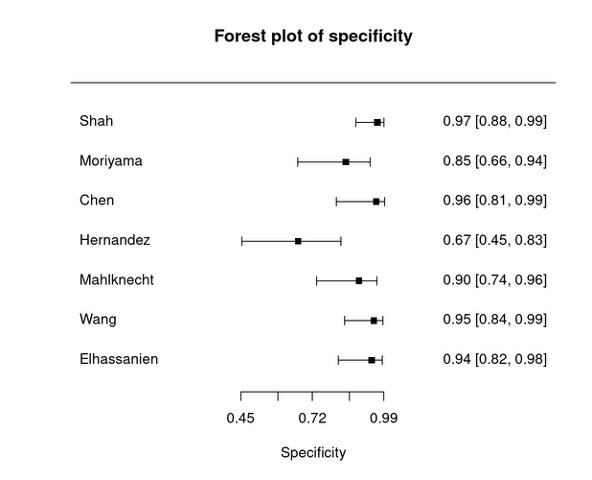
Figure 3.
To cite this abstract in AMA style:
M. Schiess, J. Martinez-Lemus, J. Rissardo, J. Patino, A. Caprara, A. Mcgarry, I. Walker. Smell as a Diagnostic Signature: Systematic Review and Meta-Analysis of UPSIT Accuracy in Distinguishing Parkinson’s Disease from Essential Tremor [abstract]. Mov Disord. 2026; 41 (suppl 1). https://www.mdsabstracts.org/abstract/smell-as-a-diagnostic-signature-systematic-review-and-meta-analysis-of-upsit-accuracy-in-distinguishing-parkinsons-disease-from-essential-tremor/. Accessed October 1, 2026.« Back to 2026 International Congress
MDS Abstracts - https://www.mdsabstracts.org/abstract/smell-as-a-diagnostic-signature-systematic-review-and-meta-analysis-of-upsit-accuracy-in-distinguishing-parkinsons-disease-from-essential-tremor/