
Category: Parkinson's disease: Neuroimaging
Objective: To explore whether motor reserve in early Parkinson’s disease (PD) is related to structural-functional coupling (SFC)
Background: Motor reserve contributes to individual variability in motor symptoms among PD patients with comparable dopaminergic loss. Structural–functional coupling (SFC), indexing the alignment between structural and functional connectivity, may represent its neural basis.
Method: 101 early PD patients were enrolled from the Parkinson’s Progression Markers Initiative. Motor reserve was defined as the residual of UPDRS-III after adjusting for striatal dopamine transporter binding. Regional SFC was estimated by modeling functional connectivity from structural connectivity derived from 36 communication models. Cross-sectional and longitudinal associations between motor reserve and SFC were examined by general linear regression and linear mixed effects models.
Results: Regions with significant association between motor reserve and SFC include the cerebellum, inferior frontal gyrus, cingulate cortex, and hippocampus (Fig.1). Stronger SFC in these regions was associated with better motor performance despite similar dopaminergic loss and predicted a slower increase in levodopa equivalent daily dose over 5 years (Fig.2).
Conclusion: SFC in frontal, limbic, and cerebellar regions may reflect a reconfiguration of neural communication supporting motor reserve in early PD. Motor reserve-related SFC may serve as a biomarker of motor reserve and guide individualized interventions for maintaining motor performance.
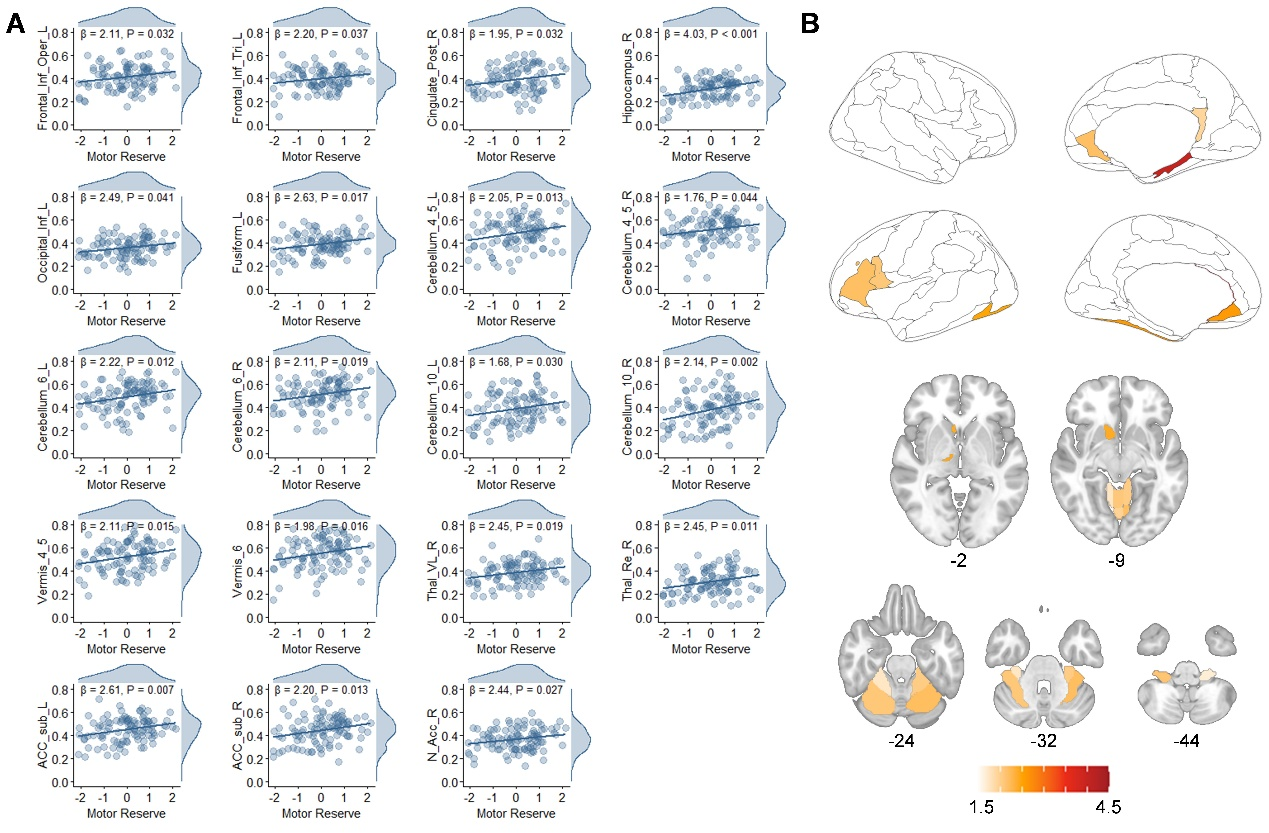
Figure1
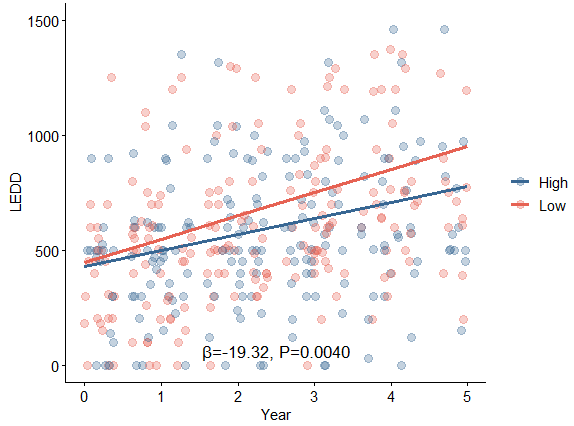
Figure2
To cite this abstract in AMA style:
Y. Li, P. He, L. Wang, K. Nie. Structural-Functional Coupling Supporting Motor Reserve in Early-Stage Parkinson’s Disease [abstract]. Mov Disord. 2026; 41 (suppl 1). https://www.mdsabstracts.org/abstract/structural-functional-coupling-supporting-motor-reserve-in-early-stage-parkinsons-disease/. Accessed October 1, 2026.« Back to 2026 International Congress
MDS Abstracts - https://www.mdsabstracts.org/abstract/structural-functional-coupling-supporting-motor-reserve-in-early-stage-parkinsons-disease/