
Category: Parkinson's Disease: Surgical Therapy
Objective: This study aims to determine the effects of subthalamic nucleus deep brain stimulation (STN‑DBS) on sleep quality and daytime sleepiness in Parkinson’s disease (PD).
Background: Sleep disturbances are among the most prevalent and disabling non‑motor symptoms (NMS) in PD. While STN‑DBS is an established therapy for motor symptoms, its impact on nocturnal sleep quality and daytime somnolence remains variably reported. The Parkinson’s Disease Sleep Scale (PDSS) and the Epworth Sleepiness Scale (ESS) provide validated frameworks for assessing distinct dimensions of sleep dysfunction.
Method: A systematic review and meta-analysis of longitudinal unilateral and bilateral STN‑DBS studies were conducted using PubMed-indexed articles. Nine studies reporting PDSS outcomes (n =286) and eight studies reporting ESS outcomes (n =190) were included. Extracted variables included sample sizes, mean change from baseline, standard errors, and follow-up duration. Data were synthesized using an inverse‑variance model with fixed‑effects. Heterogeneity was assessed using I² and tau², and prediction intervals were calculated.
Results: Most participants (93.68%) underwent bilateral STN‑DBS. STN‑DBS was associated with a significant pooled mean change from baseline in PDSS scores of 21.23 points (95% CI: 11.59 to 30.87) indicating substantial improvement in overall sleep quality [Figure 1]. Improvement peaked at six months. Heterogeneity was negligible (I² = 0%; tau² = 0), with a prediction interval of 9.61 to 32.86. ESS outcomes also improved significantly, with a pooled mean change from baseline of –3.62 (95% CI: –5.09 to –2.14) [Figure 2]. Heterogeneity for ESS was also minimal (I² = 0%; tau² = 0).
Conclusion: STN‑DBS yields robust and reproducible improvements in both nocturnal sleep quality and daytime somnolence in PD. The consistency across PDSS and ESS outcomes supports the utility of DBS for sleep‑related NMS and highlights the value of standardized measurement tools in evaluating DBS effects.
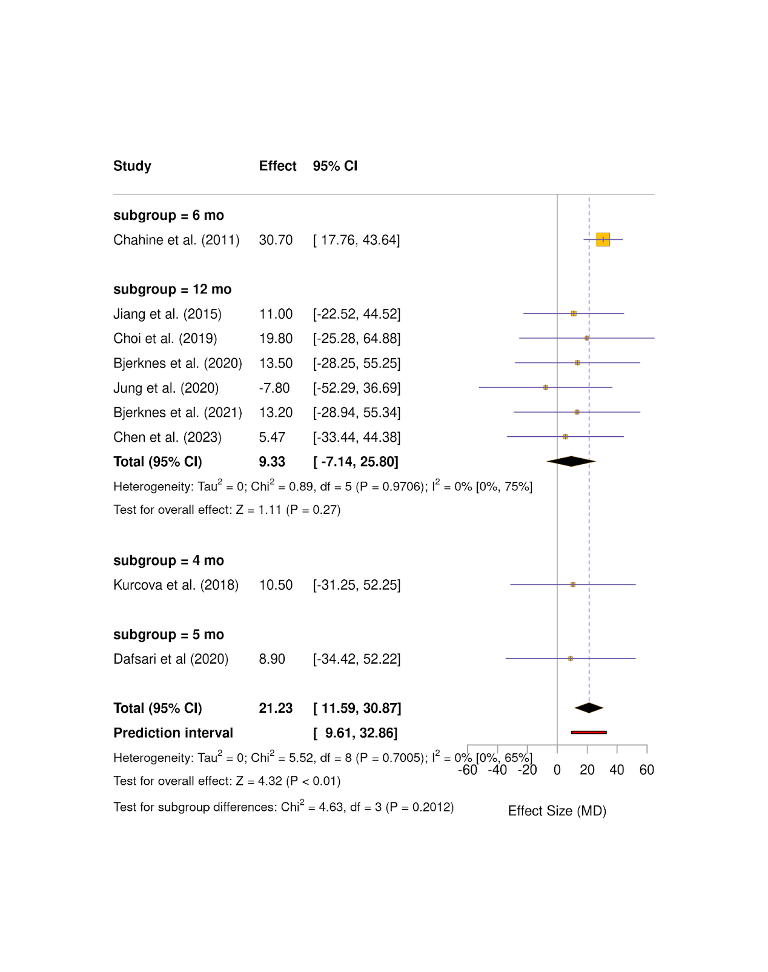
Figure 1
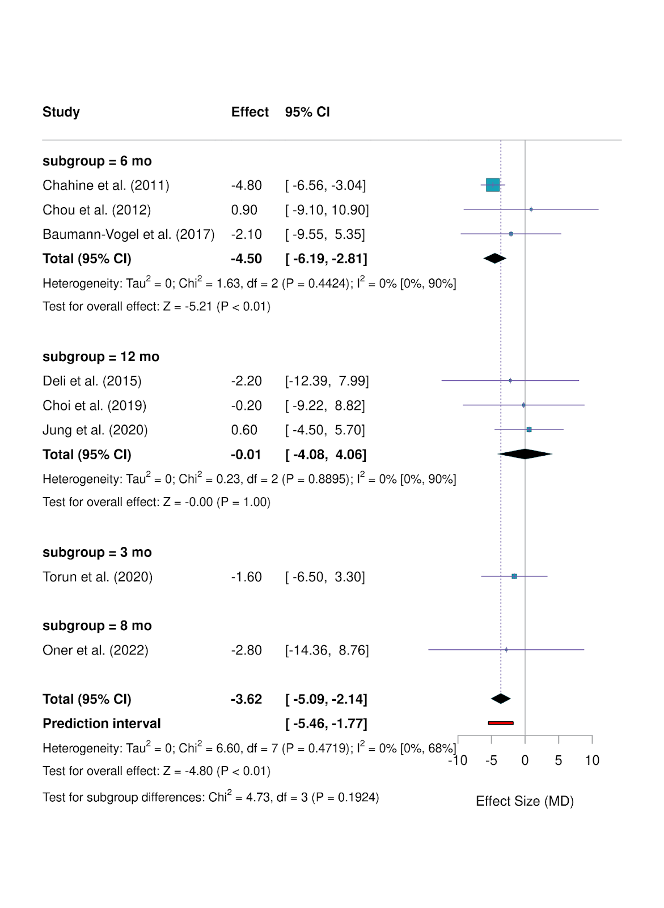
Figure 2
To cite this abstract in AMA style:
M. Schiess, J. Martinez-Lemus, J. Rissardo, J. Patino, A. Caprara, A. Mcgarry, I. Walker. Subthalamic Deep Brain Stimulation Produces Consistent Improvements in Sleep Quality and Daytime Sleepiness in Parkinson’s Disease: A Systematic Review and Meta-analysis [abstract]. Mov Disord. 2026; 41 (suppl 1). https://www.mdsabstracts.org/abstract/subthalamic-deep-brain-stimulation-produces-consistent-improvements-in-sleep-quality-and-daytime-sleepiness-in-parkinsons-disease-a-systematic-review-and-meta-analysis/. Accessed October 1, 2026.« Back to 2026 International Congress
MDS Abstracts - https://www.mdsabstracts.org/abstract/subthalamic-deep-brain-stimulation-produces-consistent-improvements-in-sleep-quality-and-daytime-sleepiness-in-parkinsons-disease-a-systematic-review-and-meta-analysis/