
Objective: We aimed to determine whether temporal prediction and multisensory integration are altered in musician’s dystonia (MD) and whether task-specific visual, auditory, and audiovisual cues modulate predictive accuracy.
Background: When passion becomes a lifelong vocation, the prospect of developing MD after years of dedicated, daily practice is deeply unsettling. MD is a focal task-specific dystonia (FTSD) that disrupts fine motor control during instrumental performance and is increasingly viewed as a network disorder involving the basal ganglia, cerebellum, and cortical-subcortical circuits. Impaired connectivity between sensory and motor regions, altered temporal processing, and abnormal sensorimotor integration have been described in FTSDs such as writer’s cramp, suggesting that predictive timing and multisensory integration may be selectively affected. Examining these processes in highly trained professional pianists offers an opportunity to capture task-specific adaptations within the dystonic network.
Method: We studied 40 professional pianists, 20 with MD (dystonia group, DP) and 20 healthy musician controls (control group, CP). Participants were asked to predict the endpoint of a repeating sequence that was interrupted at various timepoints, in both a task-specific and a non-task-specific context. The task-specific condition used visual, auditory, and audiovisual presentations of C major piano scales; the non-task-specific condition consisted of a moving ball paired with an artificially generated glissando. Mean age was 49±12 years for DP and 47±13 years for CP. Statistical analyses were performed via linear mixed effects regression models.
Results: Prediction accuracy increased with later interruption points in both groups (main effect of interruption point, p<0.001). In the visual-only condition, DP showed higher prediction accuracy than CP (p=0.011). In auditory and audiovisual conditions, no significant group differences were observed (p>0.05; {figure1}).
Conclusion: Musicians with dystonia showed preserved or even enhanced visual-only temporal prediction, suggesting compensatory reliance on visual cues and potentially strengthened visual-motor integration. These findings support the view of MD as a network-level disorder with modality-specific adaptations. In the future, this may inform the development of targeted, visually guided rehabilitative strategies.
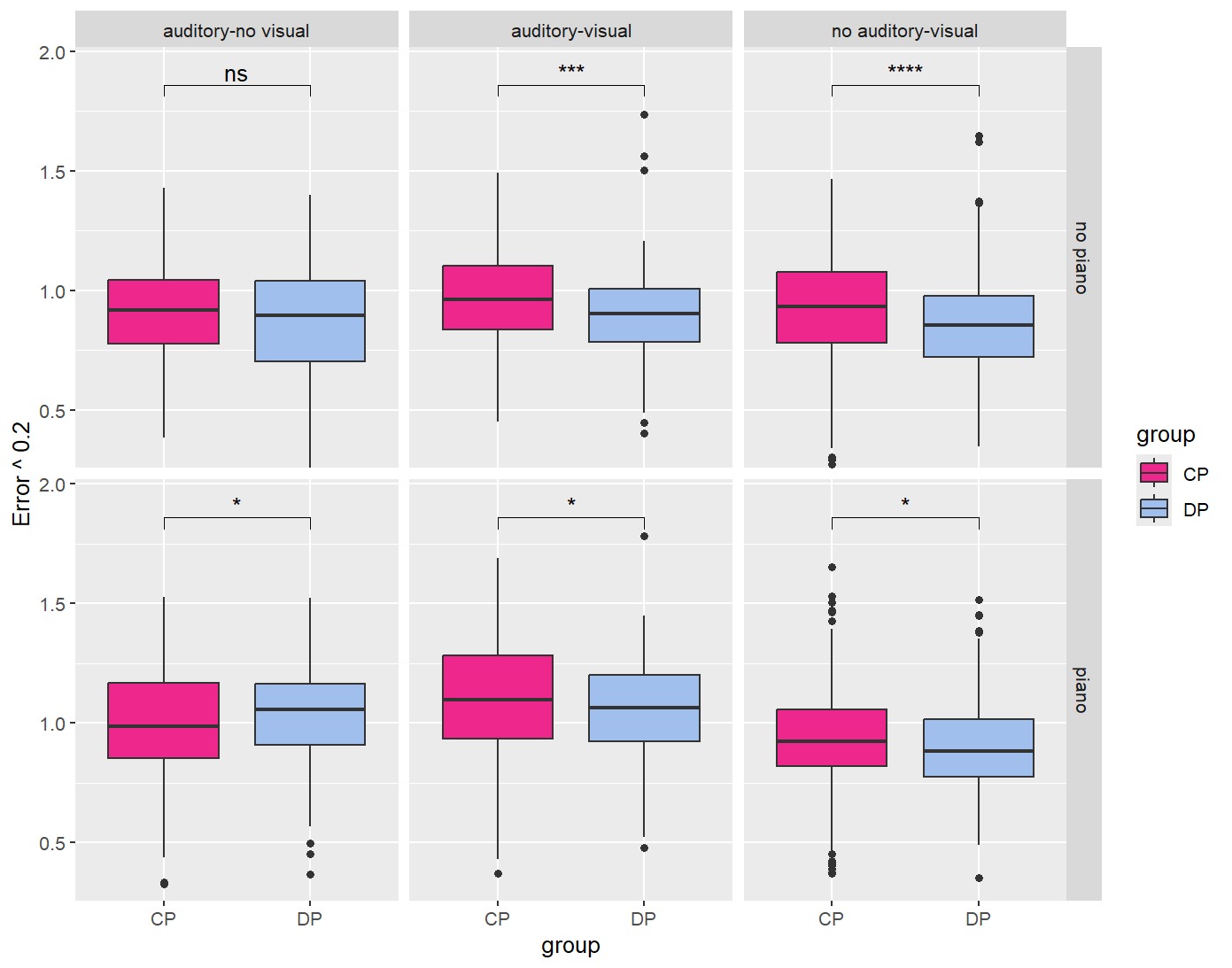
{1}
To cite this abstract in AMA style:
H. Klein, J. Doll-Lee, E. Passarotto, T. Oku, S. Furuya, E. Altenmüller, A. Lee. Temporal Prediction and Multisensory Integration in Musician’s Dystonia [abstract]. Mov Disord. 2026; 41 (suppl 1). https://www.mdsabstracts.org/abstract/temporal-prediction-and-multisensory-integration-in-musicians-dystonia/. Accessed October 1, 2026.« Back to 2026 International Congress
MDS Abstracts - https://www.mdsabstracts.org/abstract/temporal-prediction-and-multisensory-integration-in-musicians-dystonia/