
Objective: To investigate tongue shape complexity across three consonants (/t/, /k/, /s/) in Cantonese people with Parkinson’s disease (PD) using ultrasound tongue imaging (UTI).
Background: Articulatory impairment is prevalent in PD, yet mixed acoustic and kinematic findings persist, likely due to nonlinear articulatory-acoustic relations or point-based kinematics (i.e., electromagnetic articulography) missing underlying muscular synergies [4]. UTI visualizes larger extent of the tongue contours [5,6], allowing the evaluation of tongue shape complexity. It reflects regional functional independence of the tongue musculature [7] and may be reduced in PD due to lingual rigidity. While applied in other speech disorders [8], this biomarker lacks sufficient validation in PD [9,10], particularly cross-linguistic evidence.
Method: The study involved 6 Cantonese speakers with PD (Mean= 64.83) and 6 age-matched healthy controls (HCs) (Mean= 63.3). Synchronized UTI and audio data were recorded via Articulate Assistant Advanced (AAA). Participants repeated Cantonese consonants /t, k, s/ (varying in place, manner, and complexity[13-15]) 5 times in /Ca/ contexts (打 [ta:], 家 [ka:], 沙 [sa:]). Consonant duration was manually annotated using a TextGrid in Praat; TextGrids were imported into AAA for frame selection. Tongue contours were tracked using DeepLabCut, and two complementary metrics, the Modified Curvature Index (MCI) [7] and the Number of Inflections (NINFL) [18] were calculated via Python. Aligned Rank Transform ANOVAs assessed the effects of group and consonant on both metrics.
Results: MCI results showed a significant main effect of consonant for both groups (F(2, 165) = 20.52, p < .001). Post-hoc comparisons revealed that tongue shape complexity was higher for /k/ than /t/ (p= .003) and /s/ (p <.001); and higher for /t/ than /s/ (p = .010). A significant group difference was found (F(1, 9.8) = 15.48, p = .003), with PD exhibiting overall lower NINFL than HCs across all consonants. This indicates reduced tongue shape complexity in PD.
Conclusion: This pilot study pioneered the use of tongue shape complexity as a potential articulatory biomarker in Cantonese speakers with PD. The findings further support UTI for enhancing cross-linguistic understanding of tongue motor control in individuals with PD. Future research requires larger cohorts and diverse speech tasks to account for individual variability and fully characterize PD speech impairments.

Table 1

Table 2
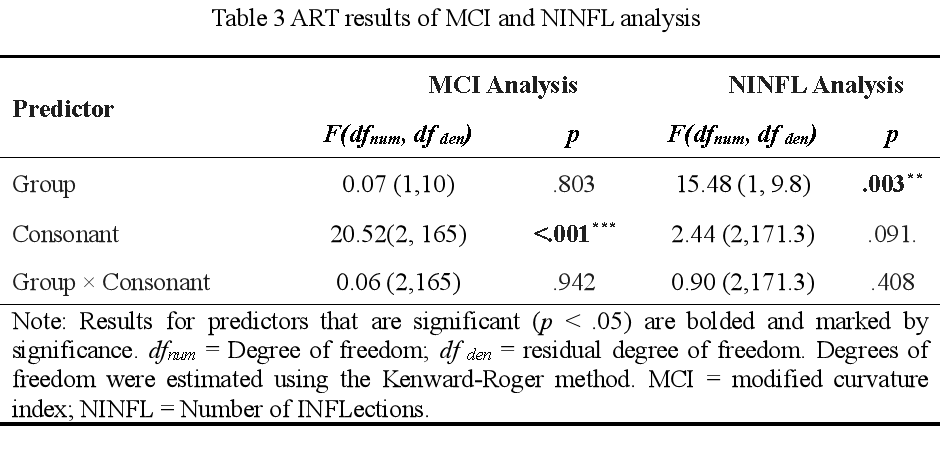
Table 3
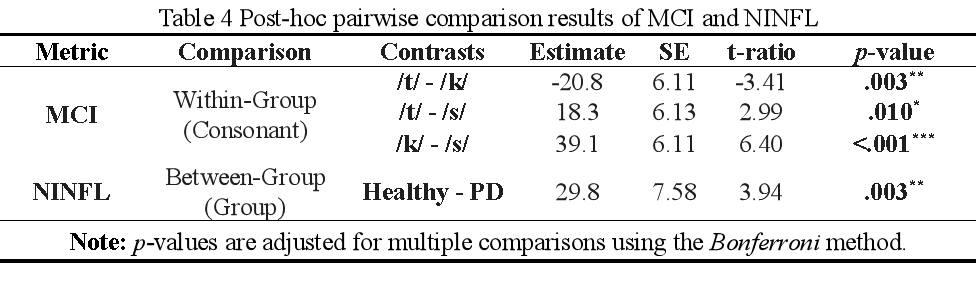
Table 4
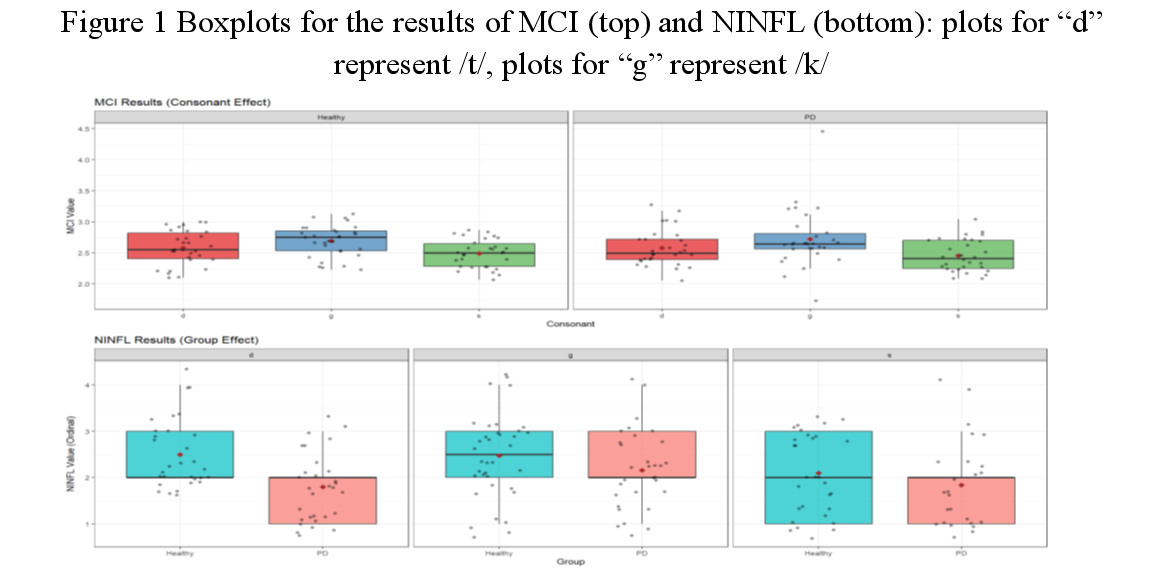
Figure 1
References: [1]Duffy, J. R. (2013). Motor speech disorders: Substrates, differential diagnosis, and management (3rd ed). Mosby.
[2]Freed, D. B. (2025). Motor speech disorders: Diagnosis and treatment (4th ed.). Plural Publishing.
[3]Mefferd, A., & Dietrich, M. (2019). Tongue- and jaw-specific articulatory underpinnings of reduced and enhanced acoustic vowel contrast in talkers with Parkinson’s disease. Journal of Speech Language and Hearing Research, 62(7), 2118–2132.
[4]Thompson, A., & Kim, Y. (2024). Acoustic and kinematic predictors of intelligibility and articulatory precision in Parkinson’s disease. Journal of Speech Language and Hearing Research, 67(10), 3595–3611.
[5]Ball, M. J. (Ed.). (2021). Manual of Clinical Phonetics. Routledge.
[6]Chen, S., Whalen, D. H., & Mok, P. P. K. (2024). What R Mandarin Chinese /ɹ/s? – Acoustic and articulatory features of Mandarin Chinese rhotics. Phonetica, 81(5), 509–552.
[7]Dawson, K. M., Tiede, M. K., & Whalen, D. H. (2016). Methods for quantifying tongue shape and complexity using ultrasound imaging. Clinical Linguistics & Phonetics, 30(3–5), 328–344.
[8]Dokovova, M., Sugden, E., Cartney, G., Schaeffler, S., & Cleland, J. (2023). Tongue shape complexity in children with and without speech sound disorders. Journal of Speech, Language, and Hearing Research, 66(7), 2164–2183.
[9]Dawson, K. M., Iskarous, K., & Whalen, D. H. (2013). An analysis of tongue shape during Parkinsonian speech. The Journal of the Acoustical Society of America, 134(5_Suppl.), 4204.
[10]Whalen, D. H., Dawson, K. M., Carl, M., & Iskarous, K. (2014). Tongue shape complexity for liquids in Parkinsonian speech. The Journal of the Acoustical Society of America, 135(4_Suppl.), 2389.
[11]Articulate Instruments Ltd (2012). Articulate Assistant Advanced user guide: (Version 2.14) [Computer software manual].
[12]Articulate Instruments Ltd. (2008). Ultrasound stabilisation headset users manual (Rev. 1.4) [Manual].
[13]Kent, R. D. (1992). The biology of phonological development. In C. A. Ferguson, L. Menn, & C. Stoel-Gammon (Eds.), Phonological Development: Models, Research, Implications (pp. 65–90). York Press.
[14]Kuruvilla-Dugdale, M., Salazar, M., Zhang, A., & Mefferd, A. S. (2020). Detection of articulatory deficits in parkinson’s disease: Can systematic manipulations of phonetic complexity help? Journal of Speech, Language, and Hearing Research, 63(7), 2084–2098.
[15]Stokes, S. F., & Surendran, D. (2005). Articulatory complexity, ambient frequency, and functional load as predictors of consonant development in children. Journal of Speech, Language, and Hearing Research, 48(3), 577–591.
[16]Boersma, P., & Weenink, D. (2023). Praat: Doing phonetics by computer [Computer software]. https://www.fon.hum.uva.nl/praat/
[17]Wrench, A., & Balch-Tomes, J. (2022). Beyond the edge: Markerless pose estimation of speech articulators from ultrasound and camera images using DeepLabCut. Sensors, 22(3), 1133.
[18]Preston, J. L., McCabe, P., Tiede, M., & Whalen, D. H. (2019). Tongue shapes for rhotics in school-age children with and without residual speech errors. Clinical Linguistics & Phonetics, 33(4), 334–348.
To cite this abstract in AMA style:
C. Wang, M. Wong, B. Wang. Tongue Shape Complexity in Cantonese Parkinsonian Speech [abstract]. Mov Disord. 2026; 41 (suppl 1). https://www.mdsabstracts.org/abstract/tongue-shape-complexity-in-cantonese-parkinsonian-speech/. Accessed October 1, 2026.« Back to 2026 International Congress
MDS Abstracts - https://www.mdsabstracts.org/abstract/tongue-shape-complexity-in-cantonese-parkinsonian-speech/