
Objective: To compare urine and plasma bis(monoacylglycero)phosphate (BMP) levels in Parkinson disease (PD) patients carrying Asian-prevalent LRRK2 variants (p.G2385R, p.R1628P) against idiopathic PD (iPD) and healthy controls (HC).
Background: LRRK2 p.G2385R and p.R1628P variants each affects 5-10% of Asian PD cases, were shown to increase LRRK2 kinase activity[1,2]. BMP is a promising phospholipid biomarker for lysosomal dysfunction and LRRK2 pathway activity. While urine BMP is elevated in LRRK2 G2019S carriers[3,4], studies in Asian-prevalent LRRK2 variants are scarce.
Method: 243 subjects were recruited: PD-G2385R(n=57), PD-R1628P(n=61), PD-G2385R+R1628P(n=5), iPD(n=62), and HC(n=58). Ultra-performance liquid chromatography-tandem mass spectrometry quantified six urine and fourteen plasma BMP isoforms[3]. Associations between BMP levels and PD motor/non-motor severity were also examined.
Results: Among the 20 urine/plasma BMP isoforms, significant differences between PD vs. HC were seen primarily in urine 22:6 BMP species. Compared to HC, urine 2,2’ di-22:6 BMP levels were significantly increased in iPD, PD-G2385R and PD-R1628P, while urine 2,3’/2’,3 di-22:6 BMP levels were higher in all PD groups. Urine 3/3’ di-22:6 BMP levels were elevated in iPD, PD-G2385R and PD-G2385R+R1628P(Fig.1). No other urine/plasma BMP isoforms differed significantly between PD groups and HC. When comparing within PD groups, plasma di-20:4 BMP levels were significantly lower in PD-G2385R and PD-R1628P vs iPD, while no other urine or plasma BMP isoforms differed significantly between LRRK2 variant carriers and iPD. In PD patients, urine di-22:6 and plasma di-20:4 BMP levels correlated with worse motor severity, i.e. MDS-UPDRS, CISI-PD and MoCA scores.
Conclusion: Urine di-22:6 BMP isoforms were elevated across PD groups compared to HC, consistent with lysosomal dysfunction in PD. However, urine BMP profiles were largely similar between PD patients with p.G2385R or p.R1628P and iPD, suggesting that BMP may not distinguish Asian LRRK2-related PD from sporadic disease. Conversely, reduced plasma di-20:4 BMP levels in Asian LRRK2 variant carriers may indicate potential genotype-related differences in lipid metabolism that warrant further investigation. These findings offer new insights for interpreting BMP as a potential lysosomal and LRRK2 biomarker in PD.
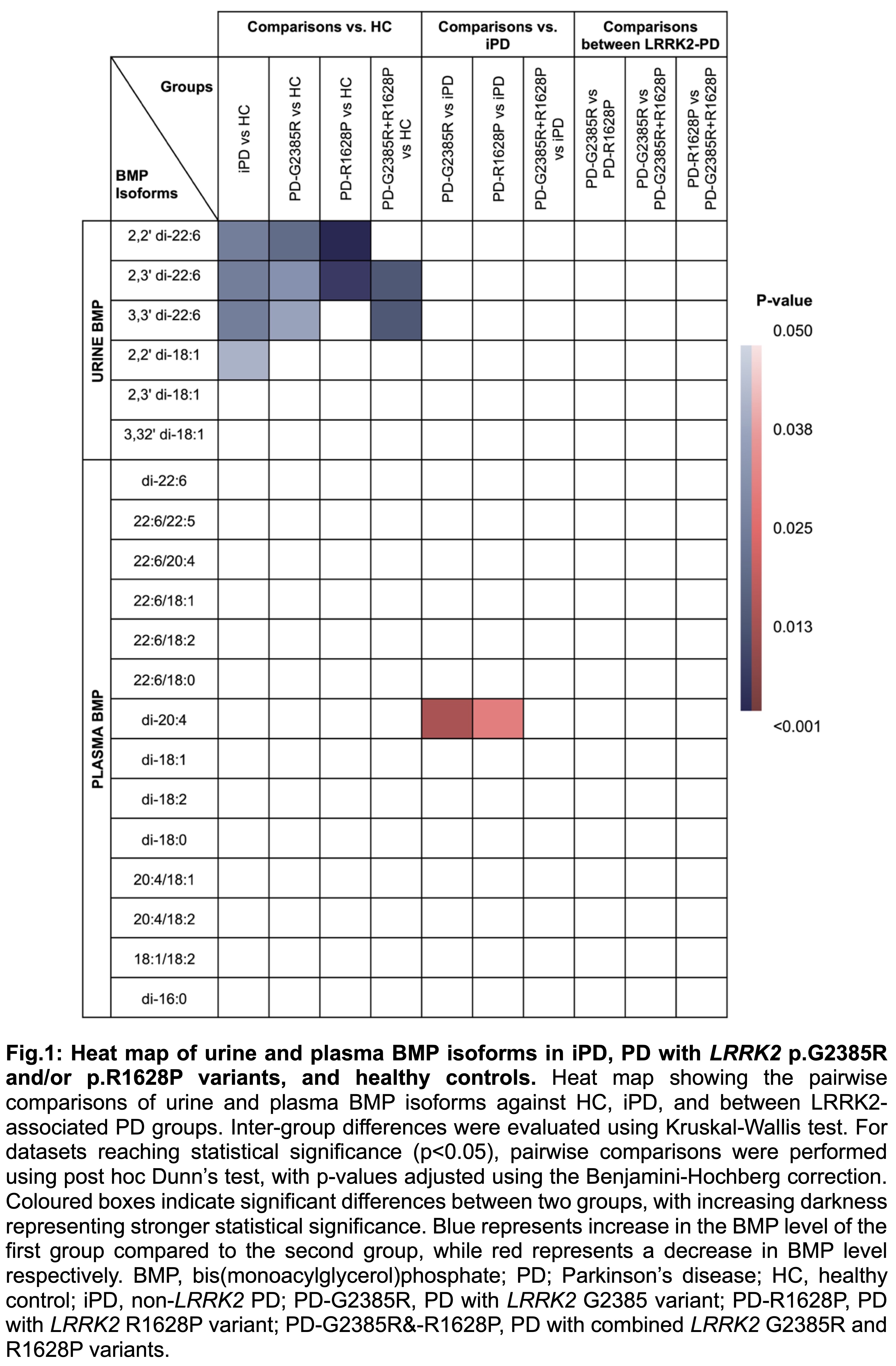
Fig.1 BMP
References: [1] Lim SY, Tan AH, Ahmad-Annuar A, et al. Uncovering the genetic basis of Parkinson’s disease globally: from discoveries to the clinic. Lancet Neurol. 2024;23(12):1267-1280. doi:10.1016/S1474-4422(24)00378-8
[2] Toh TS, Lit LC, Lim SY, et al. Precision Stratification: Kinase Assay in Asian LRRK2 Risk Carriers and Idiopathic Parkinson Disease. medRxiv. 2025 Sep. doi:10.1101/2025.09.23.25336067
[3] Alcalay RN, Hsieh F, Tengstrand E, et al. Higher Urine bis(Monoacylglycerol)Phosphate Levels in LRRK2 G2019S Mutation Carriers: Implications for Therapeutic Development. Mov Disord. 2020;35(1):134-141. doi:10.1002/mds.27818
[4] Gomes S, Garrido A, Tonelli F, et al. Elevated urine BMP phospholipids in LRRK2 and VPS35 mutation carriers with and without Parkinson’s disease. NPJ Parkinsons Dis. 2023;9(1):52. Published 2023 Apr 4. doi:10.1038/s41531-023-00482-4
To cite this abstract in AMA style:
AN. Khairul Anuar, SY. Lim, TS. Toh, CCY. Lew, JW. Hor, YW. Tay, A. Ahmad-Annuar, L. Li, F. Hsieh, LC. Lit, AH. Tan. Urine and Plasma Bis(monoacylglycero)phosphate (BMP) in Asian LRRK2 p.G2385R and p.R1628P Variant Carriers with Parkinson’s Disease [abstract]. Mov Disord. 2026; 41 (suppl 1). https://www.mdsabstracts.org/abstract/urine-and-plasma-bismonoacylglycerophosphate-bmp-in-asian-lrrk2-p-g2385r-and-p-r1628p-variant-carriers-with-parkinsons-disease/. Accessed October 1, 2026.« Back to 2026 International Congress
MDS Abstracts - https://www.mdsabstracts.org/abstract/urine-and-plasma-bismonoacylglycerophosphate-bmp-in-asian-lrrk2-p-g2385r-and-p-r1628p-variant-carriers-with-parkinsons-disease/