
Category: Surgical Therapy: Parkinson's Disease
Objective: To assess the impact of different parameters (voltage, pulse width, frequency) of subthalamic nucleus (STN) deep brain stimulation (DBS) on axial and limb symptoms in patients with Parkinson’s disease (PD) in a retrospective study.
Background: STN DBS has been shown to be an effective therapeutic option for advanced PD patients with refractory motor fluctuations and dyskinesias.The clinical success of DBS for treating PD critically depends on the quality of postoperative management of the parameters. The programming of DBS is complex work because the parameter setting is not standardized so far.
Method: Twenty-seven PD patients receiving bilateral STN DBS were included. All patients were evaluated using the Unified Parkinson’s Disease Rating Scale (UPDRS) part III at baseline, 3, 6 and 12 months following-up. The patients were divided into two groups according to the parameter settings during follow-up: Group I (only adjusting voltage) and group II (adjusting more than one stimulation parameters).
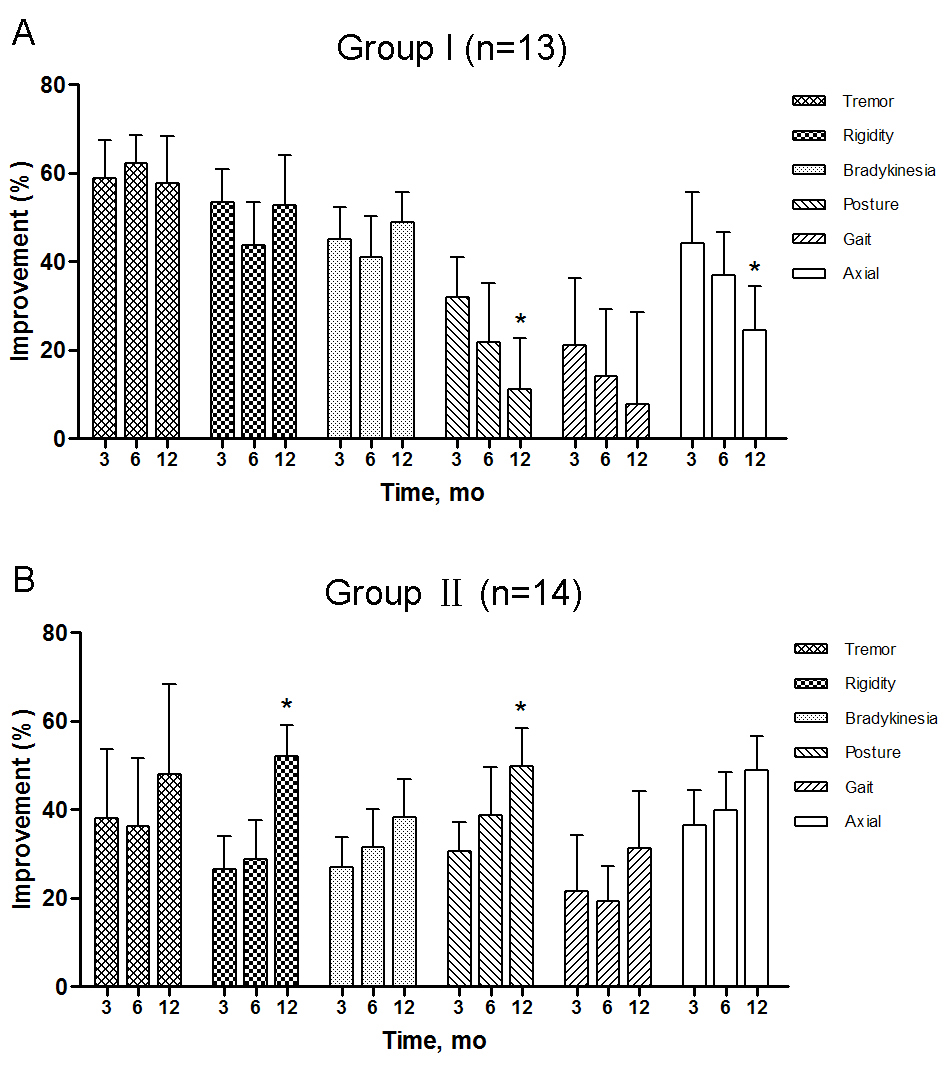
Results: Patients in group I retained stable improvement in limb symptoms during follow-up, but improvements in postural stability and total axial symptoms became less pronounced at 12-month follow-up compared to 3-month follow-up ( p=0.035, 0.016, respectively). Patients in group II achieved better improvements in rigidity and posture stability at 12-month follow-up compared to 3-month follow-up ( p=0.019, 0.036, respectively) and their improvements in tremor, bradykinesia and total axial remained constant during follow-up (figrue). Step-wise multiple regression showed a positive correlation between posture stability improvement and frequency (R2=0.373, p=0.020), as well as between gait improvement and pulse width (R2=0.349, p=0.026).
Conclusion: Voltage adjustment of STN DBS has a satisfactory effect on limb symptoms. Pulse width and frequency adjustments may be beneficial for PD patients with severe axial symptoms and limb symptoms which don’t respond to voltage adjustment.
To cite this abstract in AMA style:
W. Xian, L. Chen, J. Liu, C. Yang. Voltage Adjustment Effects More on Limb Symptoms than Axial Symptoms in Parkinson’s Disease Patients Treated with Subthalamic Nucleus Stimulation [abstract]. Mov Disord. 2020; 35 (suppl 1). https://www.mdsabstracts.org/abstract/voltage-adjustment-effects-more-on-limb-symptoms-than-axial-symptoms-in-parkinsons-disease-patients-treated-with-subthalamic-nucleus-stimulation/. Accessed November 8, 2026.« Back to MDS Virtual Congress 2020
MDS Abstracts - https://www.mdsabstracts.org/abstract/voltage-adjustment-effects-more-on-limb-symptoms-than-axial-symptoms-in-parkinsons-disease-patients-treated-with-subthalamic-nucleus-stimulation/