
Objective: To examine how wearable-derived cardiac performance and cardiac–motor interconnection (CCM) vary across Parkinson’s disease (PD) severities, stratified by the Parkinson’s disease–cognitive rating scale (PD-CRS) and the Movement Disorder Society–Unified Parkinson’s Disease Rating Scale (MDS-UPDRS), versus controls.
Background: PD progression involves motor and autonomic alterations that are not fully captured by clinical scales alone. Brief upper-limb tasks with wearable sensing may provide scalable markers of systemic dysregulation, including coupling between cardiac dynamics and motor output (CCM). [1–3]
Method: This ongoing study recruits individuals with idiopathic PD across severities and age-matched controls. Participants perform a standardised elbow flexion–extension task while wearing electrocardiography and gyroscope sensors. Cardiac features and CCM metrics are computed from synchronised signals. Group differences are tested with one-way ANOVA and Holm–Bonferroni–corrected post-hoc comparisons. AI disclosure: ChatGPT (OpenAI) was used only to improve English clarity; it was not used for data collection or statistical analysis.
Results: Current enrolment: controls n=10; PD mild n=5, moderate n=4, severe n=3. CCM HR→M decreased across strata (0.80±0.10, 0.63±0.08, 0.48±0.12, 0.34±0.09) with significant differences between controls and each PD group (p<0.01 to p<0.001) and between mild and severe PD (p<0.01) ([figure1A], [table1], [table2]). Heart rate increase (%) was lower in moderate and severe PD (22.90±5.49, 22.20±4.87, 14.25±4.72, 10.67±3.06), with significant differences for control vs moderate and mild vs moderate (both p<0.05) ([figure1B], [table1], [table2]).
Conclusion: Cardiac performance and CCM derived during a brief elbow flexion–extension task varied across PD severities. CCM showed a graded reduction from controls to advanced PD, suggesting sensitivity to severity-related changes in autonomic–motor integration. With continued recruitment, these wearable-derived measures may support objective stratification of PD severity and strengthen multimodal characterisation of disease progression.
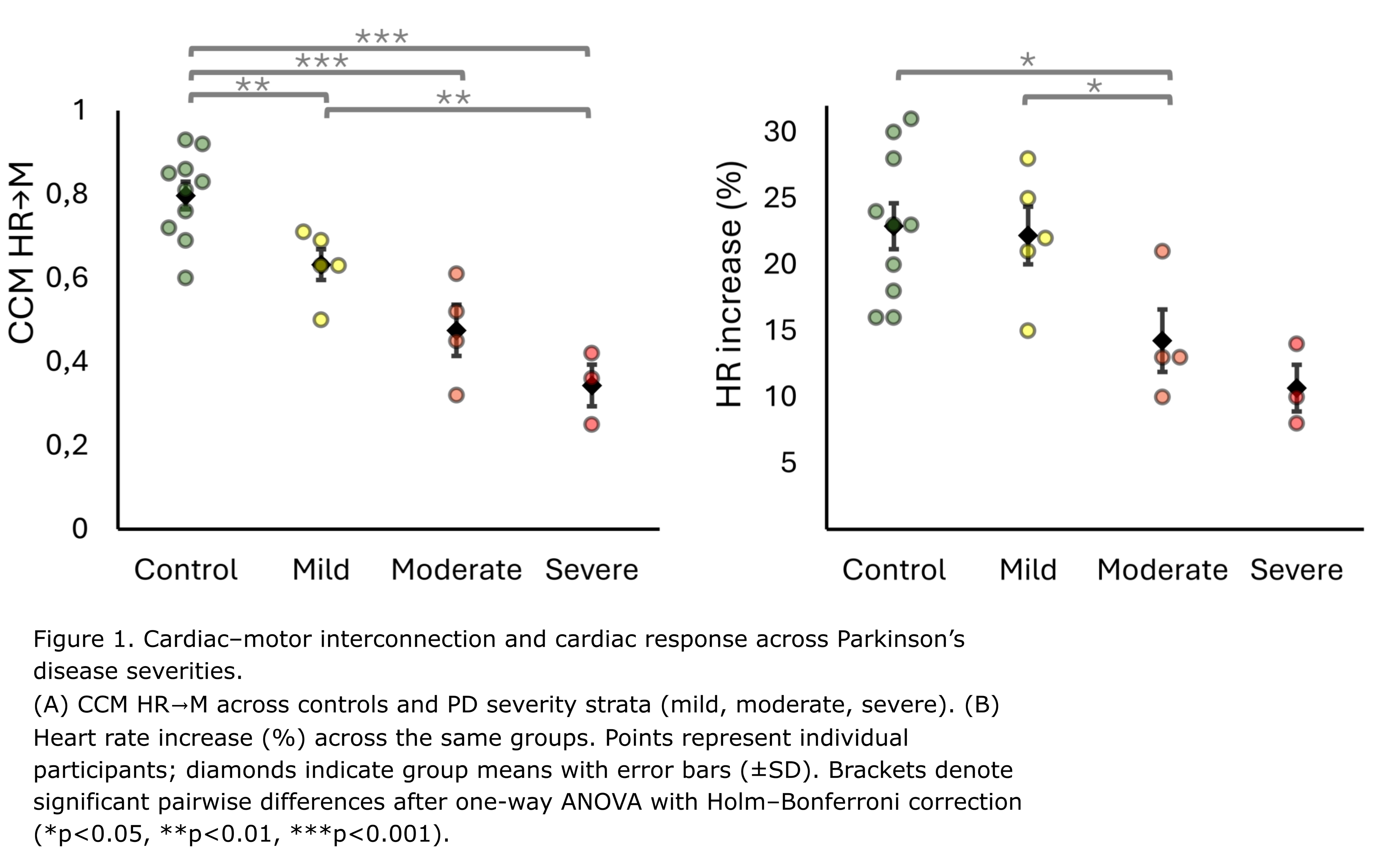
Relevant parameters across Parkinson severities
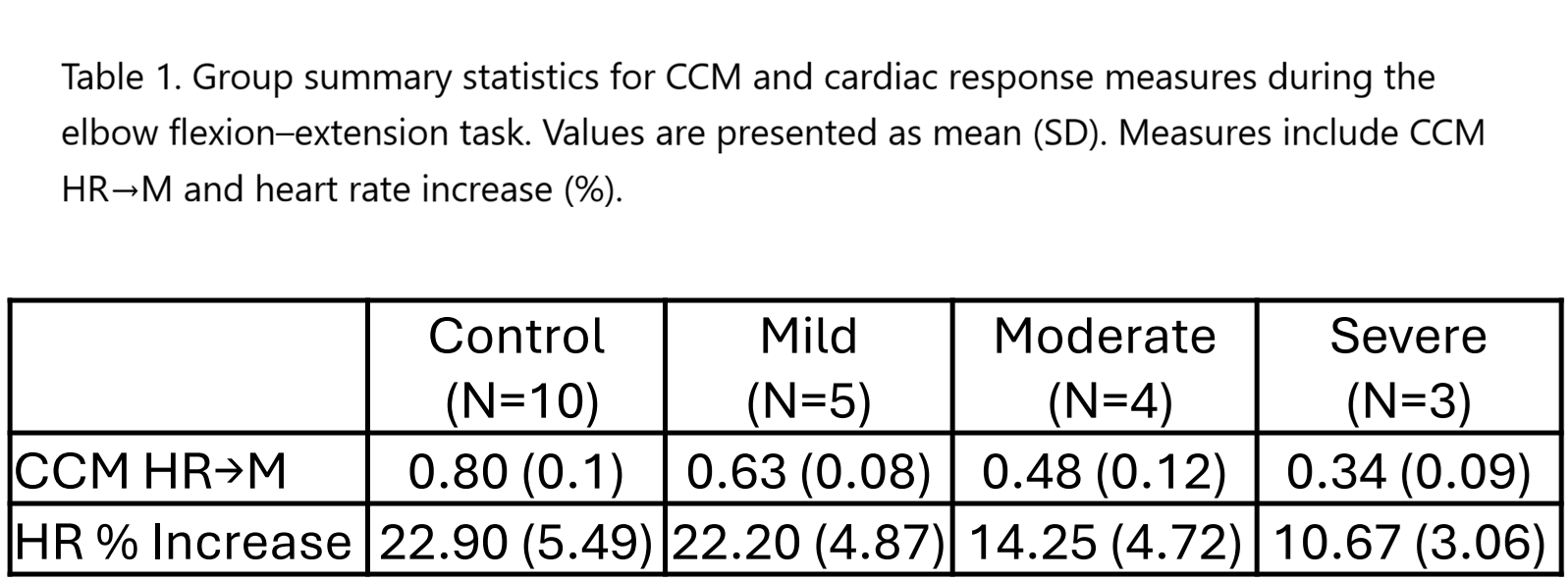
Group summary statistics
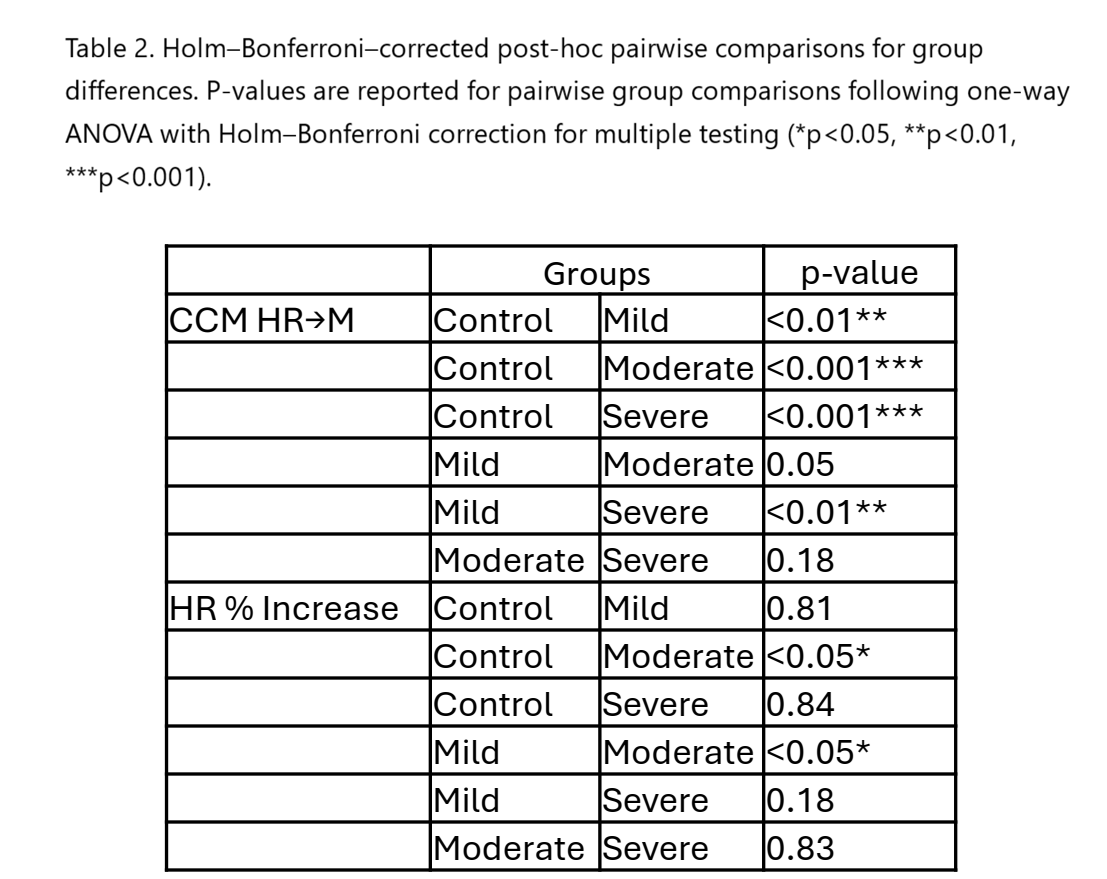
Pairwise comparisons for group differences
References: [1] Toosizadeh N, Wendel C, Hsu CH, Zamrini E, Mohler J. Frailty assessment in older adults using upper-extremity function: index development. BMC Geriatr. 2017;17(1):1–7.
[2] Toosizadeh N, Eskandari M, Ehsani H, Parvaneh S, Asghari M, Sweitzer N. Frailty assessment using a novel approach based on combined motor and cardiac functions: a pilot study. BMC Geriatr. 2022;22(1):1–10.
[3] Arrué P, Laksari K, Russo M, La Placa T, Smith M, Toosizadeh N. Associating frailty and dynamic dysregulation between motor and cardiac autonomic systems. Frontiers in Aging. 2024 May 13;5.
To cite this abstract in AMA style:
P. Arrue. Wearable-Derived Cardiac Features and Cardiac–Motor Interconnection Across Parkinson’s Disease Severities [abstract]. Mov Disord. 2026; 41 (suppl 1). https://www.mdsabstracts.org/abstract/wearable-derived-cardiac-features-and-cardiac-motor-interconnection-across-parkinsons-disease-severities/. Accessed October 1, 2026.« Back to 2026 International Congress
MDS Abstracts - https://www.mdsabstracts.org/abstract/wearable-derived-cardiac-features-and-cardiac-motor-interconnection-across-parkinsons-disease-severities/