
Objective: To describe real-world long-term outcomes, tolerability, and complications of device-aided therapies (DAT) in people with multiple system atrophy (MSA; PwMSA) treated at a specialist movement disorders centre.
Background: One third of PwMSA show lasting levodopa-response and experience bothersome motor comlications. (Blaise et al., 2022) While DAT are well established for advanced Parkinson’s disease, their long-term effectiveness and tolerability in MSA are unclear.
Method: A retrospective case series of consecutive patients with clinically established/probable MSA (Wenning et al., 2022) who received a DAT (continuous subcutaneous apomorphine infusion (APO-CSI), deep brain stimulation of nucleus subthalamicus (STN DBS), levodopa–carbidopa intestinal gel (LCIG), or continuous subcutaneous foslevodopa infusion (LDp/CDp-CSI)) between 2018 and the present at a single specialist movement disorders centre. Clinical data were extracted from medical records.
Results: Six PwMSA (5 female; age range 48–71 years) were initated on APO-CSI (n=3), LDp/CDp-CSI (n=3), and STN-DBS (n=1) and followed-up for up to 46 months. Four of five patients receiving one of the SCIs experienced a reduction in motor fluctuations, whereas the individual who underwent STN-DBS developed an immediate worsening of gait. DAT-related complications included autonomic dysfunction, neuropsychiatric symptoms, postural instability with recurrent falls, and daytime somnolence, leading to DAT discontinuation in 2/5 individuals treated with SCIs. Table 1.
Conclusion: In selected PwMSA, DAT may provide short-term symptomatic benefit; however, with disease progression, adverse events limit longer-term functional gains.
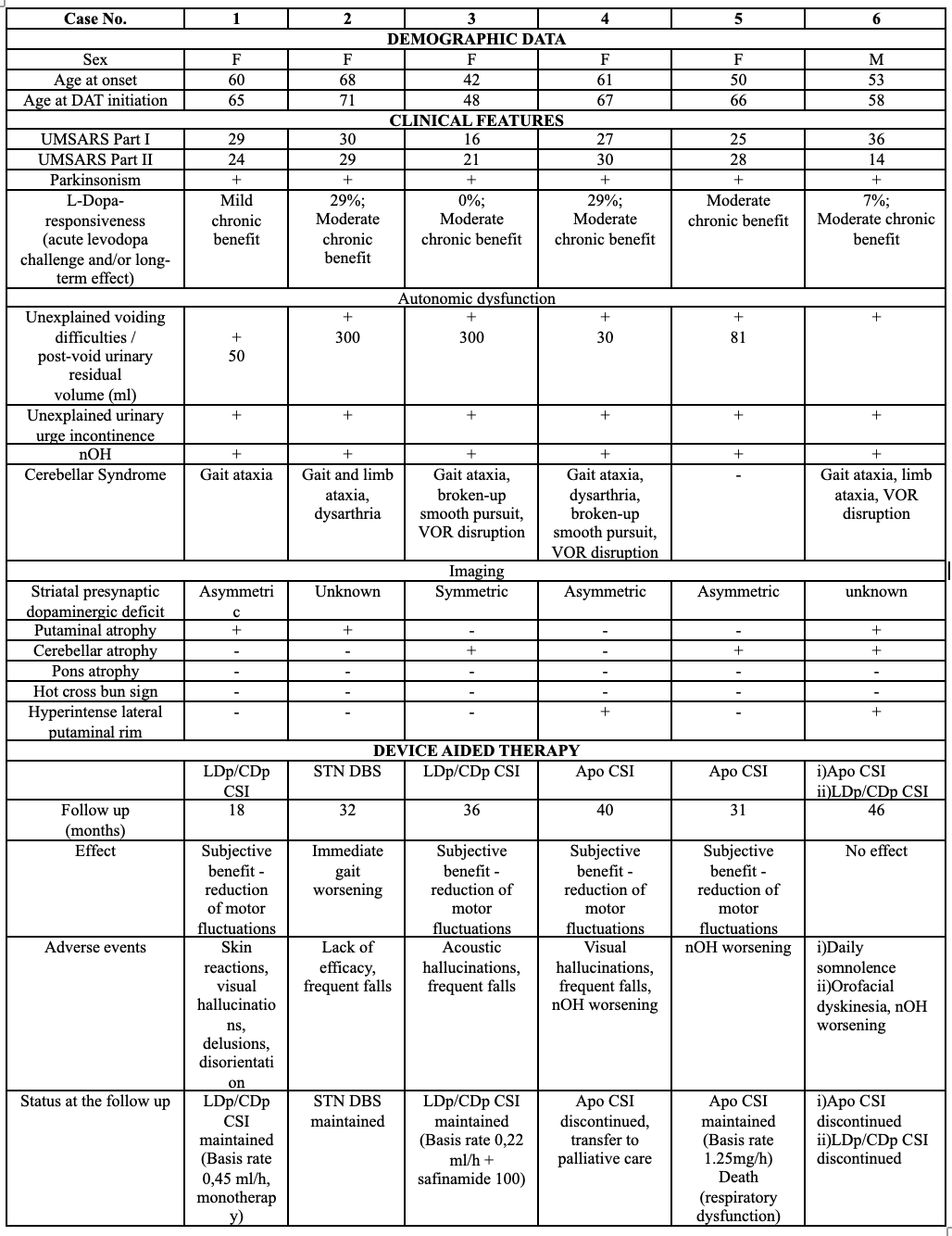
Table 1.
References: 1. Blaise AS, Cuvelier E, Carriere N, et al. Use of levodopa-carbidopa intestinal gel to treat patients with multiple system atrophy. Parkinsonism Relat Disord 2022;100:41-44. doi: 10.1016/j.parkreldis.2022.05.018 [published Online First: 20220526]
2. Wenning GK, Stankovic I, Vignatelli L, et al. The Movement Disorder Society Criteria for the Diagnosis of Multiple System Atrophy. Mov Disord 2022;37(6):1131-48. doi: 10.1002/mds.29005 [published Online First: 20220421]
To cite this abstract in AMA style:
K. Rukavina, H. Stuke, J. Malleike, D. Carneiro, N. Campese, D. Gruber, G. Ebersbach. Device-aided Therapies in Multiple System Atrophy: Long-term Follow-up Case Series [abstract]. Mov Disord. 2026; 41 (suppl 1). https://www.mdsabstracts.org/abstract/device-aided-therapies-in-multiple-system-atrophy-long-term-follow-up-case-series/. Accessed October 1, 2026.« Back to 2026 International Congress
MDS Abstracts - https://www.mdsabstracts.org/abstract/device-aided-therapies-in-multiple-system-atrophy-long-term-follow-up-case-series/