
Objective: Quantify Bradykinesia Through Standardized Drawing in PD patients.
Background: Bradykinesia is the cardinal symptom in Parkinson’s Disease (PD). The slowing and progressive reduction in the amplitude and speed during repetitive movements, (decremental effect), is characteristic. Although bradykinesia is usually assessed through the MDS-UPDRS scale, in some patients the clinical examination may be challenging and the presence of bradykinesia may be difficult to determine. This study aims to assess whether sequential drawing of a tower pattern could be a useful tool for identifying bradykinesia.
Method: In this exploratory study, a total of 20 PD patients were included. All patients were evaluated during the ON medication state. Participants were asked to perform a sequential tower drawing task under two conditions: first at a slow and precise pace and subsequently at maximal speed. Each drawing consisted of nine consecutive tower units. The height and width of each individual tower were quantified in millimeters, as well as the total length of each drawing. Bradykinesia was assessed using the MDS-UPDRS Part III.
For the analysis, each tracing was divided into three sequential segments in order to assess potential changes in performance throughout the task: segment 1 (towers 1–3), segment 2 (towers 4–6), and segment 3 (towers 7–9). Differences between segments were analyzed using the Wilcoxon signed-rank test, comparing segment 1 versus segment 2 and segment 1 versus segment 3.
Results: A progressive decrement in tower height was observed in both drawing conditions (slow/precise and maximal speed). Between S1 and S2, median tower height decreased by 0.8 mm in the slow/precise condition (p = 0.027) and by 2.4 mm in the maximal-speed condition (p = 0.03). This decrement became more pronounced between S1 and S3, reaching reductions of 2.1 mm and 6.2 mm, respectively (both p < 0.001).
Conclusion: Sequential tower drawing revealed a progressive decrement in movement amplitude, consistent with the sequence effect characteristic of bradykinesia. This simple drawing task may represent a useful bedside tool for detecting bradykinesia in patients with PD.
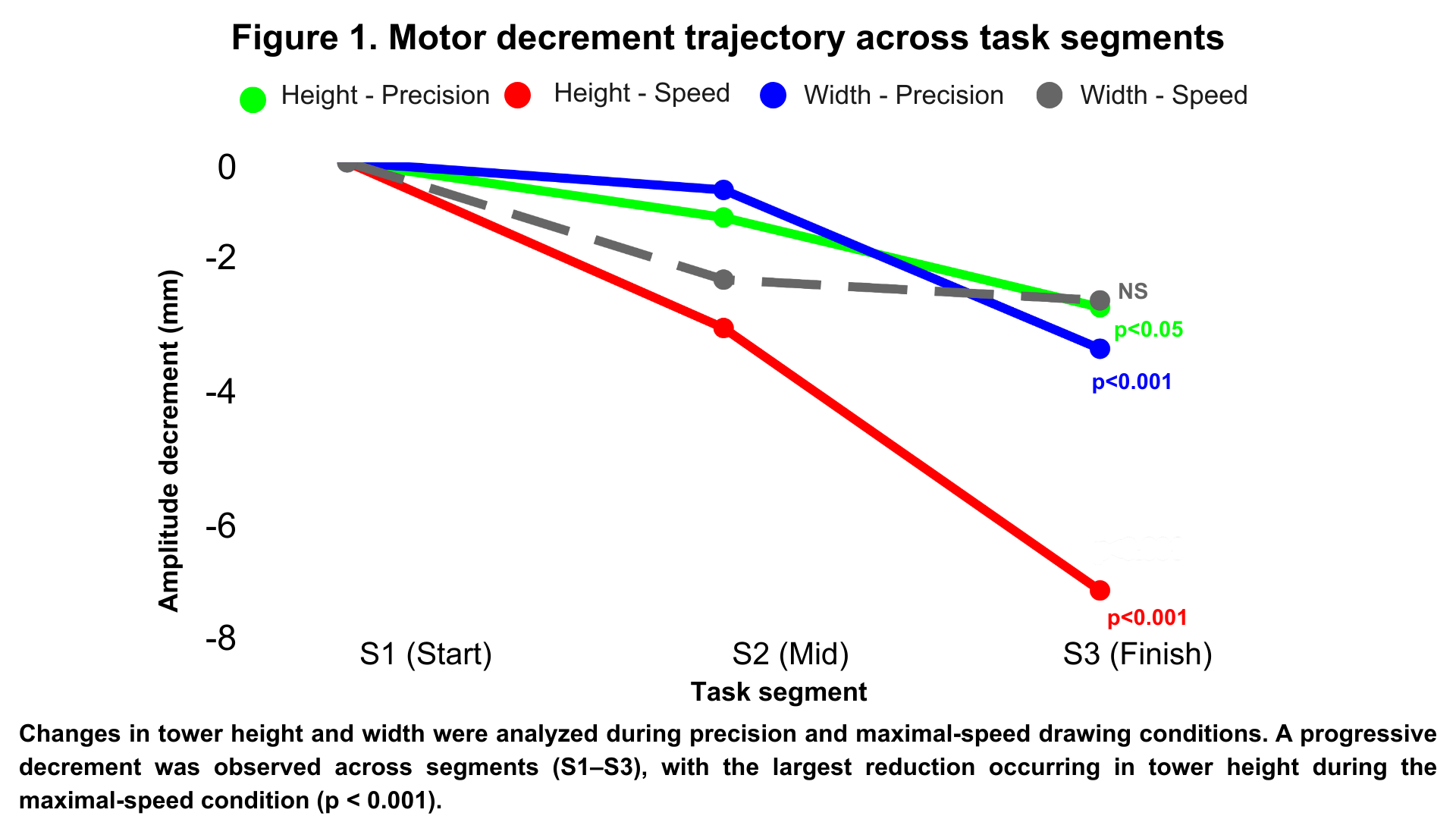
Figure 1
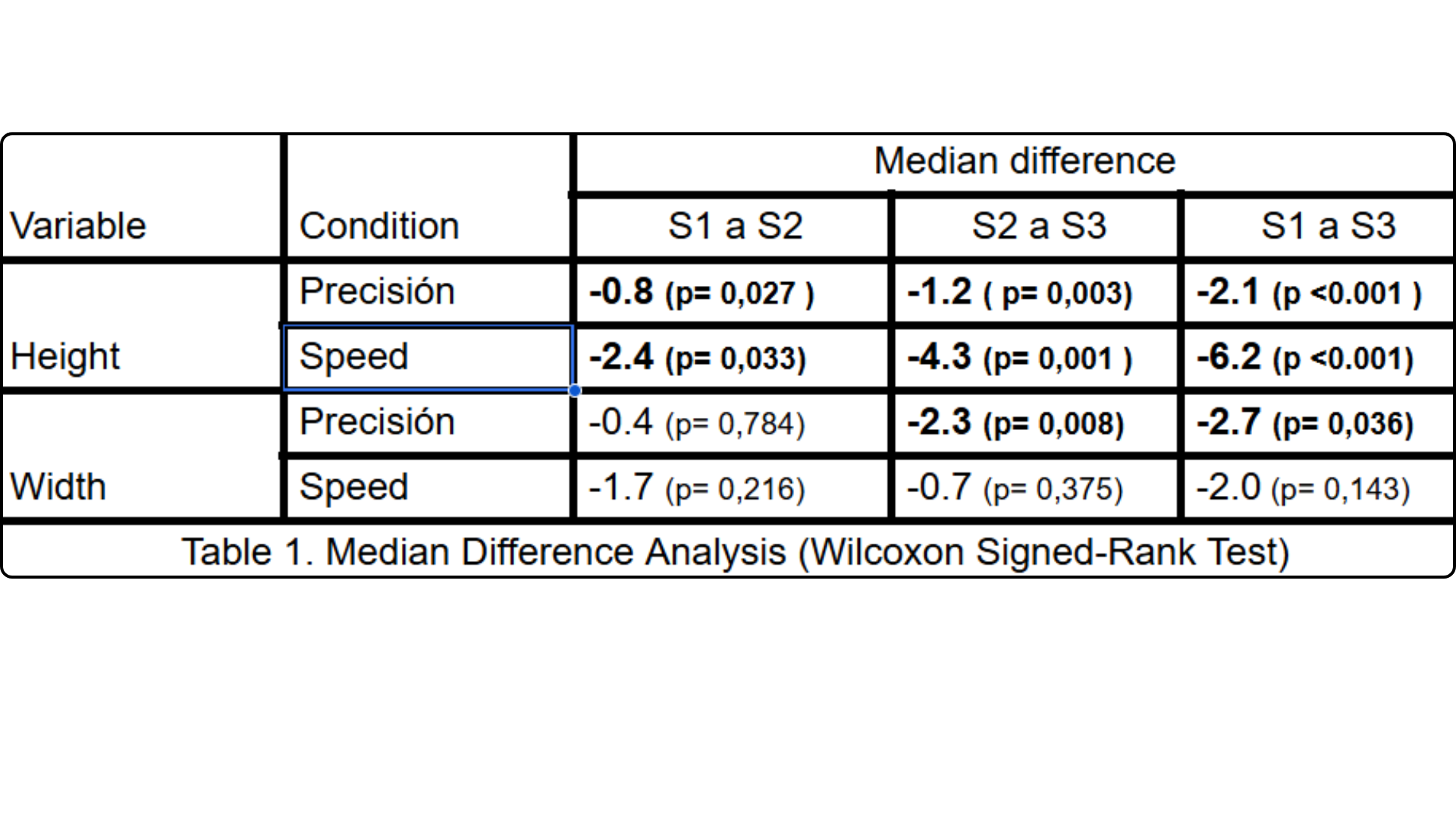
Table 1
References: 1- Armstrong MJ, Okun MS. Diagnosis and treatment of Parkinson disease: a review. JAMA 2020;323(6):548-560. doi:10.1001/jama.2019.
2- Simon DK, Tanner CM, Brundin P. Parkinson disease epidemiology, pathology, genetics, and pathophysiology. Clin Geriatr Med 2020;36(1): 1-12. doi:10.1016/j.cger.2019.08.002.
3- Bologna M, Paparella G, Fasano A, Hallett M, Berardelli A. Evolving concepts on bradykinesia. Brain 2020; 143(3): 727–750. https://doi.org/10.1093/brain/awz344 .
4-Goetz, C. G., Tilley, B. C., Shaftman, S. R., Stebbins, G. T., Fahn, S., Martinez-Martin, P., Poewe, W., Sampaio, C., Stern, M. B., Dodel, R., Dubois, B., Holloway, R., Jankovic, J., Kulisevsky, J., Lang, A. E., Lees, A., Leurgans, S., LeWitt, P. A., Nyenhuis, D., … LaPelle, N. (2008). Movement Disorder Society-sponsored revision of the Unified Parkinson’s Disease Rating Scale (MDS-UPDRS): Scale presentation and clinimetric testing results. Movement Disorders, 23(15), 2129–2170. https://doi.org/10.1002/mds.22340.
5-Postuma, R. B., Berg, D., Adler, C. H., Bloem, B. R., Chan, P., Deuschl, G., Gasser, T., Goetz, C. G., Halliday, G., Lang, A. E., Lewis, S. J., Li, Y., Marek, K., Litvan, I., Schapira, A. H., & Poewe, W. (2015). MDS clinical diagnostic criteria for Parkinson’s disease. Movement Disorders, 30(12), 1591-1601. https://doi.org/10.1002/mds.26424
To cite this abstract in AMA style:
S. Celi Aguilar, F. Ramos, F. Echeverria, T. Arakaki, S. Rodriguez Quiroga, N. Garretto. The “Guarda” (Tower) Drawing Test: A Novel Bedside Tool to Quantify Bradykinesia in Parkinson’s Disease [abstract]. Mov Disord. 2026; 41 (suppl 1). https://www.mdsabstracts.org/abstract/the-guarda-tower-drawing-test-a-novel-bedside-tool-to-quantify-bradykinesia-in-parkinsons-disease/. Accessed October 1, 2026.« Back to 2026 International Congress
MDS Abstracts - https://www.mdsabstracts.org/abstract/the-guarda-tower-drawing-test-a-novel-bedside-tool-to-quantify-bradykinesia-in-parkinsons-disease/