
Category: Parkinsonism (Other)
Objective: To characterise FDG-PET metabolic phenotypes in idiopathic normal pressure hydrocephalus (iNPH) using integrated visual and voxel-wise analyses.
Background: iNPH is a potentially treatable cause of gait impairment and a heterogeneous syndrome that overlaps clinically and radiologically with neurodegenerative disorders (ND). How ND-like metabolic patterns present within iNPH remains incompletely defined.
Method: We retrospectively analysed 50 adults (mean age 72.0 ± 7.5 years) with gait impairment and ventriculomegaly, defined by disproportionately enlarged subarachnoid-space hydrocephalus, Evans Index >0.30, and callosal angle <90°. Clinical phenotyping integrated longitudinal neurological and cognitive assessments, brain magnetic resonance imaging, cerebrospinal fluid biomarkers when available to support etiological classification, and dopaminergic imaging as indicated (Tables 1–3). Baseline FDG-PET underwent blinded visual interpretation by an experienced nuclear medicine specialist. Voxel-wise analyses were performed in Statistical Parametric Mapping (SPM) on spatially and intensity-normalised images. Group comparisons used independent-sample t-tests and ANOVA at voxel-level p<0.005; maps were projected onto a T1-weighted template.
Results: Visual reads showed canonical ND patterns: progressive supranuclear palsy (PSP) frontoparietal/subcortical hypometabolism; Alzheimer’s disease (AD) parietotemporal/posterior cingulate involvement; dementia with Lewy bodies (DLB) parieto-occipital hypometabolism with cingulate island preservation; and frontotemporal dementia (FTD) frontotemporal deficits. Within iNPH, the predominant visual phenotype was bilateral frontoparietal hypometabolism,with less frequent subcortical involvement (Figure 1). Voxel-wise comparisons demonstrated relative metabolic preservation in iNPH versus PSP (ventromedial frontal regions/basal ganglia), versus AD (medial temporal cortices), versus DLB (posterior cortices), and versus FTD/Parkinson’s disease (cerebellar vermis) (p<0.005) (Figure 2).
Conclusion: Integrated visual and voxel-wise FDG-PET reveals metabolic heterogeneity within iNPH and supports early metabolic phenotyping and clinical characterisation in ventriculomegaly.
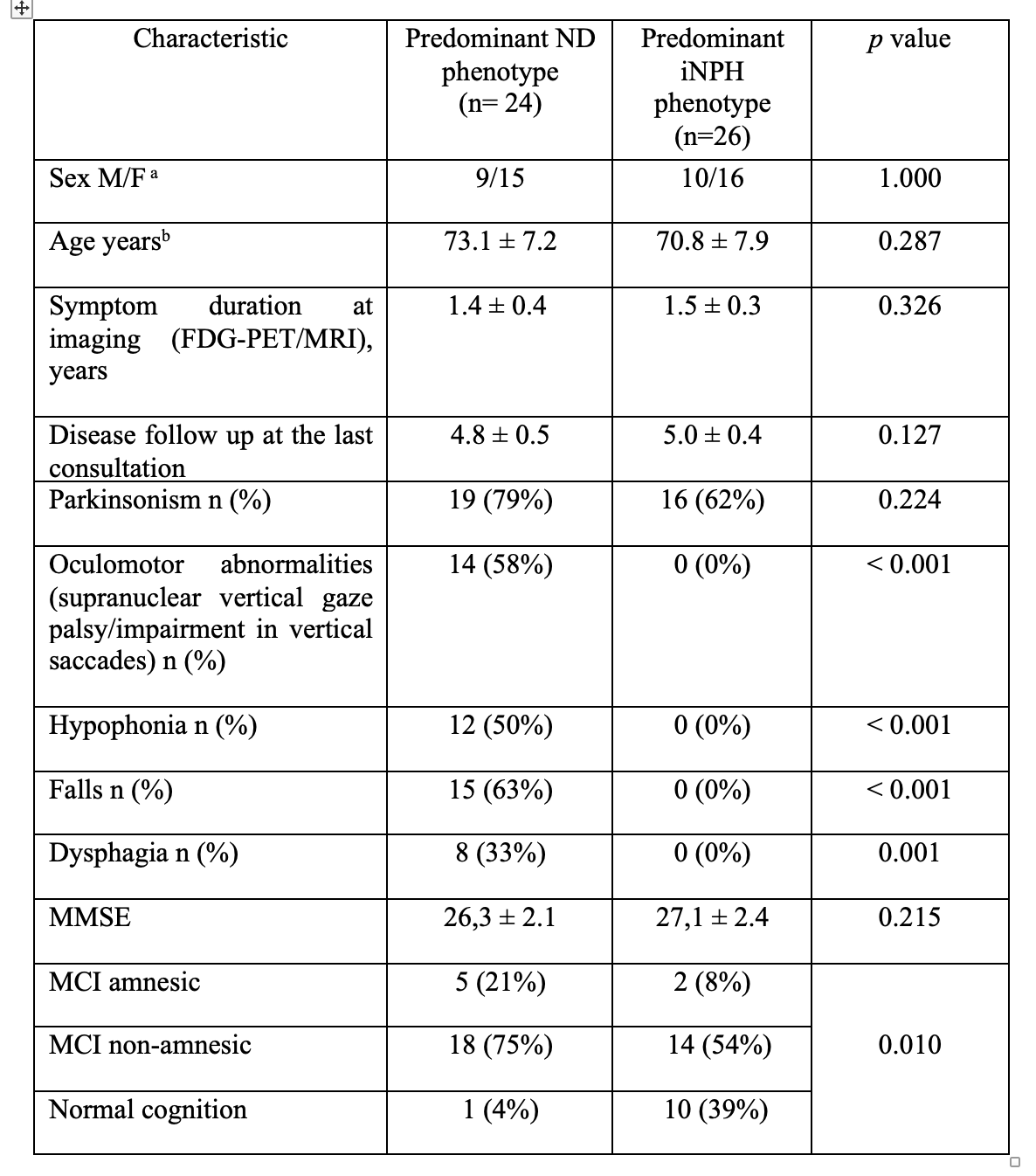
Cohort demographic and clinical features
![[18F]-dopa PET and L-dopa response](https://www.mdsabstracts.org/wp-content/uploads/2026/09/0988_1474_000539_2.png)
[18F]-dopa PET and L-dopa response
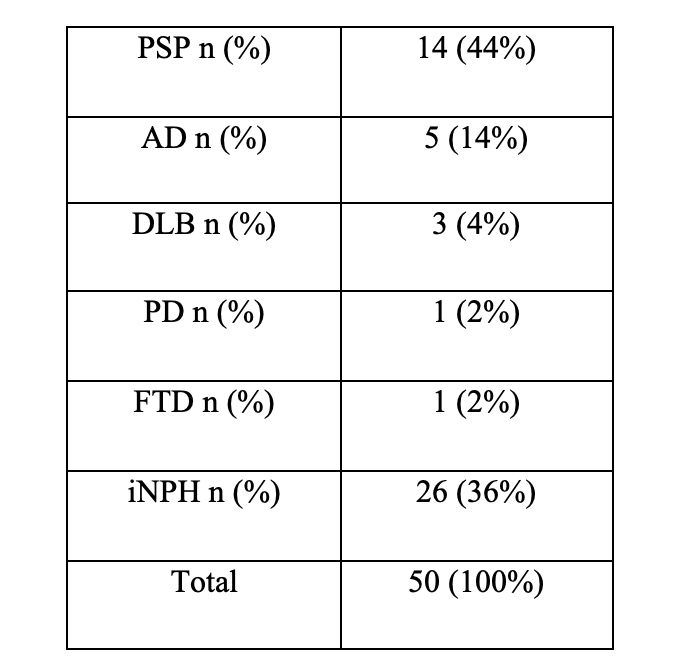
Final clinical diagnosis in the study cohort
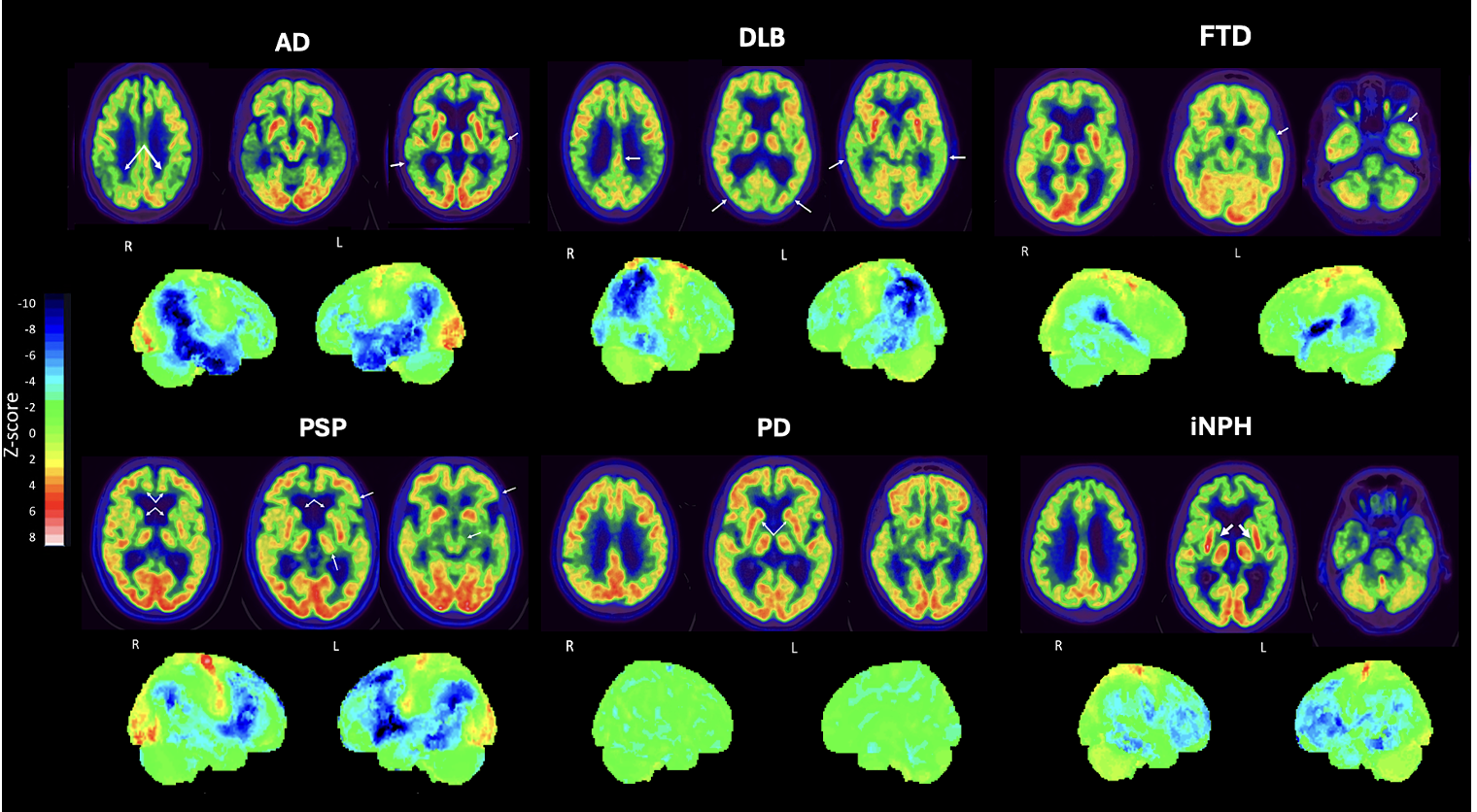
Visual FDG-PET metabolic patterns across groups
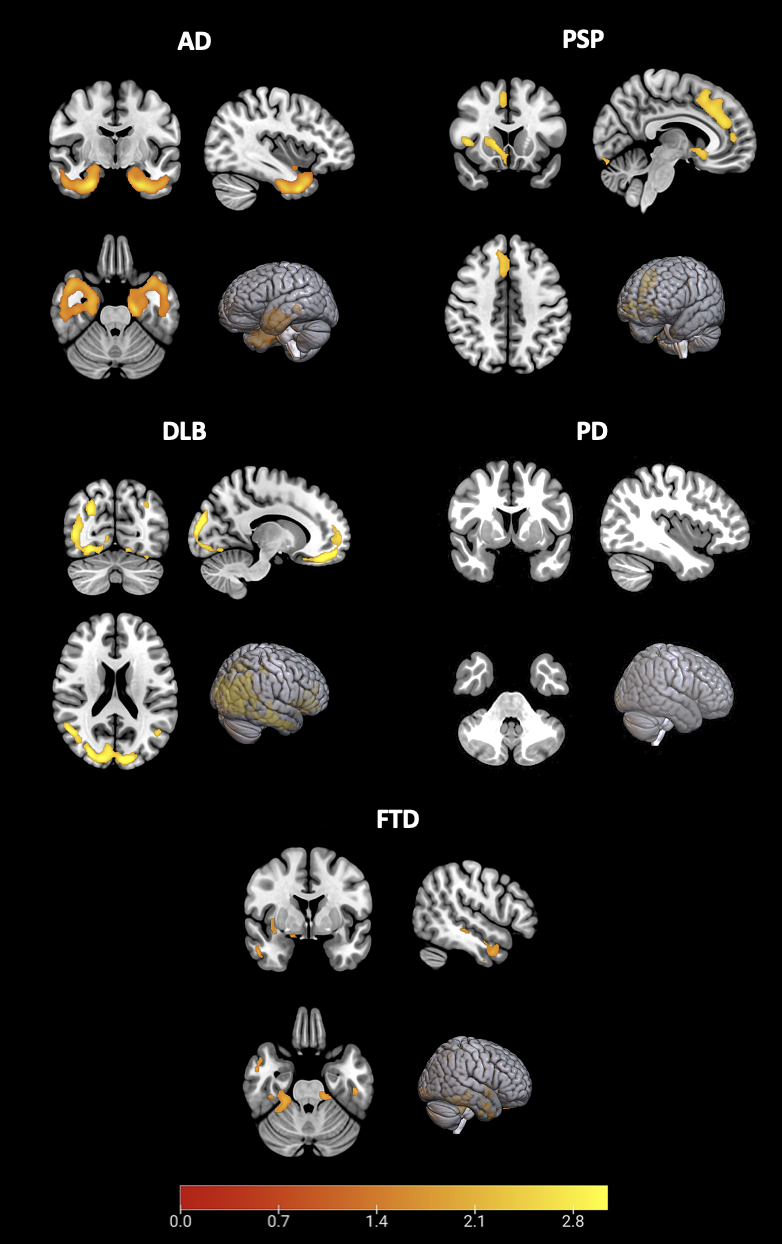
Voxel-wise FDG-PET patterns across groups
References: 1. Townley RA, Botha H, Graff-Radford J, Boeve BF, Petersen RC, Senjem ML, Knopman DS, Lowe V, Jack CR Jr, Jones DT. 18F-FDG PET-CT pattern in idiopathic normal pressure hydrocephalus. Neuroimage Clin. 2018 Feb 28;18:897-902. doi: 10.1016/j.nicl.2018.02.031.
2. Rau A, Schröter N, Blazhenets G, Maurer C, Urbach H, Meyer PT, Frings L. The metabolic spatial covariance pattern of definite idiopathic normal pressure hydrocephalus: an FDG PET study with principal components analysis. Alzheimers Res Ther. 2023 Nov 18;15(1):202. doi: 10.1186/s13195-023-01339-x.
3. Miyazaki K, Hanaoka K, Kaida H, Chiba Y, Ishii K. Changes in cerebral glucose metabolism caused by morphologic features of prodromal idiopathic normal pressure hydrocephalus. EJNMMI Res. 2019 Dec 16;9(1):111. doi: 10.1186/s13550-019-0573-y.
To cite this abstract in AMA style:
C. Espinoza-Vinces, E. Prieto-Azcárate, I. Avilés-Olmos, J. Núñez-Córdoba, J. Arbizu, M. Luquin. [18F]-FDG-PET metabolic phenotyping in idiopathic normal pressure hydrocephalus: visual and voxel-wise evidence across neurodegenerative phenotypes [abstract]. Mov Disord. 2026; 41 (suppl 1). https://www.mdsabstracts.org/abstract/18f-fdg-pet-metabolic-phenotyping-in-idiopathic-normal-pressure-hydrocephalus-visual-and-voxel-wise-evidence-across-neurodegenerative-phenotypes/. Accessed October 1, 2026.« Back to 2026 International Congress
MDS Abstracts - https://www.mdsabstracts.org/abstract/18f-fdg-pet-metabolic-phenotyping-in-idiopathic-normal-pressure-hydrocephalus-visual-and-voxel-wise-evidence-across-neurodegenerative-phenotypes/