
Category: Parkinson’s Disease: Clinical Trials
Objective: To evaluate the association between Local Field Potential (LFP) sensing use and patient outcomes (EuroQol 5-Dimensions (EQ5D), medications), as well as device-related outcomes by Total Electrical Energy Delivered (TEED) using data from a multicenter, real-world Deep Brain Stimulation (DBS) registry.
Background: LFP sensing enables personalization of DBS stimulation programming. Optimizing stimulation parameters influences TEED, reflecting stimulation efficiency. By identifying optimal stimulation settings (amplitude, frequency, pulse width), DBS provides clinical benefit, including improved patient‑reported outcomes, while minimizing power consumption in both rechargeable and non‑rechargeable DBS systems.
Method: Available TEED, EQ5D by LFP status data from 466 patients (age: 64.7(10.91); sex: 203-F; disease duration: 12.0(7.8)) years) enrolled in a prospective, multisite registry (May 2020–Oct 2025) up to 12 months following neurostimulator implant (initial implant 79%, replacement 21%) were analyzed.
Results: TEED measured by LFP sensing status using non-rechargeable neurostimulators at 6 and 12 months following the neurostimulator implant was reported. A statistically significant TEED reduction was shown at 6 months postimplant when LFP is “On” vs LFP “Off” groups (106.6 vs.159.9, p=0.03) and at 12 months (102.1 vs 191.1, p<0.01) [table1]). The results from Linear mixed model showed a TEED decreased by approximately 27% (95% CI: 2 – 58%), and 48% (95% CI: 18 – 85%), at 6, and 12 months, respectively, when LFP sensing was “On” versus “Off”. TEED increased from 6 to 12 months, with lower mean TEED at both time points when LFP sensing was “On” vs “Off” [Figure 1].
Patient‑reported outcomes demonstrated a significant improvement in EQ‑5D index scores [Table 2] from baseline to 6 months when comparing LFP “On” vs LFP “Off” groups (0.15 [0.00, 0.24] vs 0.03 [-0.17, 0.17]; p=0.0062). No clear between‑group difference was observed at the 12‑month follow‑up.
Conclusion: In this large real‑world registry, use of LFP sensing during DBS therapy was associated with lower energy delivery and improved clinical outcomes. At 6 months, LFP sensing guided stimulation was associated with significantly reduced TEED and greater improvement in EQ5D. These findings support the clinical value of LFP sensing‑guided DBS programming in routine clinical practice.
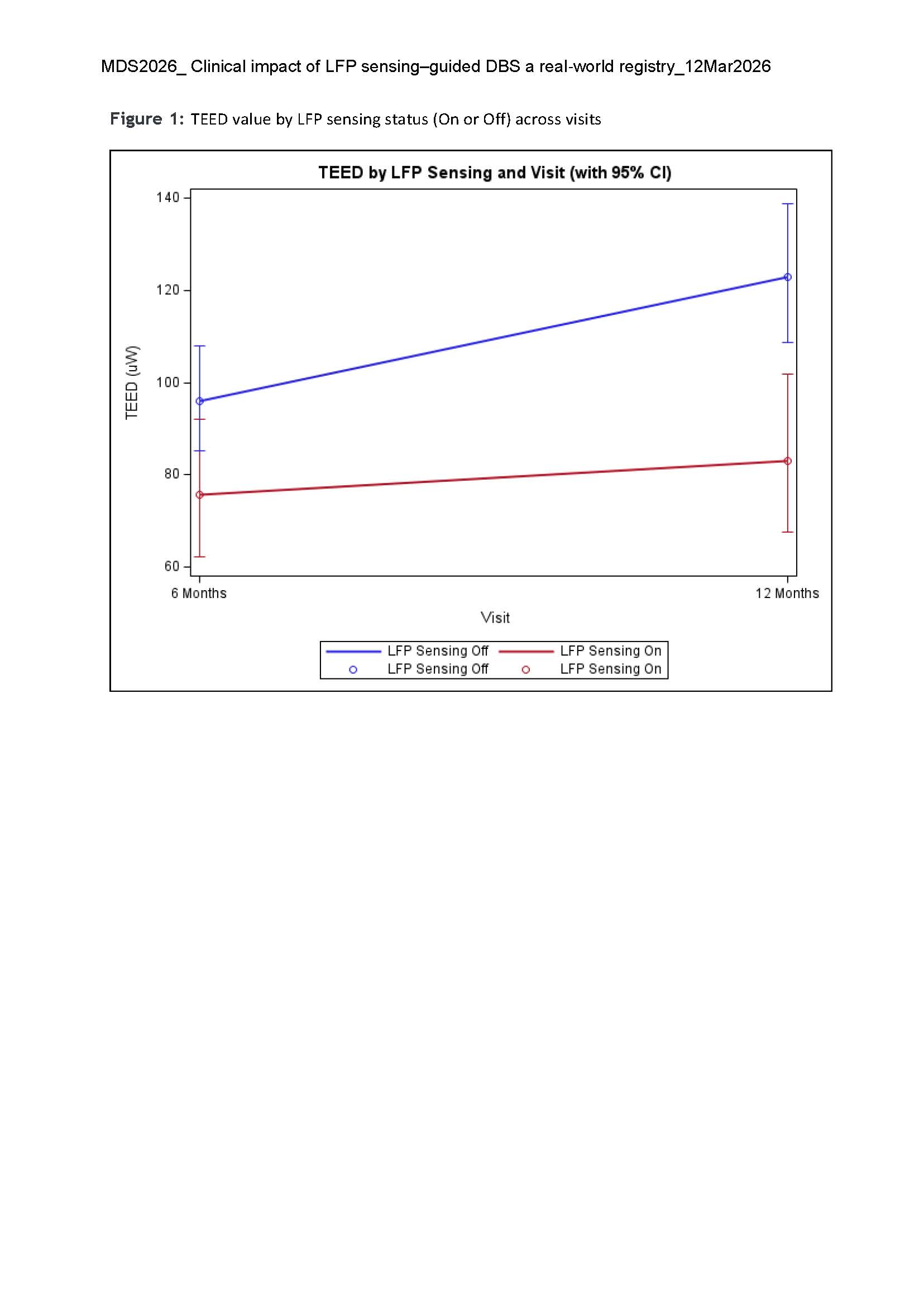
Figure 1
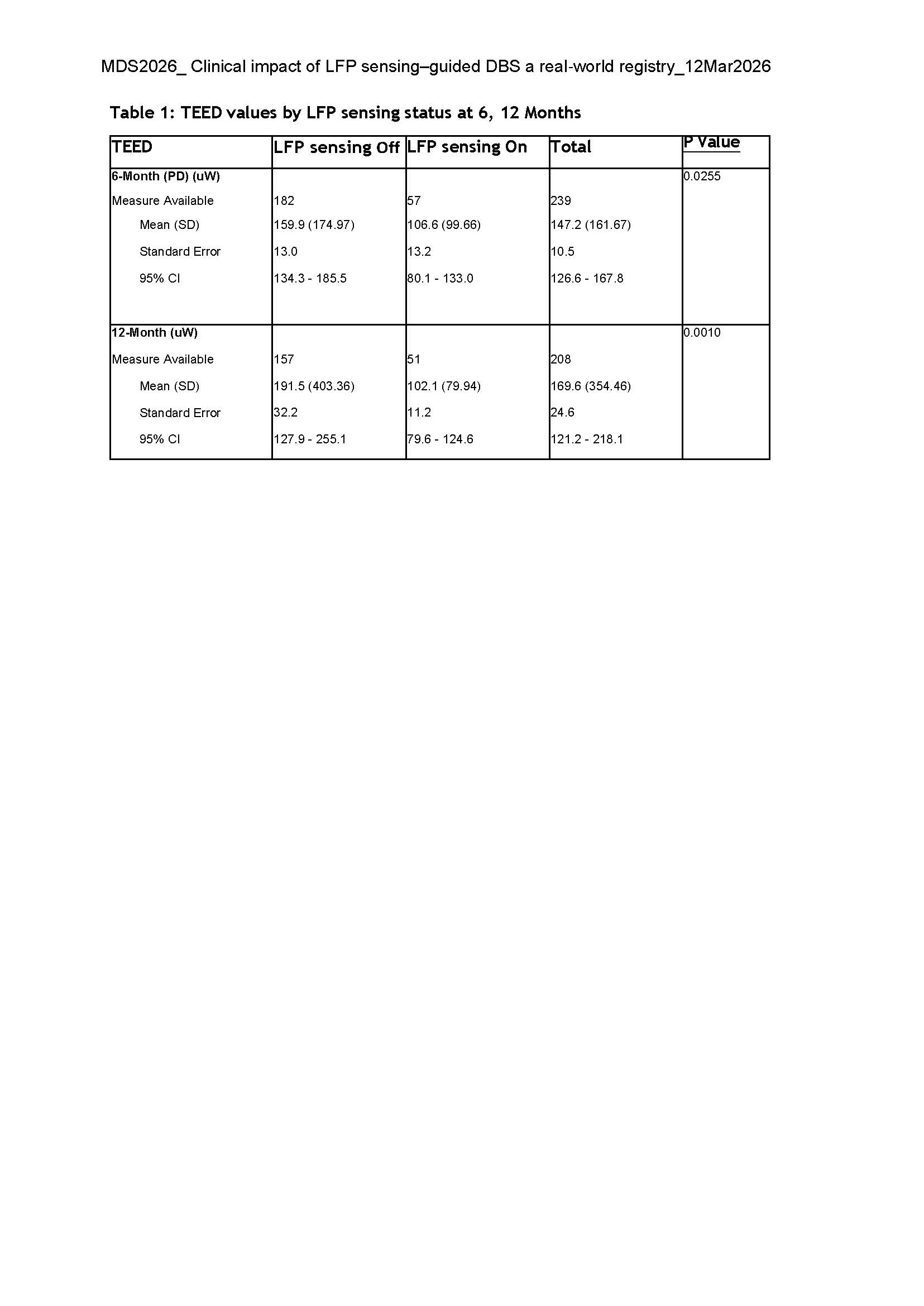
Table 1
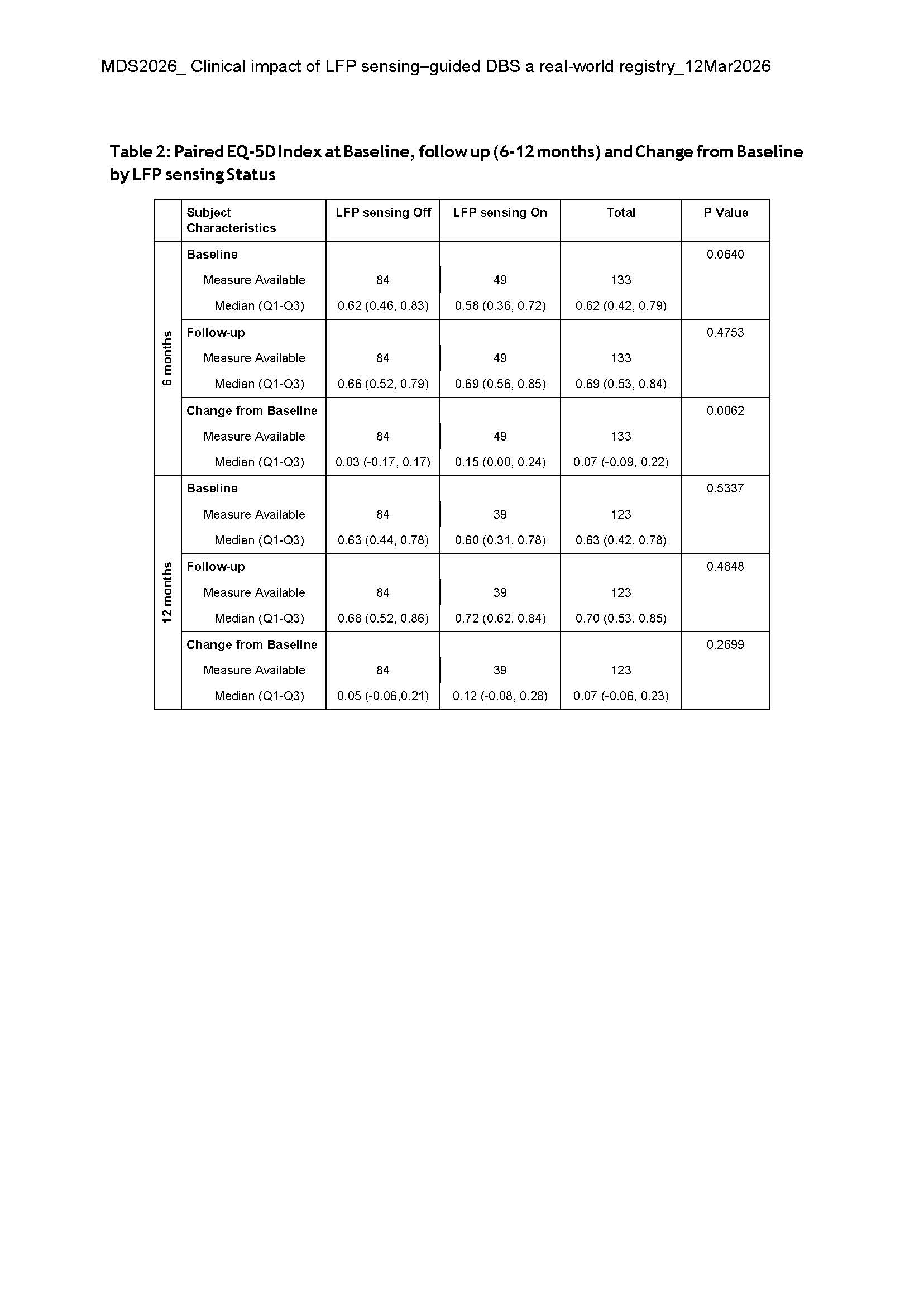
Table 2
To cite this abstract in AMA style:
J. Youn, S. Bick, P. Konrad, M. Schiess, T. Theys, T. Witt, H. Mure, H. Oshima, K. Kimura, G. Oyama, H. Kishima, N. Murase, Y. Tsuboi, A. Fasano, T. Brionne, I. Buffin, G. Choi, X. Sun, Y. Ren, T. Weaver. Clinical impact of local field potential sensing–guided deep brain stimulation: a real‑world registry [abstract]. Mov Disord. 2026; 41 (suppl 1). https://www.mdsabstracts.org/abstract/clinical-impact-of-local-field-potential-sensing-guided-deep-brain-stimulation-a-real-world-registry/. Accessed October 1, 2026.« Back to 2026 International Congress
MDS Abstracts - https://www.mdsabstracts.org/abstract/clinical-impact-of-local-field-potential-sensing-guided-deep-brain-stimulation-a-real-world-registry/