
Category: Parkinsonism (Other)
Objective: To characterise cognitive severity and domain-specific profiles in patients with idiopathic normal pressure hydrocephalus (iNPH) and to examine the impact of coexisting neurodegeneration.
Background: iNPH is a potentially treatable cause of gait impairment. However, coexisting neurodegenerative disorders (ND) are increasingly recognised and may generate overlapping cognitive phenotypes, complicating diagnostic interpretation.
Method: We retrospectively analysed 60 age-comparable patients with ventriculomegaly and gait impairment who underwent comprehensive, standardised neuropsychological assessment. Baseline demographic and clinical characteristics are summarised in Table 1. Global cognition was assessed using the MMSE. Domain-specific performance was systematically evaluated across episodic memory (free and total recall), attention, executive function, language, and visuoconstruction. Cognitive status was classified as normal cognition, amnestic MCI (aMCI), or non-amnestic MCI (naMCI) based on domain-level impairment. Following multidisciplinary diagnostic review integrating clinical, imaging, biomarker and tap test data, patients were classified as probable iNPH or as having coexisting ND (progressive supranuclear palsy, Alzheimer’s disease, dementia with Lewy bodies, frontotemporal dementia, or Parkinson’s disease) (Table 2).
Results: Patients with iNPH without ND showed higher global cognition (MMSE 27.8 ± 2.0 vs 26.2 ± 1.7; p=0.001) and better episodic memory (both p<0.001) and visuoconstruction (p=0.01). Other domains did not differ significantly (Table 3). Subgroup cognitive profiles are detailed in Table 4. naMCI predominated in ND, whereas normal cognition was more frequent in iNPH (Table 5).
Conclusion: In ventriculomegaly with gait impairment, coexisting ND is associated with greater cognitive severity, while iNPH shows relative preservation of episodic memory, supporting distinct yet overlapping phenotypes and the clinical value of cognitive stratification.
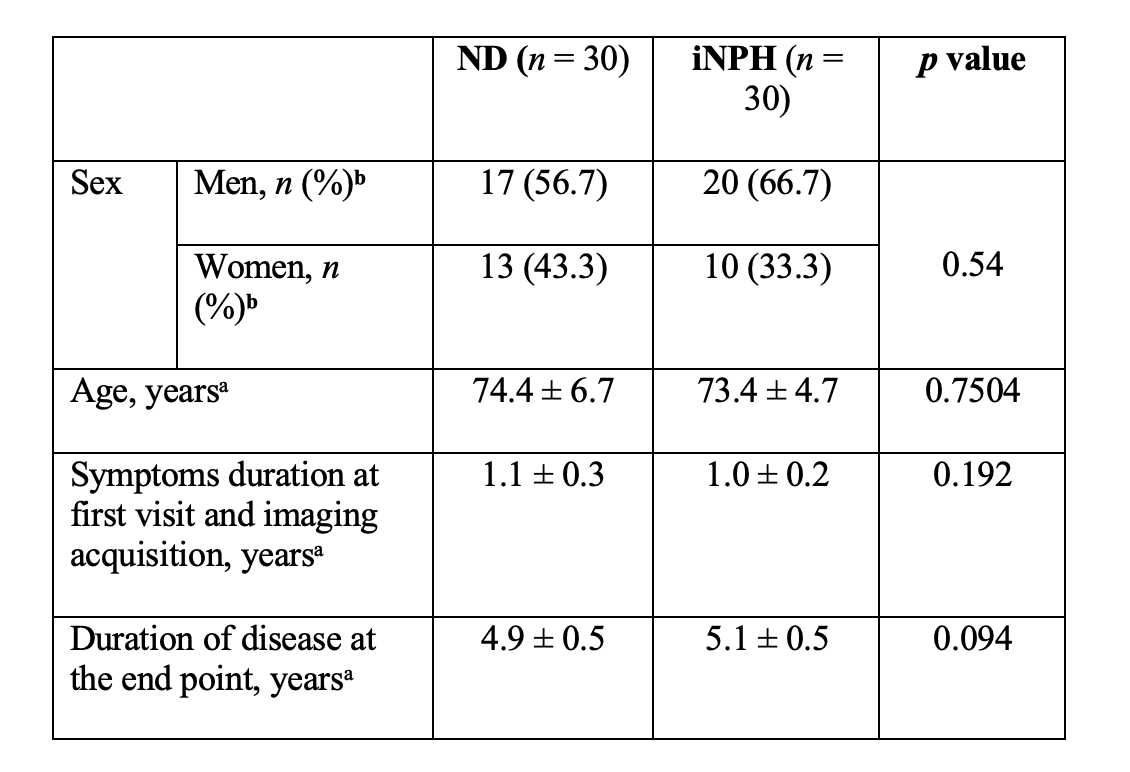
Demographic and Clinical Features in Cohort
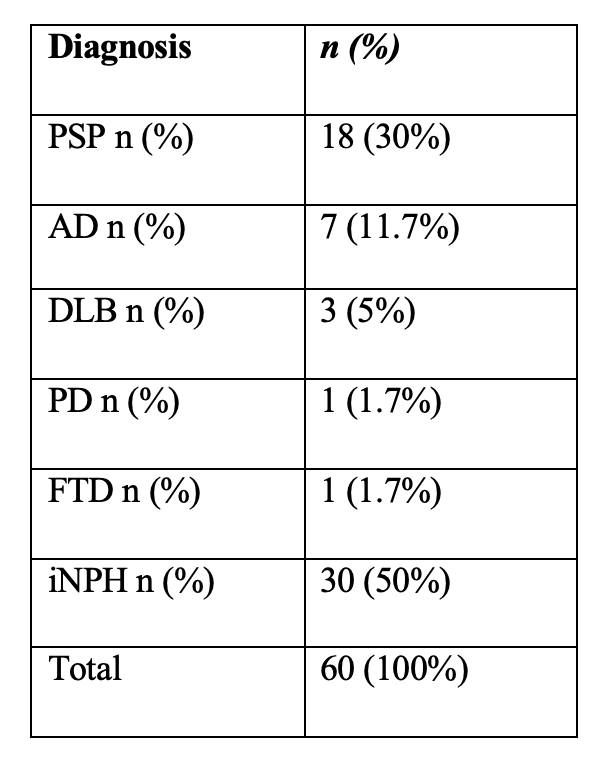
Final clinical diagnosis in the study cohort
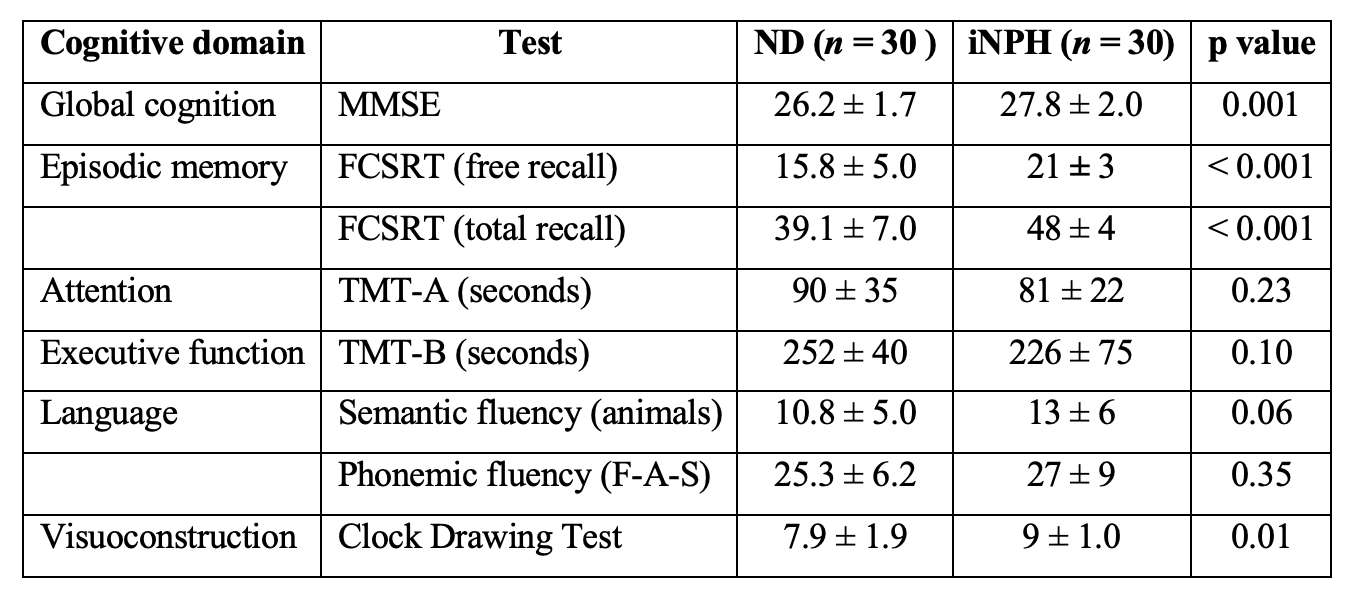
Cognitive Domain Performance by Diagnosis
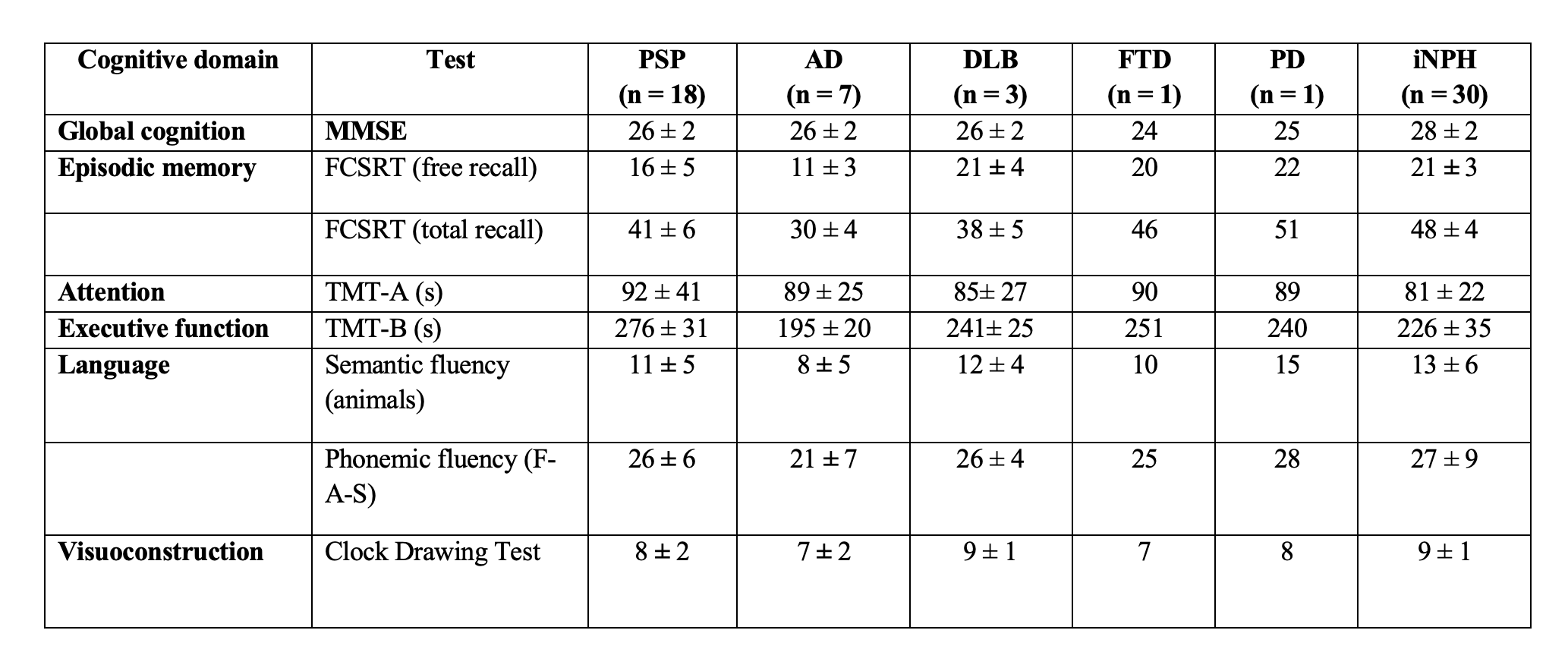
Cognitive Profiles by Specific Diagnosis
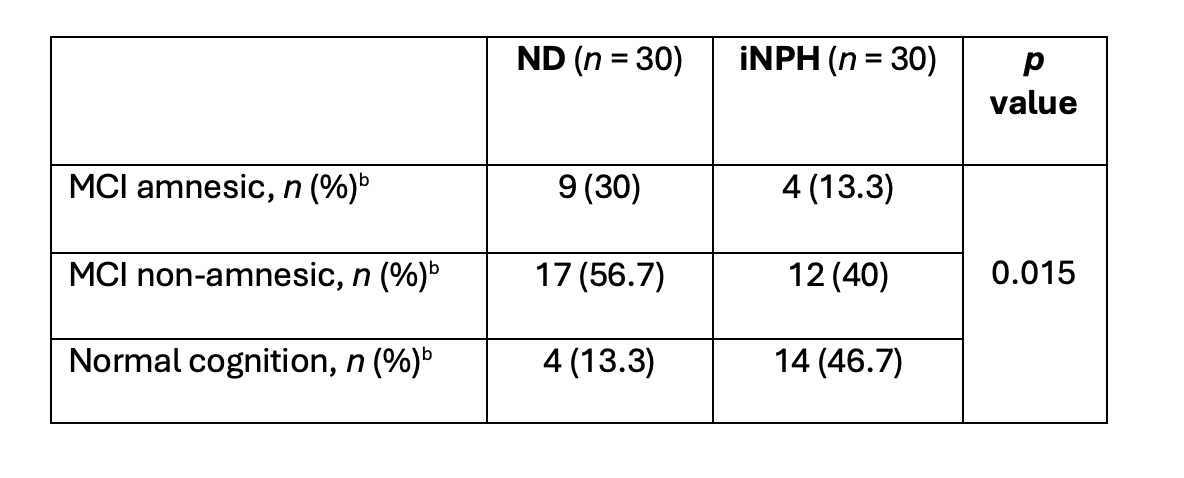
Cognitive Status Stratification by Group
References: 1. Bluett, B., Acosta, L. M., Ash, E., Bloem, B. R., Espay, A. J., Farheen, A., Fasano, A., Higinbotham, A., Krauss, J. K., Lang, A. E., Mostile, G., Aviles-Olmos, I., Quattrone, A., Tipton, P. W., & Tang-Wai, D. F. (2025). Standardizing the large-volume “tap test” for evaluating idiopathic normal pressure hydrocephalus: A systematic review. Journal of Neurosurgical Sciences, 69(1), 46–63. https://doi.org/10.23736/S0390-5616.24.06368-9
2. Klemke, L. L., Schmitz, K. M., Kolman, A., & Seitz, R. J. (2023). Evolution of neurodegeneration in patients with normal pressure hydrocephalus: A monocentric follow-up study. Neurological Research and Practice. https://doi.org/10.1186/s42466-023-00272-6
3. Nakajima, M., Yamada, S., Miyajima, M., Ishii, K., Kuriyama, N., Kazui, H., Kanemoto, H., Suehiro, T., Yoshiyama, K., Kameda, M., Kajimoto, Y., Mase, M., Murai, H., Kita, D., Kimura, T., Samejima, N., Tokuda, T., Kaijima, M., Akiba, C., Kawamura, K., … Research Committee of Idiopathic Normal Pressure Hydrocephalus. (2021). Guidelines for management of idiopathic normal pressure hydrocephalus (third edition). Neurologia Medico-Chirurgica, 61(2), 63–97. https://doi.org/10.2176/nmc.st.2020-0292
4. Yasar, S., & Tullberg, M. (2025). Hakim’s disease: An update on idiopathic normal pressure hydrocephalus. Journal of Neurosurgical Sciences, 69(1), 4–19. https://doi.org/10.23736/S0390-5616.25.06365-9.
To cite this abstract in AMA style:
C. Espinoza-Vinces, I. Avilés-Olmos, G. Montoya-Murillo, J. Núñez-Córdoba, M. Luquin. Cognitive profiles in idiopathic normal pressure hydrocephalus: clinical patterns and the impact of coexisting neurodegeneration [abstract]. Mov Disord. 2026; 41 (suppl 1). https://www.mdsabstracts.org/abstract/cognitive-profiles-in-idiopathic-normal-pressure-hydrocephalus-clinical-patterns-and-the-impact-of-coexisting-neurodegeneration/. Accessed October 1, 2026.« Back to 2026 International Congress
MDS Abstracts - https://www.mdsabstracts.org/abstract/cognitive-profiles-in-idiopathic-normal-pressure-hydrocephalus-clinical-patterns-and-the-impact-of-coexisting-neurodegeneration/