
Category: Parkinson's disease: Neuroimaging
Objective: To non-invasively characterise cortical oscillatory activity in Parkinson’s disease (PD), with high spatial resolution, during a turning task, and to compare sensorimotor dynamics between PD and healthy controls (HC) during different stages of movement.
Background: PD is commonly associated with gait impairment, including instability and freezing, which contributes to falls risk and loss of independence. Whilst cortical oscillatory activity reflects subcortical changes, non-invasive cortical recording offers a window into the neurophysiology of movement in PD that does not require surgical implantation and is therefore available to the broader PD population. Electroencephalography is commonly used to assess neuronal activity during gait but is limited by low spatial resolution, and susceptibility to muscle artefacts. Conventional MEG offers improved spatial resolution but restricts participants to static postures. Optically pumped magnetometer-magnetoencephalography (OPM-MEG) overcomes both limitations, providing high resolution cortical recording during complex movements such as walking and turning.
Method: We collected OPM-MEG data from 15 patients with PD and 12 age-matched HC using a 192-channel system. Participants completed 32 single-task trials of a turning task (90° left or right), with motion capture defining movement onset and offset. Beta band oscillatory modulation was localised using a beamformer approach, and group differences were assessed using Wilcoxon rank-sum tests.
Results: All participants successfully completed the task. Beta modulation localised to the sensorimotor network in both PD and HC. Significant differences between PD and HC, in beta power (p<0.05) and theta power (p<0.05) during standing were detected. During movement, PD patients showed a 20% lower beta power reduction (p<0.05) compared with HC.
Conclusion: This is the first study to non-invasively characterise beta oscillatory activity during a naturalistic turning task in PD, with high spatial and temporal resolution. Attenuated beta desynchronisation during movement, alongside altered beta and theta power on standing, provides neurophysiological insight into the cortical mechanisms underlying gait impairment in PD. These findings extend prior observations from simple motor tasks to ecologically validate whole-body movement and support the potential of OPM-MEG as a tool for studying cortical dysfunction in movement disorders.
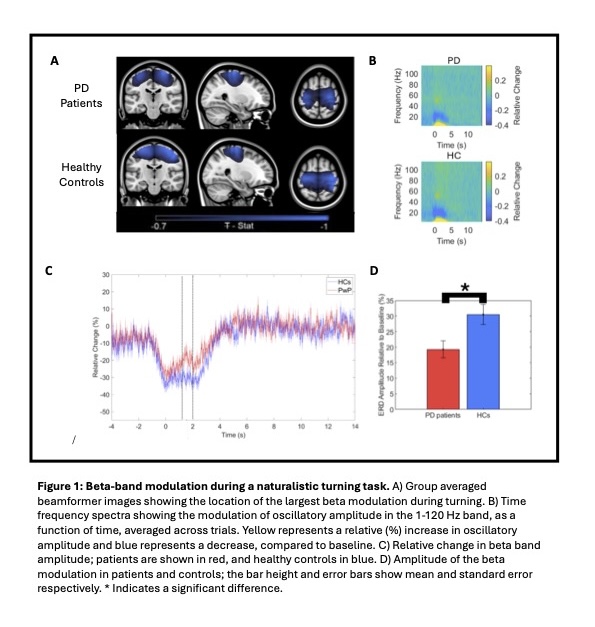
Figure 1
To cite this abstract in AMA style:
P. Sharma, B. Sanders, C. Gilmartin, L. Rier, L. Gascoyne, J. Leggett, I. Tu, M. Dabbagh, H. Pai, L. Eriamietor, N. Holmes, R. Hill, E. Boto, A. Hibbert, H. Schofield, K. Mullinger, K. Radford, A. Fasano, M. Brookes, N. Evangelou. Cortical Oscillatory Dynamics during Turning in Parkinson’s Disease using OPM-MEG [abstract]. Mov Disord. 2026; 41 (suppl 1). https://www.mdsabstracts.org/abstract/cortical-oscillatory-dynamics-during-turning-in-parkinsons-disease-using-opm-meg/. Accessed October 1, 2026.« Back to 2026 International Congress
MDS Abstracts - https://www.mdsabstracts.org/abstract/cortical-oscillatory-dynamics-during-turning-in-parkinsons-disease-using-opm-meg/