
Category: Parkinson's disease: Neuroimaging
Objective: To explore changes in global BOLD (gBOLD) signal and cerebrospinal fluid flow (CSF) coupling in isolated REM sleep behavior disorder (iRBD) as a Magnetic Resonance Imaging (MRI) proxy of glymphatic function and its association with Non-Motor symptoms (NMS).
Background: Impaired glymphatic clearance may contribute to protein aggregation in neurodegeneration [1]. MRI measures -such as diffusion tensor imaging along the perivascular space (DTI-ALPS) index, choroid plexus volume (CPV), perivascular spaces (PVS), and free water in white matter (FW-WM)- have been proposed as indirect proxies to assess glymphatic function [2]. Recently, gBOLD-CSF coupling has been proposed as a potential proxy of glymphatic activity [3], shown to be reduced in Parkinson’s disease [4], but unexplored in prodromal stages.
Method: Fifty-seven patients with iRBD and thirty-eight healthy controls (HC) underwent clinical and MRI assessment. T1-weighted, FLAIR, resting-state functional MRI and diffusion-weighted sequences were acquired to compute CPV, DTI-ALPS, FW-WM, PVS and gBOLD-CSF coupling. Coupling was defined as the maximum anticorrelation of the gBOLD-CSF cross-correlation (-10s,10s) [3]. NMS scale was assessed to obtain total and domain scores (Gastrointestinal, Urinary, Sexual function, Cardiovascular, Apathy/Attention/Memory, Perceptual/Hallucinatory, Depression/Anxiety/Anhedonia, Sleep/Fatigue, and Miscellaneous). Group differences were adjusted by sex, and correlations for age and sex.
Results: Patients with iRBD exhibited higher scores in most NMS domains (Table 1), along with reduced DTI-ALPS and gBOLD-CSF coupling with respect to HC (Table 2, Figure 1).
gBOLD-CSF coupling correlated negatively with total NMS score, Depression/Anxiety/Anhedonia and cardiovascular domain scores. In addition, a significant correlation was observed between the DTI‑ALPS index and Miscellaneous score (Figure 2). No association was found between the significant MRI glymphatic proxies.
Conclusion: Our findings show abnormal gBOLD–CSF coupling in iRBD, suggesting that glymphatic clearance processes are already disrupted at the prodromal stage. Moreover, gBOLD-CSF coupling was associated with NMS, supporting its potential as a biomarker of early α‑synucleinopathy‑related dysfunction. Future studies are needed to clarify its relationship with disease progression and neurodegeneration biomarkers.
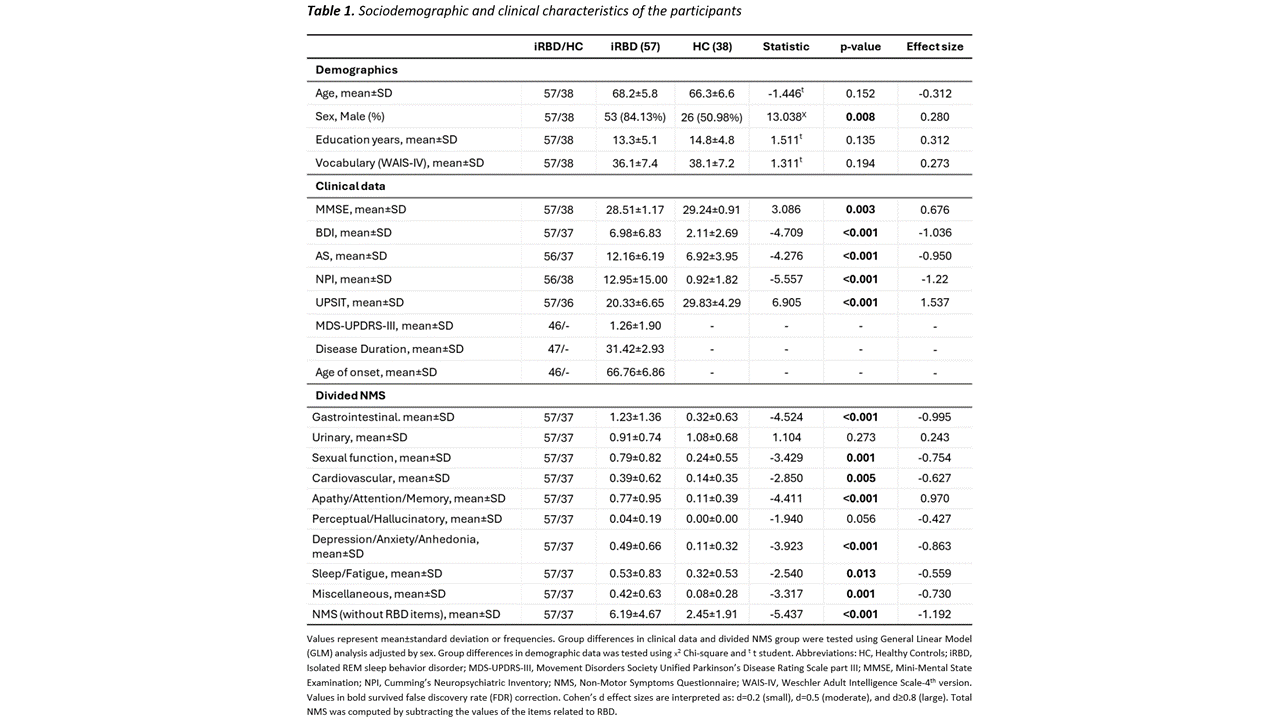
Table 1
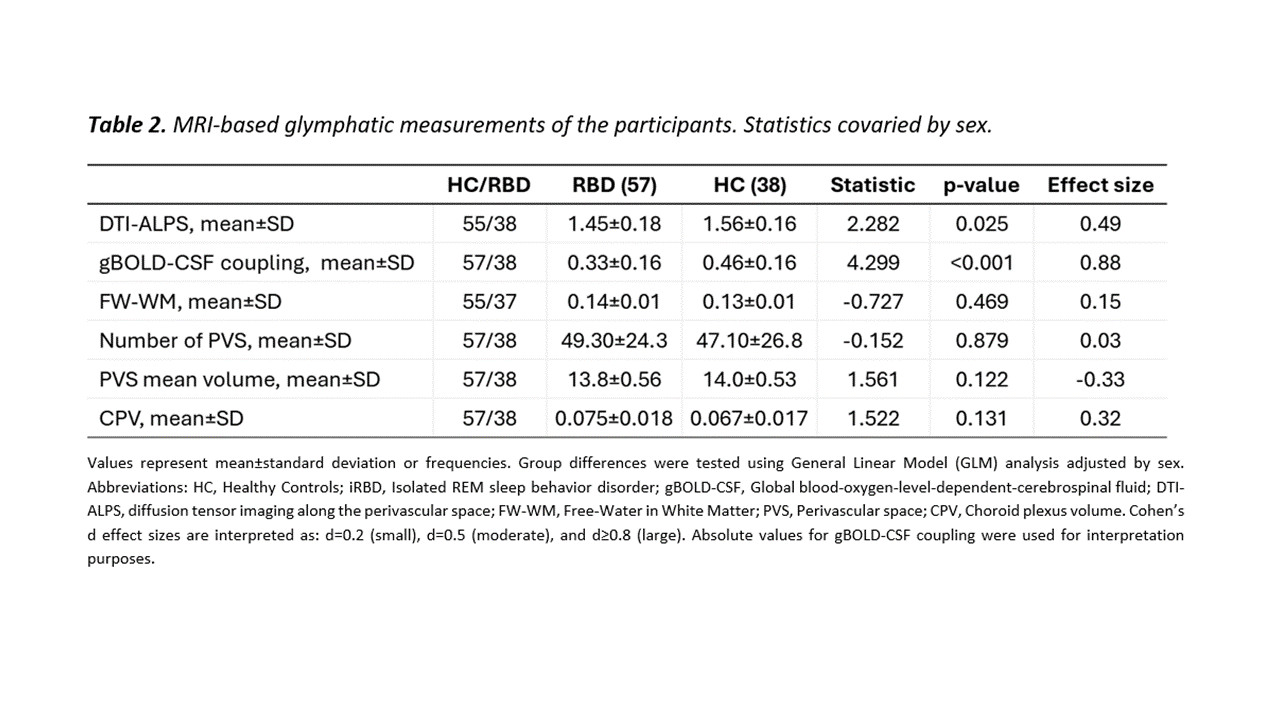
Table 2
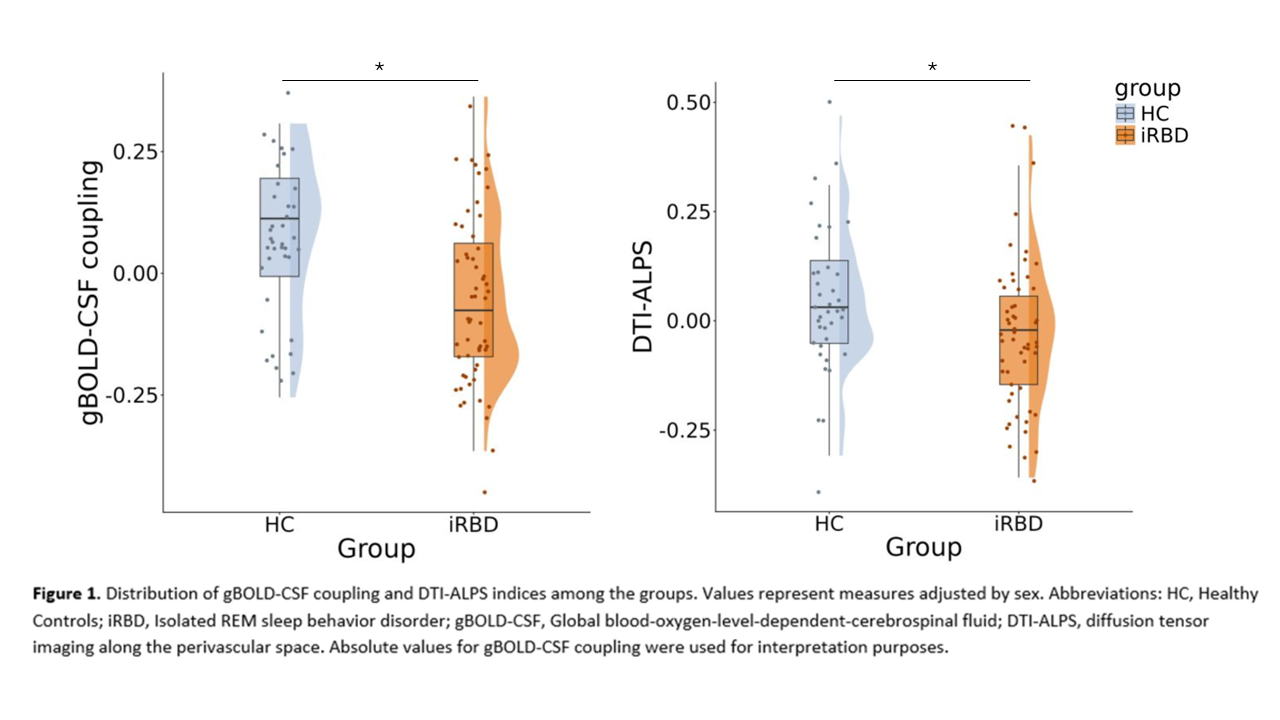
Figure 1
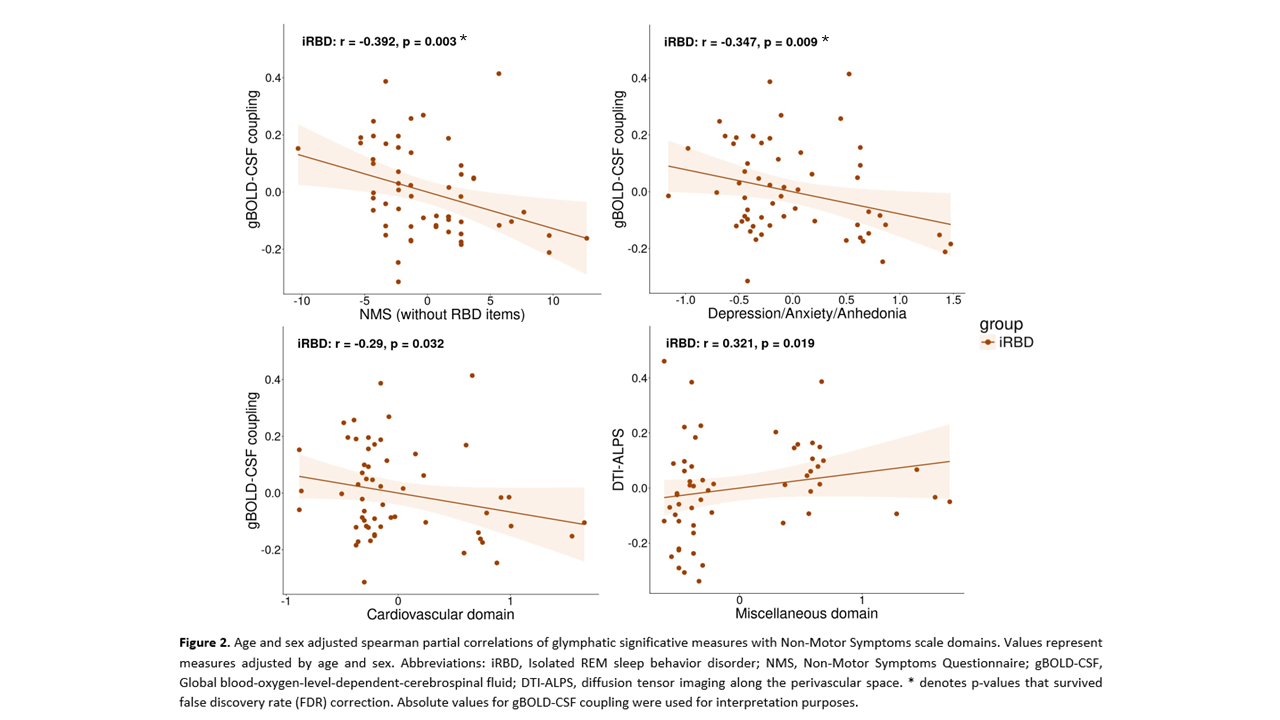
Figure 2
References: 1] Sundaram S, Hughes RL, Peterson E, et al. Establishing a framework for neuropathological correlates and glymphatic system functioning in Parkinson’s disease. Neurosci Biobehav Rev. 2019;103:305-315. doi:10.1016/j.neubiorev.2019.05.016
[2] Zhou X, Hu Y, Yang J, et al. Glymphatic, Structural, and Cognitive Changes During Breast Cancer Chemotherapy: A Longitudinal MRI Study. Hum Brain Mapp. 2025;46(13):e70334. doi:10.1002/hbm.70334
[3] Fultz NE, Bonmassar G, Setsompop K, Stickgold RA, Rosen BR, Polimeni JR, Lewis LD. Coupled electrophysiological, hemodynamic, and cerebrospinal fluid oscillations in human sleep. Science. 2019 Nov 1;366(6465):628-631. doi: 10.1126/science.aax5440. PMID: 31672896; PMCID: PMC7309589.
[4] Wang Z, Song Z, Zhou C, Fang Y, Gu L, Yang W, Gao T, Si X, Liu Y, Chen Y, Guan X, Guo T, Wu J, Bai X, Zhang M, Zhang B, Pu J. Reduced coupling of global brain function and cerebrospinal fluid dynamics in Parkinson’s disease. J Cereb Blood Flow Metab. 2023 Aug;43(8):1328-1339. doi: 10.1177/0271678X231164337. Epub 2023 Mar 16. PMID: 36927139; PMCID: PMC10369155.
To cite this abstract in AMA style:
C. Martín-Barceló, I. Roura, R. Sala-Llonch, C. Falcon, J. Pardo, C. Garcia-Vicente, L. Pacheco-Jaime, N. Bargalló, M. Serradell, G. Mayà, A. Montini, M. Buongiorno, C. Gaig, C. Junqué, A. Iranzo, B. Segura. Coupling between global BOLD signal and cerebrospinal fluid flow in isolated REM sleep behavior disorder and its relation with non-motor symptoms. [abstract]. Mov Disord. 2026; 41 (suppl 1). https://www.mdsabstracts.org/abstract/coupling-between-global-bold-signal-and-cerebrospinal-fluid-flow-in-isolated-rem-sleep-behavior-disorder-and-its-relation-with-non-motor-symptoms/. Accessed October 1, 2026.« Back to 2026 International Congress
MDS Abstracts - https://www.mdsabstracts.org/abstract/coupling-between-global-bold-signal-and-cerebrospinal-fluid-flow-in-isolated-rem-sleep-behavior-disorder-and-its-relation-with-non-motor-symptoms/