
Category: Parkinson's Disease: Surgical Therapy
Objective: In this paper, approach for simultaneous analysis of tract density and T1 MRI with fractional anisotropy map is proposed for implantation outcome evaluation and interpretation for PD patients.
Background: DBS is known to be a standard of care in the treatment of movement disorders. However, clinical response is associated with the ‘insertional effect’, and the primary mechanism is a complex of neuropathological changes, e.g., inflammatory responses near the electrode site, the activation of astrocytes, a focal activation hyperexcitability of neurons and the development of neuroplastic changes [1].
Method: We analyzed 44 PD patients, 59,0 (95% CI 50,8;62,0) y. To assess the motor symptoms III part of UPDRS is used. Connections in the whole brain are studied with DTI tractography, which is realized by DSI Studio with RK4 method, 100 million seeds. Tract density (TD) is calculated for the whole brain, it is summarized over all slices, additionally the state of TD distribution disorder is evaluated with Shannon entropy. Fractional anisotropy xx, yy, zz components are analyzed TD data, positioning of region of interest provided manually on the basis of T1 MRI.
Results: The postoperative follow-up period was 5 years. The score by III part of UPDRS in the off-med period decreased in patients with DBS STN ANOVA χ2 = 19,15, p < ,00001. In several patients, there was no effect of motor symptoms correction on one side.
TD statistical analysis shows the whole brain reorganization in the post-op state, the localization of the “most disordered” axial tract distribution (local entropy maximum) is moved with respect to electrode position (fig.1). Also, the localization of the “longest” average tract slices (local TD sum maximum) is moved (fig.2).
It is observed, that for the case without reduce tremor, hypokinesia, rigidity the strong local maximum of the TD is near the electrode (figs.4), but liquid diffusion is limited in the axial plane (fractional anisotropy xx, yy components, figs.3,5). From the physical point of view, the localized conductive channel is formed.
Conclusion: The simultaneous usage of tract density and fractional anisotropy map is shown to be perspective for evaluation and interpretation of implantation outcomes directly. Additional information about whole brain reorganization can be obtained from TD statistical analysis based on entropy and sum of tract density.
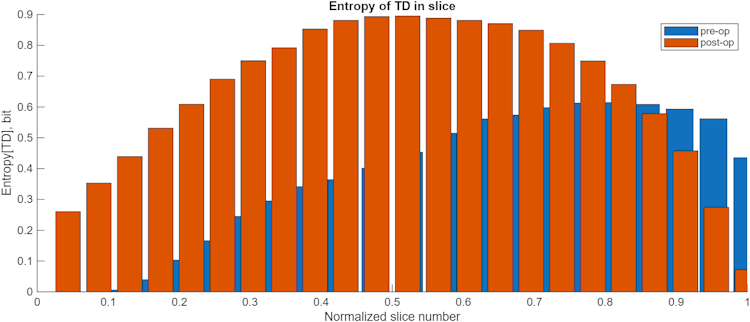
Entropy of TD in slice
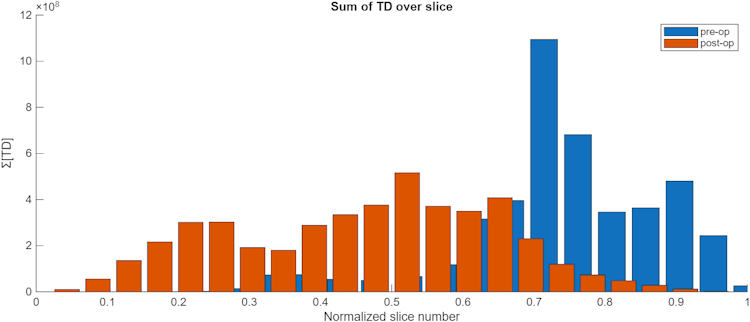
Sum of TD over slice
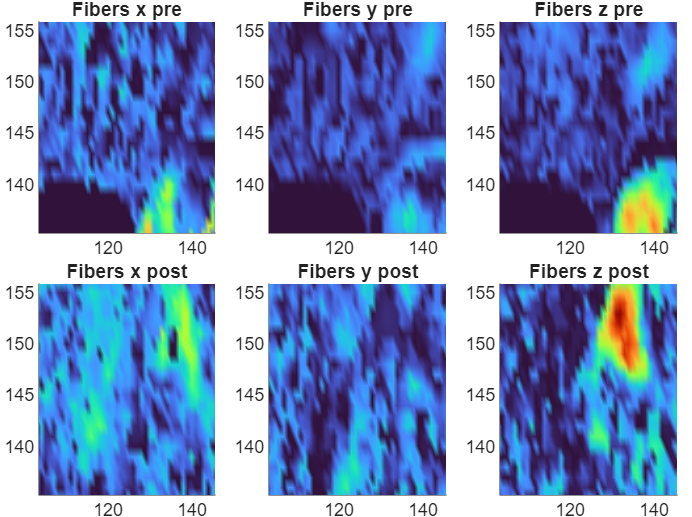
Fractional anisotropy xx, yy components, case 1
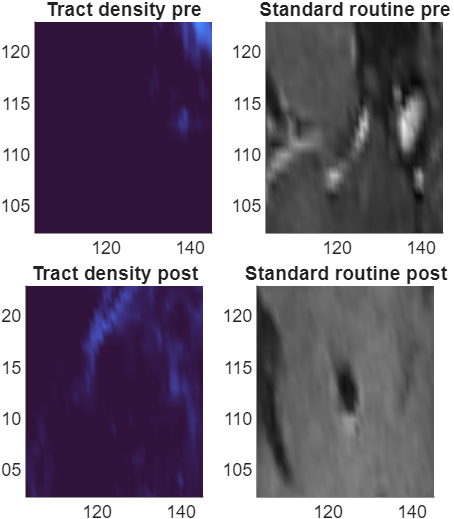
Strong local of the TD near the electrode, case 1
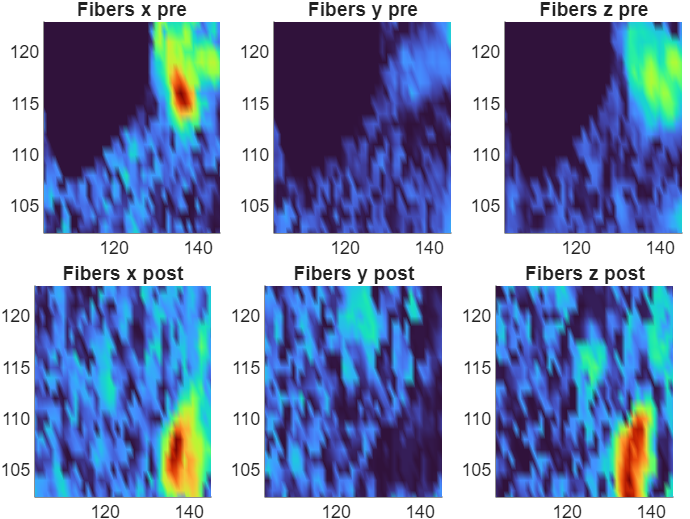
Fractional anisotropy xx, yy components, case 2
References: Hamani, C. et al. (2024) Insertional effect following electrode implantation: an underreported but important phenomenon. Brain Communications, 6(3), https://doi.org/10.1093/braincomms/fcae093.
To cite this abstract in AMA style:
A. Buniak, V. Bayarchyk, A. Mikitchuk. Electrode implantation outcome evaluation based on diffusion-tensor imaging math processing for PD patients with DBS [abstract]. Mov Disord. 2026; 41 (suppl 1). https://www.mdsabstracts.org/abstract/electrode-implantation-outcome-evaluation-based-on-diffusion-tensor-imaging-math-processing-for-pd-patients-with-dbs/. Accessed October 1, 2026.« Back to 2026 International Congress
MDS Abstracts - https://www.mdsabstracts.org/abstract/electrode-implantation-outcome-evaluation-based-on-diffusion-tensor-imaging-math-processing-for-pd-patients-with-dbs/