
Category: Technology
Objective: To compare quantitative spatiotemporal and plantar pressure gait parameters between patients with Parkinson’s disease (PD) and atypical parkinsonian syndromes (APS) using instrumented gait analysis.
Background: Gait disturbance is a prominent and disabling manifestation of PD. APS frequently present with gait abnormalities that overlap clinically with PD. Previous studies using quantitative gait analysis have demonstrated differences between PD and APS in parameters such as gait speed, stride variability, and postural instability. However, additional objective data from instrumented gait and plantar pressure systems may further characterize gait patterns in these disorders within routine clinical settings.
Method: This retrospective cohort study included 40 patients who underwent instrumented gait analysis at King Chulalongkorn Memorial Hospital between January 2021 and December 2025. Diagnoses were established by movement disorder specialists according to Movement Disorder Society (MDS) clinical diagnostic criteria. Spatiotemporal and plantar pressure parameters were recorded using the Strideway® System under a standardized walking protocol. Key gait variables included step width, stride velocity, double-support time, heel contact time, and plantar pressure metrics. Between-group comparisons were performed using appropriate statistical tests.
Results: Demographic characteristics are summarized in Table 1, and quantitative gait parameters are presented in Table 2. Step width was significantly wider in patients with APS compared with those with PD (13.98 ± 5.58 vs 10.58 ± 2.97 cm; p = 0.021). Descriptive trends suggested slower stride velocity, longer double-support time, prolonged heel contact time, lower maximum peak plantar pressure, and higher force–time integral in APS compared with PD. A schematic summary of gait parameter characteristics distinguishing PD and APS is illustrated in Figure 1.
Conclusion: Patients with APS demonstrated wider step width compared with those with PD, reflecting greater mediolateral instability. Instrumented gait analysis may provide objective metrics that support clinical judgement when differentiating parkinsonian syndromes. Larger prospective studies with subtype-specific analyses and adjustment for potential confounders are needed to clarify the role of quantitative gait analysis in differentiating parkinsonian disorders.
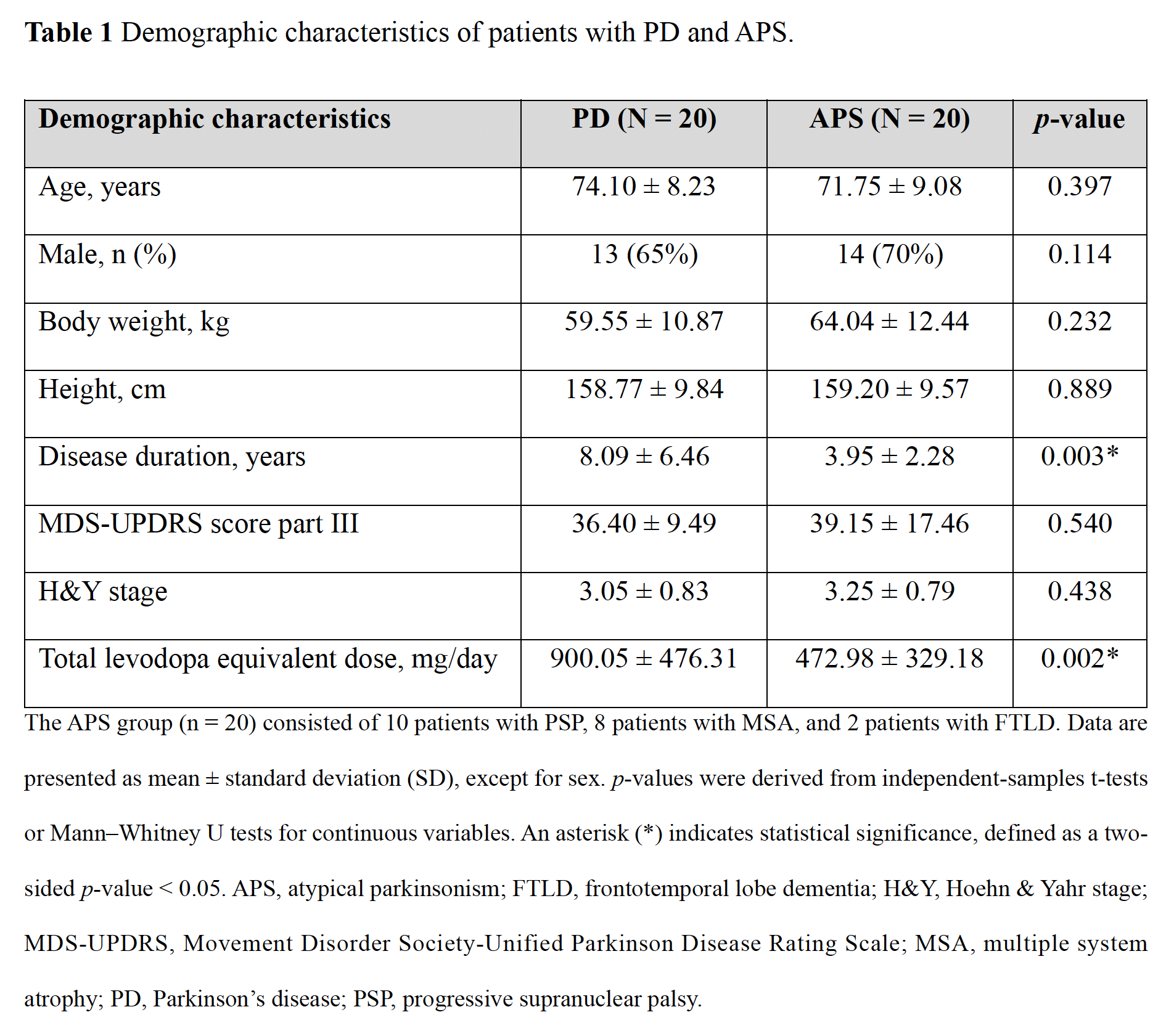
Table 1
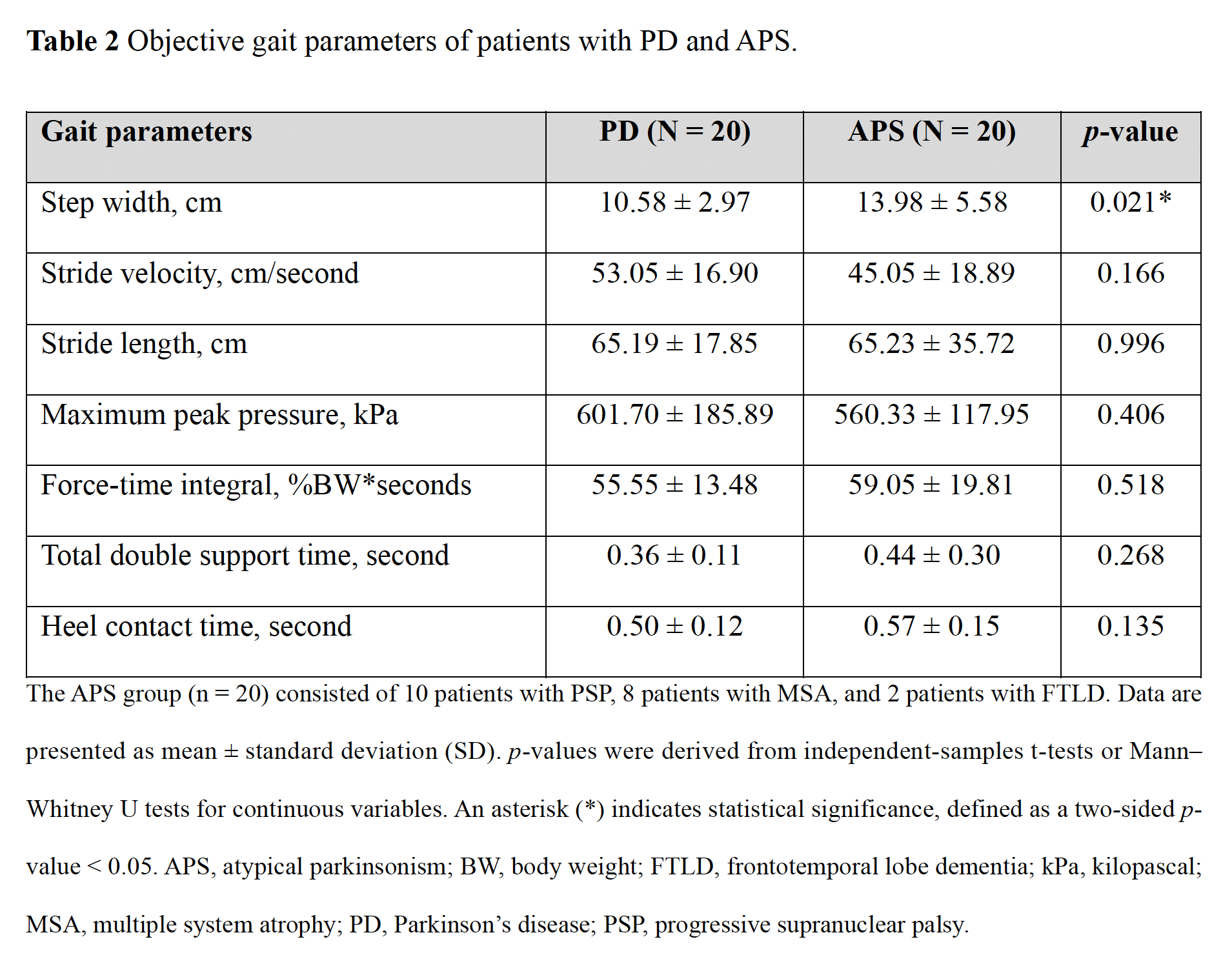
Table 2
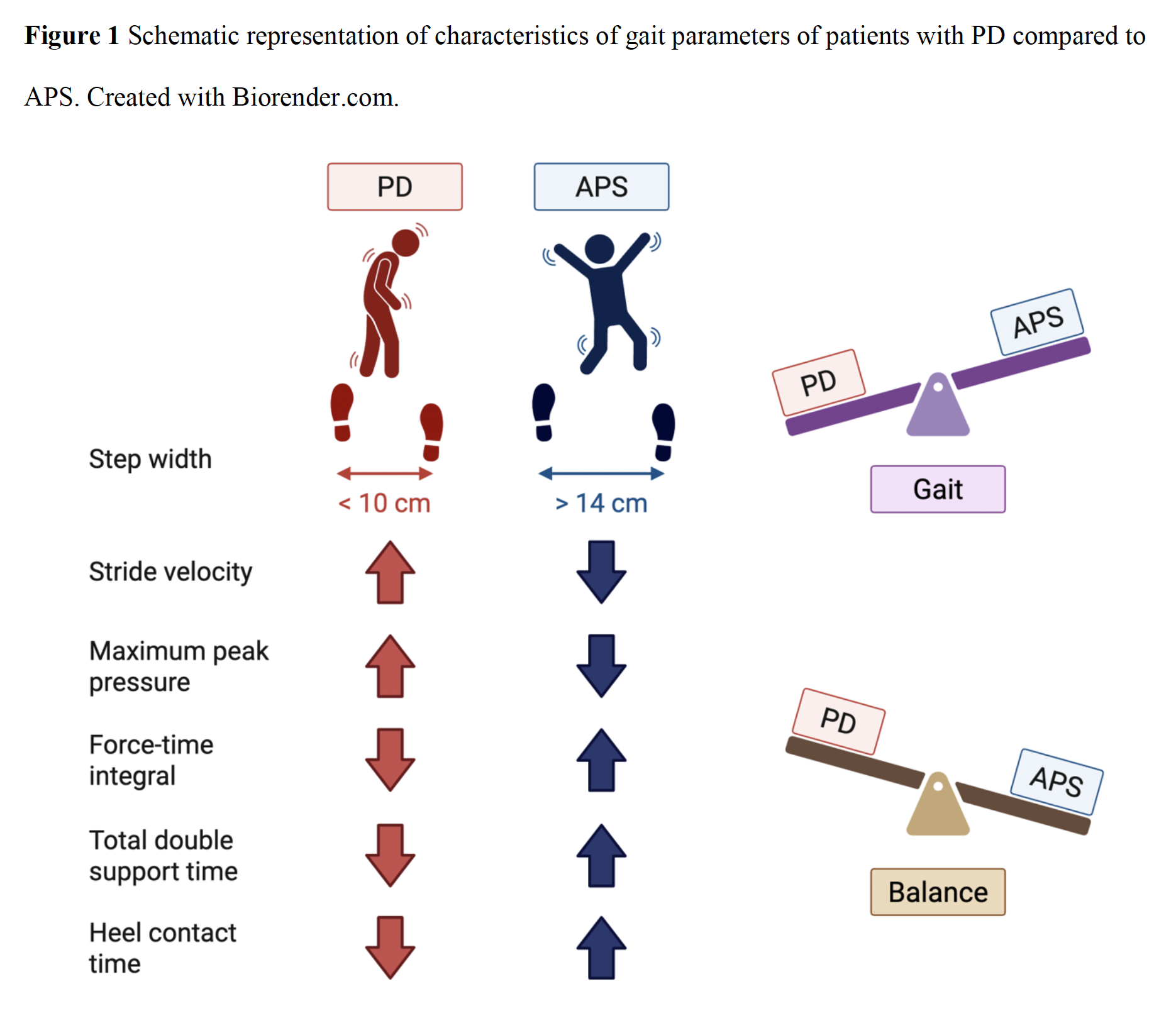
Figure 1
References: 1. Schapira AHV, Chaudhuri KR, Jenner P. Non-motor features of Parkinson disease. Nature Reviews Neuroscience. 2017;18(7):435-50.
2. Bhidayasiri R, Wannachai N, Limpabandhu S, Choeytim S, Suchonwanich Y, Tananyakul S, et al. A national registry to determine the distribution and prevalence of Parkinson’s disease in Thailand: implications of urbanization and pesticides as risk factors for Parkinson’s disease. Neuroepidemiology. 2011;37(3-4):222-30.
3. Kalia LV, Lang AE. Parkinson’s disease. Lancet (London, England). 2015;386(9996):896-912.
4. Chen P-H, Wang R-L, Liou D-J, Shaw J-S. Gait Disorders in Parkinson’s Disease: Assessment and Management. International Journal of Gerontology. 2013;7(4):189-93.
5. Snijders AH, Takakusaki K, Debu B, Lozano AM, Krishna V, Fasano A, et al. Physiology of freezing of gait. Ann Neurol. 2016;80(5):644-59.
6. Deutschländer AB, Ross OA, Dickson DW, Wszolek ZK. Atypical parkinsonian syndromes: a general neurologist’s perspective. Eur J Neurol. 2018;25(1):41-58.
7. Bae CH, Jeong HW, Yun JY, Lee JE, Han SJ. Spatiotemporal Gait Parameter Comparison for Parkinson’s Disease, Multiple System Atrophy, and Other Parkinsonism Diseases. Brain Neurorehabil. 2019;12(2).
8. Jakob V, Küderle A, Kluge F, Klucken J, Eskofier BM, Winkler J, et al. Validation of a Sensor-Based Gait Analysis System with a Gold-Standard Motion Capture System in Patients with Parkinson’s Disease. Sensors [Internet]. 2021; 21(22):[7680 p.].
9. Takamatsu Y, Matsuda N, Aiba I. The combination of short-step and wide-based gait is a gait characteristic in progressive supranuclear palsy: a retrospective, cross-sectional study. Eur Geriatr Med. 2019;10(5):809-15.
10. Hatanaka N, Sato K, Hishikawa N, Takemoto M, Ohta Y, Yamashita T, et al. Comparative Gait Analysis in Progressive Supranuclear Palsy and Parkinson’s Disease. European Neurology. 2016;75(5-6):282-9.
11. Palmisano C, Todisco M, Marotta G, Volkmann J, Pacchetti C, Frigo CA, et al. Gait initiation in progressive supranuclear palsy: brain metabolic correlates. NeuroImage: Clinical. 2020;28:102408.
12. Hulleck AA, Menoth Mohan D, Abdallah N, El Rich M, Khalaf K. Present and future of gait assessment in clinical practice: Towards the application of novel trends and technologies. Front Med Technol. 2022;4:901331.
13. Salchow-Hömmen C, Skrobot M, Jochner M, Schauer T, Kühn A, Wenger N. Review—Emerging Portable Technologies for Gait Analysis in Neurological Disorders. Frontiers in Human Neuroscience. 2022;16.
14. Raccagni C, Gaßner H, Eschlboeck S, Boesch S, Krismer F, Seppi K, et al. Sensor-based gait analysis in atypical parkinsonian disorders. Brain and Behavior. 2018;8(6):e00977.
15. Gaßner H, Raccagni C, Eskofier BM, Klucken J, Wenning GK. The Diagnostic Scope of Sensor-Based Gait Analysis in Atypical Parkinsonism: Further Observations. Front Neurol. 2019;10:5.
16. Amboni M, Ricciardi C, Picillo M, De Santis C, Ricciardelli G, Abate F, et al. Gait analysis may distinguish progressive supranuclear palsy and Parkinson disease since the earliest stages. Sci Rep. 2021;11(1):9297.
17. Zou YF, Lai YR, Chiu WC, Lien CY, Huang CC, Cheng BC, et al. Clinical Utility of Plantar Pressure Measurements as Screening in Patients With Parkinson Disease With and Without Freezing of Gait History. Arch Phys Med Rehabil. 2023;104(7):1091-8.
18. Phuenpathom W, Panyakaew P, Vateekul P, Surangsrirat D, Bhidayasiri R. Residual effects of combined vibratory and plantar stimulation while seated influences plantar pressure and spatiotemporal gait measures in individuals with Parkinson’s disease exhibiting freezing of gait. Front Aging Neurosci. 2023;15:1280324.
19. Nonnekes J, Goselink RJM, Růžička E, Fasano A, Nutt JG, Bloem BR. Neurological disorders of gait, balance and posture: a sign-based approach. Nature Reviews Neurology. 2018;14(3):183-9.
20. Raccagni C, Nonnekes J, Bloem BR, Peball M, Boehme C, Seppi K, et al. Gait and postural disorders in parkinsonism: a clinical approach. Journal of Neurology. 2020;267(11):3169-76.
21. Abdo WF, Borm GF, Munneke M, Verbeek MM, Esselink RA, Bloem BR. Ten steps to identify atypical parkinsonism. J Neurol Neurosurg Psychiatry. 2006;77(12):1367-9.
22. Goffar S, Naylor J, Reber R, Rodriguez B, Christiansen B, Walker M, et al. Dynamic plantar pressure changes during loaded gait. US Army Medical Department journal. 2010:77.
To cite this abstract in AMA style:
T. Jariyasethawong, R. Bhidayasiri, W. Phuenpathom. Exploratory Quantitative Gait Analysis for Differentiating Parkinson’s Disease from Atypical Parkinsonian Syndromes [abstract]. Mov Disord. 2026; 41 (suppl 1). https://www.mdsabstracts.org/abstract/exploratory-quantitative-gait-analysis-for-differentiating-parkinsons-disease-from-atypical-parkinsonian-syndromes/. Accessed October 1, 2026.« Back to 2026 International Congress
MDS Abstracts - https://www.mdsabstracts.org/abstract/exploratory-quantitative-gait-analysis-for-differentiating-parkinsons-disease-from-atypical-parkinsonian-syndromes/