
Objective: To determine whether intestinal barrier dysfunction in Parkinson disease (PD) is stage-specific by assessing baseline epithelial permeability and resilience to inflammatory and microbial stressors.
Background: Gastrointestinal dysfunction in PD is linked to impaired intestinal barrier integrity[1], potentially allowing microbial products to enter circulation, promote systemic inflammation and gut-brain axis neuroinflammation. Whether barrier dysfunction is uniform or progresses with disease severity remains unclear.
Method: Motor severity was evaluated using UPDRS Part III and H&Y staging[2,3]. Three-dimensional apical-out colon and ileum organoids were generated from biopsies of healthy controls (n=11), clinically moderate PD (medicated H&Y 1–2; n=11), and severe PD (medicated H&Y ≥3; n=9). Groups were age- and BMI-matched (median 68 years; 26.1 kg/m²), 45% were female, and neurodegeneration was measured by plasma neurofilament light chain (NfL)[4]. Organoids were exposed to IFNγ/TNFα, lipopolysaccharide (LPS), or hydrogen peroxide (H₂O₂), modeling inflammatory, microbial, and oxidative epithelial stress. Barrier permeability was quantified using a 4 kDa FITC-dextran diffusion assay.
Results: Higher PD severity was associated with higher plasma NfL [Figure1]. Severe PD showed elevated baseline permeability in both colon (P=0.02) and ileum (P<0.01) organoids, indicating spontaneous barrier dysfunction [Figure2]. In colonoids, moderate PD showed greater permeability increases than controls after LPS (1 ng/mL, P=0.04) and H₂O₂ (0.1 mM, P=0.02; 0.5 mM, P<0.01) [Figure2], suggesting reduced colonic resilience to microbial and oxidative injury; IFNγ/TNFα showed no group differences. In enteroids, aside from elevated baseline permeability in severe PD, stressors did not differ between groups.
Conclusion: PD shows a stage-linked epithelial barrier disruption pattern: clinically moderate PD has stress-induced, colon-selective leak, whereas clinically severe PD shows spontaneous leak in colon and ileum. This suggests greater loss of barrier resilience, increasing microbial exposure and systemic inflammation via the gut-brain axis. These findings support severity-stratified studies linking barrier dysfunction to in vivo biomarkers of gut permeability, microbial translocation, inflammation, and clinical progression.
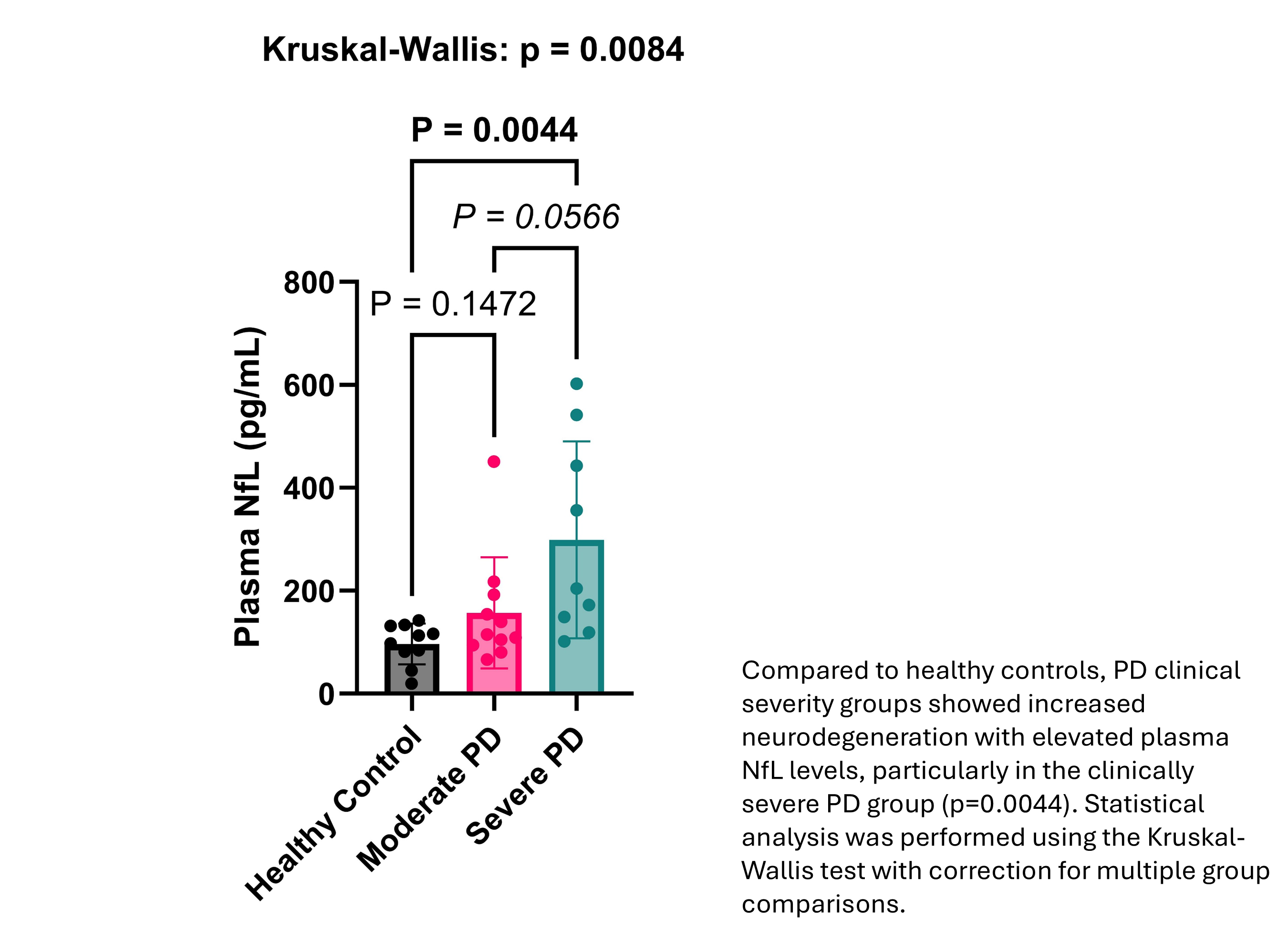
Higher PD Severity Links To Elevated Plasma NfL.
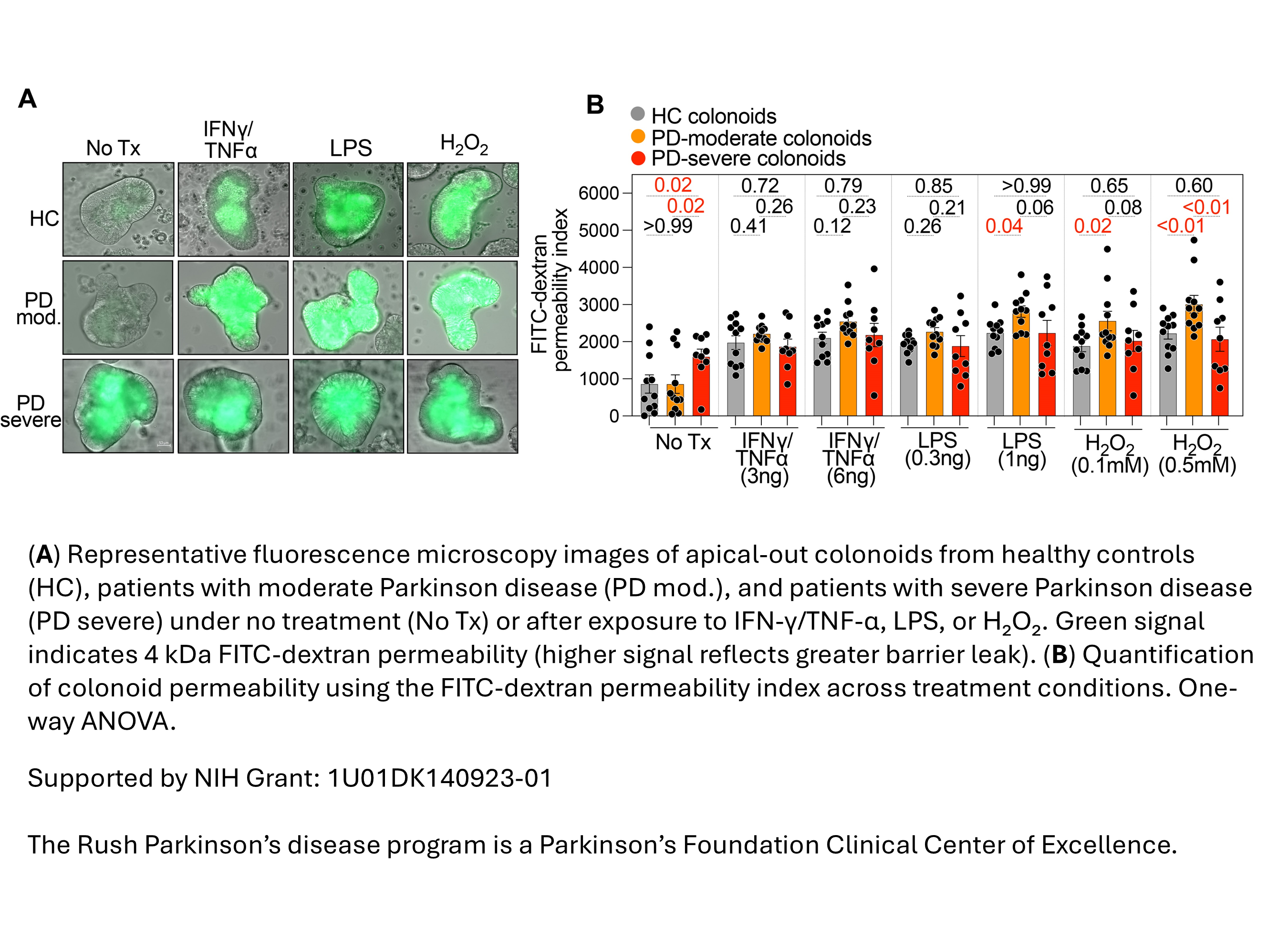
PD Colonoids Show Stage-Specific Barrier Leak.
References: 1 Forsyth, C. B. et al. Increased intestinal permeability correlates with sigmoid mucosa alpha-synuclein staining and endotoxin exposure markers in early Parkinson’s disease. PLoS One 6, e28032, doi:10.1371/journal.pone.0028032 PONE-D-11-13168 [pii] (2011).
2 Goetz, C. G. et al. Movement Disorder Society Task Force report on the Hoehn and Yahr staging scale: status and recommendations. Mov Disord 19, 1020-1028, doi:10.1002/mds.20213 (2004).
3 Skorvanek, M. et al. Differences in MDS-UPDRS Scores Based on Hoehn and Yahr Stage and Disease Duration. Mov Disord Clin Pract 4, 536-544, doi:10.1002/mdc3.12476 (2017).
4 Lin, C. H. et al. Blood NfL: A biomarker for disease severity and progression in Parkinson disease. Neurology 93, e1104-e1111, doi:10.1212/WNL.0000000000008088 (2019).
To cite this abstract in AMA style:
M. Abdel-Mohsen, M. Shaikh, L. Zhang, P. Engen, C. Neumann, M. Villanueva, D. Sanchez-Bass, L. Dibenedetto, S. Luo, B. Killinger, C. Soto, S. Green, L. Lagorio, R. Voigt, A. Sharma, C. Goetz, A. Keshavarzian. Gut Barrier Failure In Parkinson Disease: Reduced Colonic Resilience In Moderate Disease And Spontaneous Pan-Intestinal Leak In Severe Disease [abstract]. Mov Disord. 2026; 41 (suppl 1). https://www.mdsabstracts.org/abstract/gut-barrier-failure-in-parkinson-disease-reduced-colonic-resilience-in-moderate-disease-and-spontaneous-pan-intestinal-leak-in-severe-disease/. Accessed October 1, 2026.« Back to 2026 International Congress
MDS Abstracts - https://www.mdsabstracts.org/abstract/gut-barrier-failure-in-parkinson-disease-reduced-colonic-resilience-in-moderate-disease-and-spontaneous-pan-intestinal-leak-in-severe-disease/