
Category: Choreas (Non-Huntington's Disease)
Objective: To present a case where FDG-PET and neurofilament findings help portray the reversibility of neuronal damage in antiphospholipid syndrome (aPL).
Background: Chorea is the most common movement disorder in aPL and often an initial manifestation, although its mechanism remains unknown. The mostly subacute onset and absence of lesional correlates on MRIs strongly argue against ischemic origin.
Method: Clinical case presentation.
Results: 25-year-old female with one month of anxiety, cognitive deficits and predominantly right-body involuntary movements. Examination showed attentional and mnesic impairment with continuous right faciobrachial choreoballistic movements of the mouth and right limbs. Right frontal corrugation and ocular closure simple tics were also observed. Gait was impaired to due to choreiform movement interference. No clear ataxia or bradykinesia. Remaining physical examination unremarkable. Initial bloods, LP, CT scan, toxic screening, and EEG were unremarkable. Gynecological exam and abdominopelvic imaging showed no signs of malignancy.
MRI-brain showed punctiform hyperintensities in FLAIR/b1000, some with ADC-correlation, but insufficient to justify clinical picture. Brain FDG-PET reflected hypermetabolism in striatal nuclei and diffuse parieto-temporo-occipital and cerebellar hypometabolism. Autoimmune testing revealed negative autoimmune encephalitis, onconeural and surface antibodies. Anti-cardiolipine, anti-b2 glycoprotein and Lupus anticoagulant were positive, suggesting aPL syndrome debut, being labeled as primary aPL, as the rest of SLE and vasculitis work-up was negative. Treatment was started with anticoagulation, corticosteroids, Rituximab, and tetrabenazine for chorea. Eventually, she was discharged with movement and cognitive/behavioral improvement. She remained stable at 2-month follow-up, with no changes in control MRI, repeat FDG-PET with normalization of previous findings and Neurofilaments had decreased to 45.78 pg/mL.
Conclusion: APL-related chorea often lacks structural lesion correlation, aligning with a more functional immune-mediated basal-ganglia disruption theory. In our case, normalization of FDG-PET metabolism and elevated neurofilament levels after treatment reinforce the reversibility of inflammatory neuronal dysfunction, highlighting the importance of early recognition and individualized treatment.
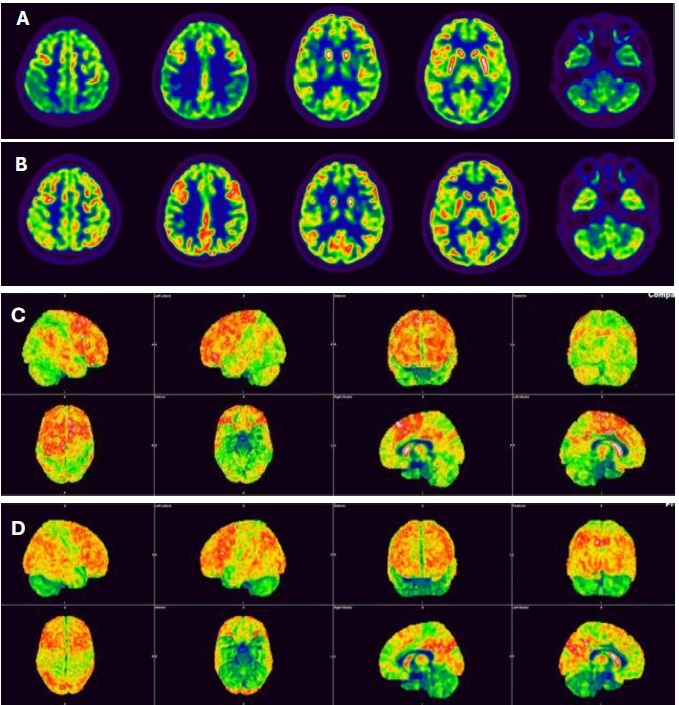
FDG-PET/CT and Syngovia quantification images.
References: Fernández-Vidal, J. M., Olmedo-Saura, G., Querol-Gutiérrez, L. A., Kulisevsky, J., & Pérez-Pérez, J. (2024). Crossed-reflex in antiphospholipidchorea. Neurological sciences: officialjournaloftheItalianNeurological Society and oftheItalianSociety ofClinical Neurophysiology, 45(9), 4635–4637. https://doi.org/10.1007/s10072-024-07622-5
Peluso, S., Antenora, A., De Rosa, A., Roca, A., Maddaluno, G., Brescia Morra, V., & De Michele, G. (2012). Antiphospholipid-relatedchorea. Frontiers in neurology, 3, 150. https://doi.org/10.3389/fneur.2012.00150.
Baizabal-Carvallo, J. F., Bonnet, C., & Jankovic, J. (2013). Movement disordersin systemiclupuserythematosusand theantiphospholipidsyndrome. Journal ofneuraltransmission(Vienna, Austria : 1996), 120(11), 1579–1589. https://doi.org/10.1007/s00702-013-1023-z
To cite this abstract in AMA style:
L. Peraferrer-Montesinos, J. Martínez-Rodríguez, A. Fernández-Lebrero, M. Viles-Garcia, E. Carrillo Villamizar, P. Plaza-López, V. Puente-Periz, I. Navalpotro-Gómez. Immune-mediated Chorea in Antiphospholipid Syndrome: Normalization of FDG-PET and Neurofilament as Markers of Treatment Response. [abstract]. Mov Disord. 2026; 41 (suppl 1). https://www.mdsabstracts.org/abstract/immune-mediated-chorea-in-antiphospholipid-syndrome-normalization-of-fdg-pet-and-neurofilament-as-markers-of-treatment-response/. Accessed October 1, 2026.« Back to 2026 International Congress
MDS Abstracts - https://www.mdsabstracts.org/abstract/immune-mediated-chorea-in-antiphospholipid-syndrome-normalization-of-fdg-pet-and-neurofilament-as-markers-of-treatment-response/