
Objective: To explore the influence of disease stage on real-world turning in people with Parkinson’s disease (PD).
Background: Turning can be challenging in PD due to the requirement of dynamic balance and multi-segment coordination. Turning during laboratory tests has been shown to be sensitive to detect PD and monitor change [1] Turning constitutes 45% of daily living mobility[2], capturing it in real life may provide a pragmatic tool to help identify and monitor PD but validation is needed in the real world.
Method: As part of the Mobilise-D study (n=508, mean age 65.7y, 65x% male) real-world mobility was monitored over 7 days using an inertial measurement unit worn on the lower back [3]. A validated algorithm [4] extracted turn duration and angular velocity. Data were aggregated into bands of small (45°-90°), medium (90°-135°), and large (135°-180°) turns. A Kruskal Wallis test compared turning angular velocity and duration, median and variation, in addition to clinical and functional assessments across Hoehn and Yahr (HY) disease stage (HYI n=85, HYII n=344, HYIII n=79). The standardised difference test statistic (SDTS), which reflects the average difference between groups divided by the standard error, was calculated
Results: There were no significant differences in real-world turning between HYI and HYII. Those with mild PD (HYI & HYII) performed [LR1] significantly more real-world turns (medium and large) than HYIII, however differences in the number of small turns were only seen for HYII compared to HYIII. Median turn duration was significantly reduced, and angular velocity was significantly increased, for mild PD compared to HYIII for all turns. Turn duration and velocity increased with turn size. Turn duration variability (SD, CoV) was significantly reduced in mild PD compared to HYIII for medium and large turns. The SDTS revealed a greater difference in turning duration and velocity between HYI vs HYIII compared to HYII vs. HYIII.
Conclusion: Duration and angular velocity of turns differ between PD disease stages, particularly between mild and moderate stage disease (HYIII). These differences in turning strategies may relate to differences in balance scores, mobility and fear of falling. Further analyses will include further validation of turning metrics as well as extracting signal-based features of turning to determine whether they are more sensitive to earlier disease stages.
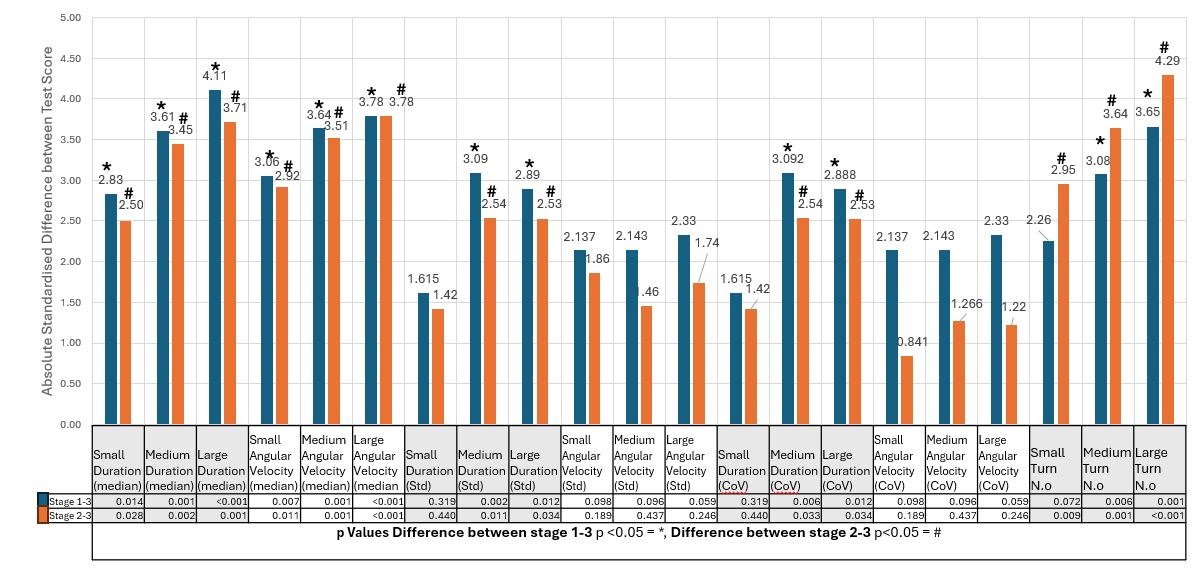
Absolute Std difference between variables
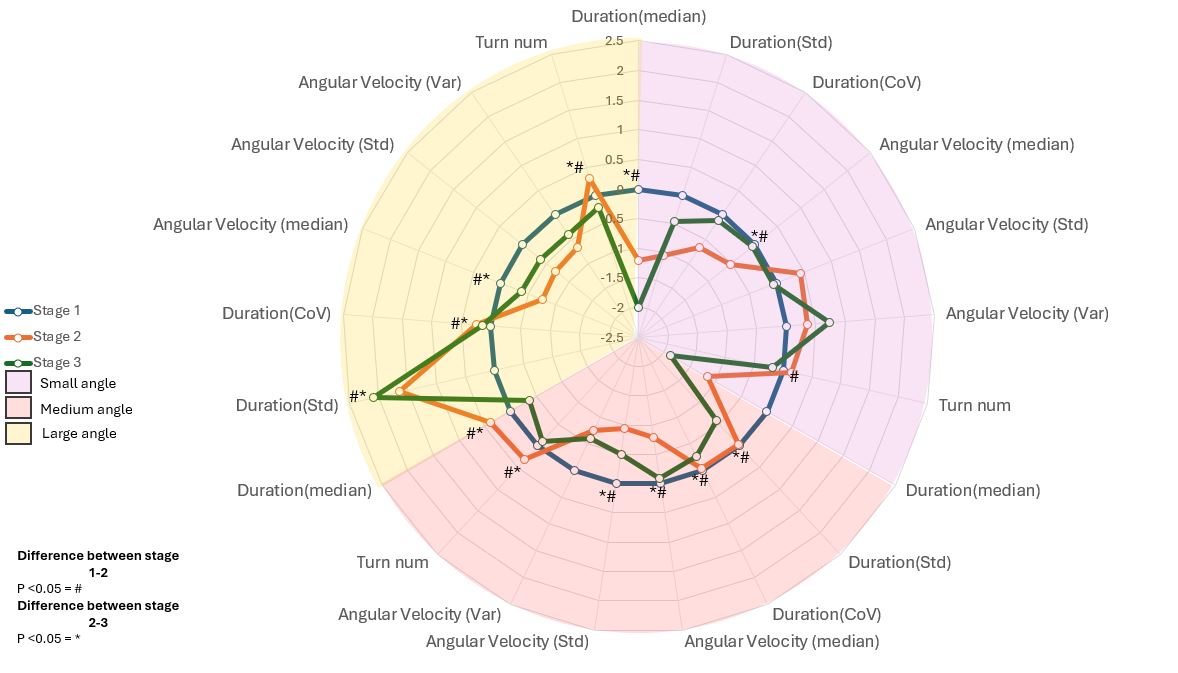
Standardised ave. of HYI-HYIII normalised to HYI.
References: [1] Zampieri C et al. Neurosurg Psychiatry. 2010 vol 81 no.2: pp.171-6 PMID: 19726406
[2] B. C. Glaister et al., 2007 vol.25, no.2, pp.289-294, PMID: 16730441
[3] Yarnall et al 2026. J Parkinsons Dis. vol16, pp.110-124 PMID: 41452018.
[4] Rehman et al., 2020 Sensors, vol.20, no.18 PMID: 32961799
To cite this abstract in AMA style:
C. Wilkinson, S. Del Din, C. Schlenstedt, C. Becker, J. Buekers, B. Caulfield, L. Delgado, J. Garcia-Aymerich, H. Gassner, A. Nieuwboer, J. Hausdorff, A. Mirelman, L. Rochester, W. Maetzler, A. Yarnall, L. Alcock. Influence of disease stage upon real-world turning performance in people with Parkinson’s [abstract]. Mov Disord. 2026; 41 (suppl 1). https://www.mdsabstracts.org/abstract/influence-of-disease-stage-upon-real-world-turning-performance-in-people-with-parkinsons/. Accessed October 1, 2026.« Back to 2026 International Congress
MDS Abstracts - https://www.mdsabstracts.org/abstract/influence-of-disease-stage-upon-real-world-turning-performance-in-people-with-parkinsons/