
Objective: To quantify and compare the diagnostic contributions of the three standard MDS-UPDRS hand motor tasks using video-based assessment of bradykinesia in Parkinson’s Disease (PD).
Background: Finger tapping, hand open-close, and pronation-supination are routinely used to assess upper-limb motor function, but whether these tasks are redundant or capture distinct aspects of motor impairment remains unclear. Ordinal MDS-UPDRS scores may reflect different underlying abnormalities, limiting interpretability in both in-person and remote assessments.
Method:
We analyzed 1,316 videos from 227 participants (176 PD, 51 controls) performing standardized MDS-UPDRS hand tasks, annotated by five neurologists with labels aggregated via weak supervision. An interpretable ML pipeline extracted task-specific kinematic signals from hand landmarks and estimated severity using ROCKET-based time-series modeling. A symptom-inference module identified clinically recognizable motor signs including low amplitude, amplitude decrement, slowness, and halts or rhythm irregularity. Inter-task redundancy and complementarity were examined.
Results: The model achieved a mean absolute error of 0.48, an accuracy of 0.90, and symptom-level accuracy of 0.89 across repetitive hand tasks, outperforming handcrafted-feature and deep-learning baselines. Impairment detection reached 93.8%, and most prediction errors fell within one severity level. Finger Tapping was most strongly associated with reduced speed and amplitude, Hand Open–Close with amplitude decrement, and Pronation–Supination with rhythm irregularity. In milder impairment, abnormalities in pronation–supination were more frequently detected (78.8%), whereas finger tapping better reflected higher levels of motor impairment (76.4%). Inter-task correlations (ρ = 0.43–0.57) indicated partial overlap but not redundancy among tasks. Finger Tapping combined with Pronation–Supination explained 91.0% of the composite severity, suggesting that this pair captures most of the observable impairment structure.
Conclusion: Quantitative video analysis reveals that standard MDS-UPDRS hand tasks capture distinct components of bradykinesia rather than redundant information. These findings suggest that different tasks may be preferentially informative at different disease stages.
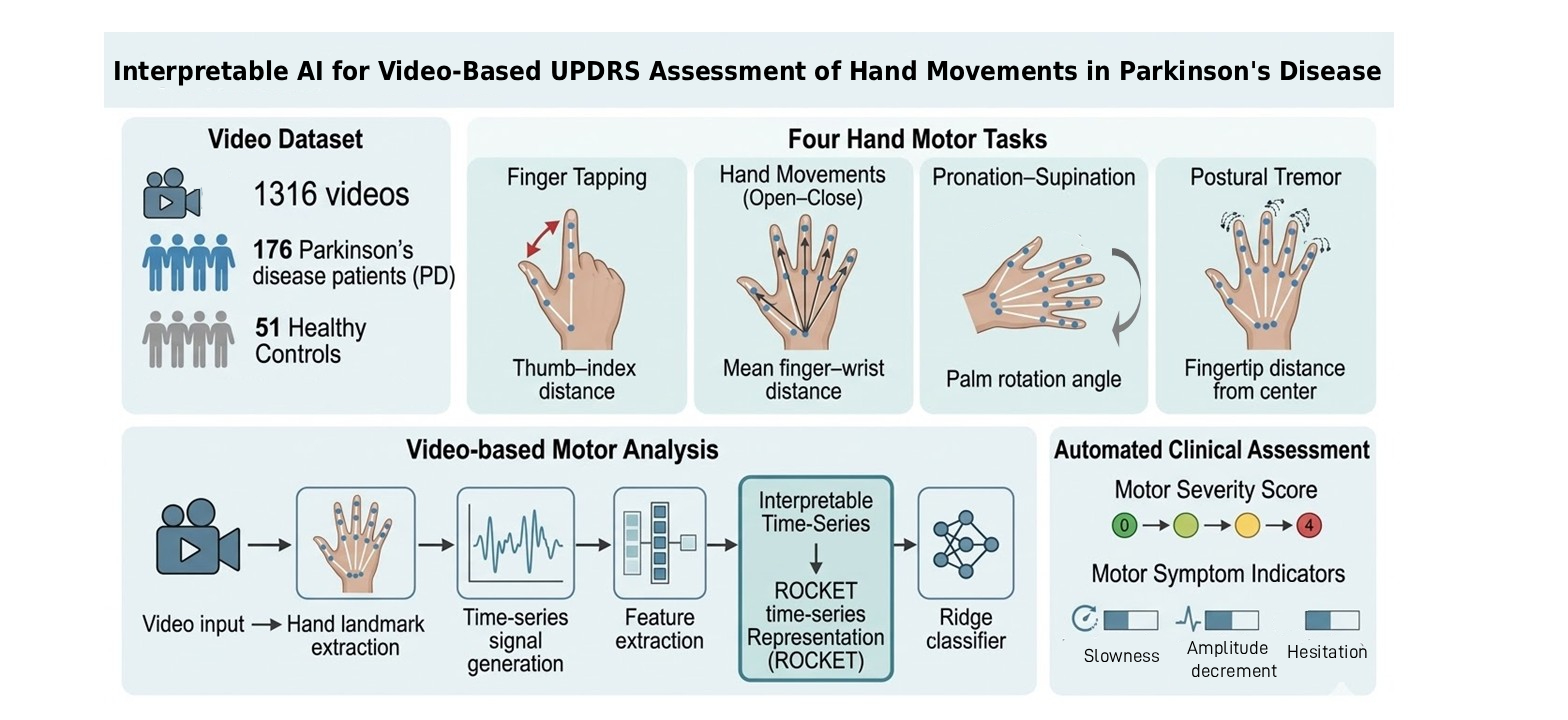
Overview of the pipeline
To cite this abstract in AMA style:
A. Irani, A. Mehrani, A. Soltani Mohammadi, K. Park, M. Mirian, R. Hosseini, H. Moradi, M. Mckeown. Interpretable AI for Quantitative Video-Based UPDRS Assessment of Hand Movements in Parkinson’s Disease [abstract]. Mov Disord. 2026; 41 (suppl 1). https://www.mdsabstracts.org/abstract/interpretable-ai-for-quantitative-video-based-updrs-assessment-of-hand-movements-in-parkinsons-disease/. Accessed October 1, 2026.« Back to 2026 International Congress
MDS Abstracts - https://www.mdsabstracts.org/abstract/interpretable-ai-for-quantitative-video-based-updrs-assessment-of-hand-movements-in-parkinsons-disease/