
Category: Drug-Induced Movement Disorders
Objective: Recent neurophysiological studies indicate that dopamine D2 receptors (D2R) may interact with N-type calcium channels in neurons of the subthalamic nucleus (STN), potentially altering neuronal firing activity within the basal ganglia. This computational study investigates the mechanisms underlying this interaction and evaluates how it influences resting membrane potential (RMP) and firing dynamics relevant to Parkinson’s disease (PD).
Background: Parkinson’s disease is characterized by degeneration of dopaminergic neurons and disruption of signaling pathways that regulate neuronal excitability in the basal ganglia network.
Method: A quantitative computational framework was developed to analyze dopaminergic modulation of STN neurons. First, electrophysiological parameters describing key ion channels in STN cells were incorporated from previously published experimental studies. Second, signaling equations representing G-protein–coupled receptor (GPCR) pathways were implemented to simulate dopamine receptor–mediated regulation of cyclic AMP (cAMP) and its effect on N-type Ca²⁺ channel conductance.
Results: Simulations using the dopamine receptor agonist bromocriptine (10 µM) demonstrated significant modulation of N-type Ca²⁺ channel activation kinetics. Activation curves shifted toward more depolarized potentials, resulting in reduced calcium window currents. This change led to a decrease in action potential firing frequency due to dopamine D2 receptor activation and altered potassium channel conductance. Under simulated current injection conditions of 100 pA for 1 ms, neuronal firing frequency decreased in the presence of the dopamine agonist. Figure 1 illustrates the simulated membrane potential traces, highlighting reduced firing activity when dopamine receptor signaling is activated.
Conclusion: The findings indicate that dopaminergic modulation of calcium and potassium channel dynamics plays an important role in regulating STN neuronal excitability. Targeting potassium channel pathways may provide an alternative therapeutic strategy for managing abnormal neuronal activity in Parkinson’s disease and could complement existing dopamine-based treatments.
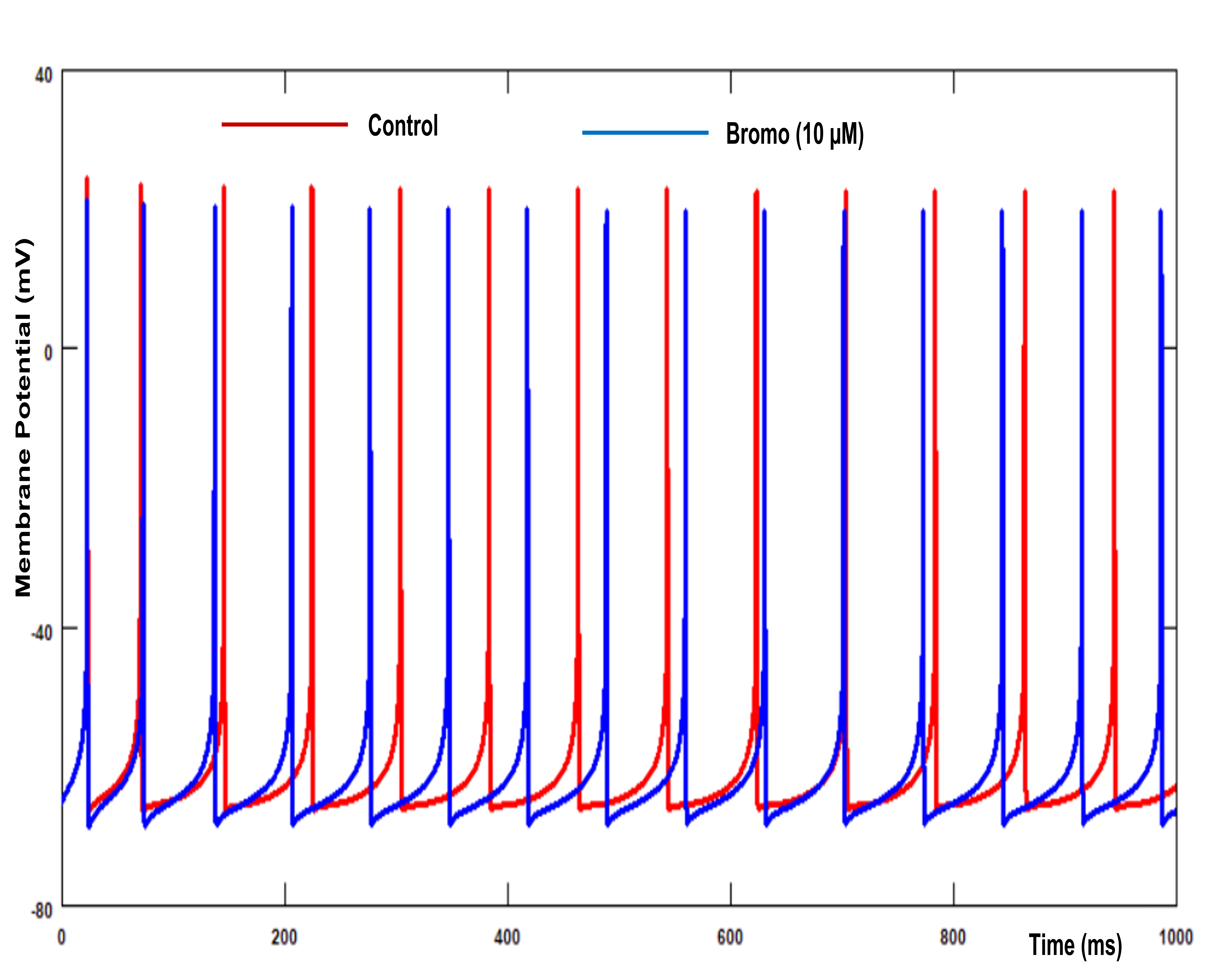
Fig 1
To cite this abstract in AMA style:
C. Mahapatra. Ion Channel Modulation by Dopamine Receptors in Subthalamic Nucleus Neurons: Implications for Parkinson’s Disease Pathophysiology [abstract]. Mov Disord. 2026; 41 (suppl 1). https://www.mdsabstracts.org/abstract/ion-channel-modulation-by-dopamine-receptors-in-subthalamic-nucleus-neurons-implications-for-parkinsons-disease-pathophysiology/. Accessed October 1, 2026.« Back to 2026 International Congress
MDS Abstracts - https://www.mdsabstracts.org/abstract/ion-channel-modulation-by-dopamine-receptors-in-subthalamic-nucleus-neurons-implications-for-parkinsons-disease-pathophysiology/