
Objective: This study aims to understand how results from monopolar sensing of local field potential (LFP) beta power can better support more efficient programming of deep brain stimulation (DBS). Specifically, we look at how patient-specific sensing compares to clinical outcomes and anatomy.
Background: DBS therapy is an effective treatment for Parkinson’s disease. Optimizing DBS programming is a traditionally time-intensive, trial-and-error process, complicated further by new technology like segmented leads that expand the number of programming parameter choices to test. There is a need for objective, patient-specific measures to help simplify programming. It has been previously shown that electrodes with the highest beta power tend to be the location for programming [1,2]. The objective was to investigate how LFP beta power obtained by a novel monopolar sensing feature can be used to inform contact selection during DBS programming.
Method: Eight patients previously implanted with Globus pallidus (GP) DBS were recruited for this study. Monopolar recordings were obtained for each patient during the initial programming visit. A monopolar review noting amplitudes of stimulation benefit and side effects was performed at the initial visit. Imaging analysis was used to localize the electrodes into a common space GP to map the LFP beta power across all patients.
Results: The electrode level with the greatest LFP beta power matched with the final programming in 81% of hemispheres (n=16). On average, it took 36 minutes to perform the standard clinical monopolar review and 4 minutes to perform the monopolar neural sensing in a hemisphere. The electrodes with high LFP power had a lower probability of inducing side effects compared to electrodes with low LFP power (p=0.08). The imaging analysis showed that 87.5% of electrodes with high LFP power were in GP [figure1].
Conclusion: Results show that patient-specific monopolar neural sensing provides objective information that can be useful for DBS programming. This study shows LFP beta power aligns with clinical programming and anatomy for patients implanted in the GP. These results demonstrate the potential for monopolar neural sensing to optimize DBS programming by narrowing down the programming choices and creating a more efficient workflow.
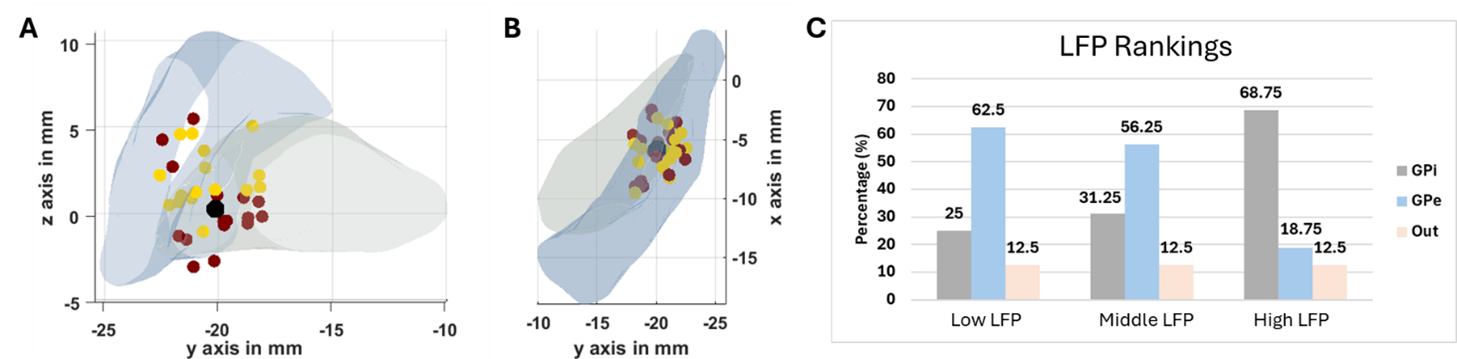
figure1
References: 1.Binder, Tobias, et al. “Feasibility of local field potential-guided programming for deep brain stimulation in Parkinson’s disease: a comparison with clinical and neuro-imaging guided approaches in a randomized, controlled pilot trial.” Brain Stimulation 16.5 (2023): 1243-1251.
2.Lewis, Sydnei, et al. “Pilot study to investigate the use of in-clinic sensing to identify optimal stimulation parameters for deep brain stimulation therapy in Parkinson’s disease.” Neuromodulation: Technology at the Neural Interface 27.3 (2024): 509-519.
To cite this abstract in AMA style:
M. Case, C. Zarns, A. Singh, R. Vigh, A. Holt-Becker, R. Raike, A. Ragothaman, J. Lee, G. Harker, L. Neilson, K. Burchiel, M. Mancini, D. Safarpour. Monopolar Sensing within the Globus Pallidus and the Relationship between Clinical Outcomes and Anatomy [abstract]. Mov Disord. 2026; 41 (suppl 1). https://www.mdsabstracts.org/abstract/monopolar-sensing-within-the-globus-pallidus-and-the-relationship-between-clinical-outcomes-and-anatomy/. Accessed October 1, 2026.« Back to 2026 International Congress
MDS Abstracts - https://www.mdsabstracts.org/abstract/monopolar-sensing-within-the-globus-pallidus-and-the-relationship-between-clinical-outcomes-and-anatomy/