
Session Information
Date: Tuesday, September 24, 2019
Session Title: Parkinsonisms and Parkinson-Plus
Session Time: 1:45pm-3:15pm
Location: Agora 3 West, Level 3
Objective: This study attempts to identify different phenotypes of patients with MSA and to describe corresponding brain 18-FDG Positron Emission Tomography (PET) patterns.
Background: In clinical practice, there is a heterogeneity in patients with multiple system atrophy (MSA) (e.g., parkinsonian/cerebellar/mixed types, cognitive impairment, atypical longer survival) that is not adequately represented by the current diagnostic criteria (Gilman et al., 2008).
Method: Patients with a “probable” MSA diagnosis for whom a brain 18-FDG PET was performed were included. A retrospective analysis (from 2006 to 2017) was conducted using standardized data collection. We used Latent Class Analysis (LCA), an innovative statistical approach, to identify profiles of patients based on common clinical characteristics. Brain metabolism of different groups was studied at rest.
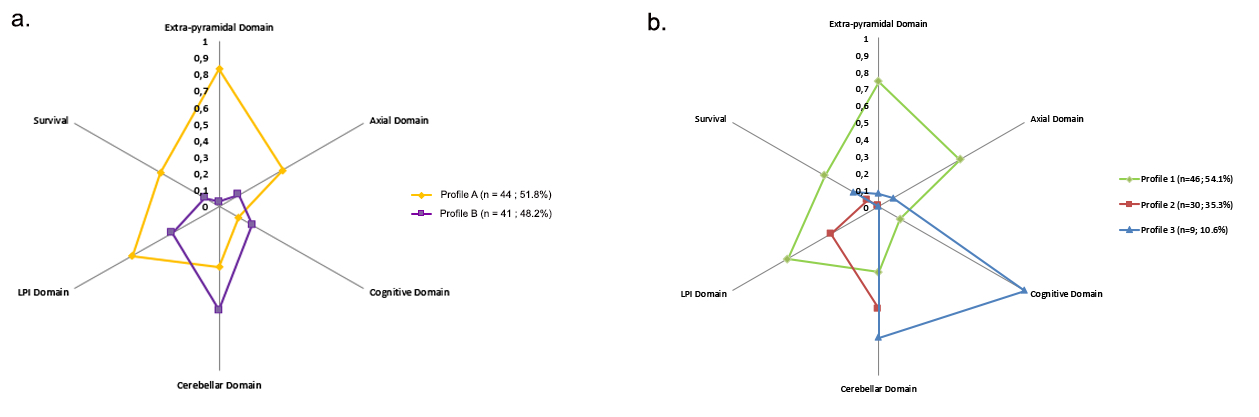
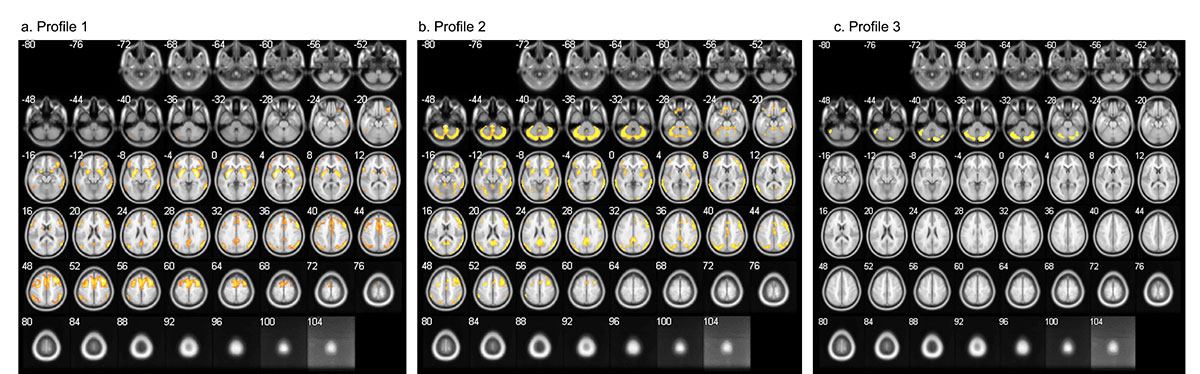
Results: Eighty-five patients were included. Three different profiles were revealed (entropy= 0.835): 1.extrapyramidal, axial, laryngeal-pharyngeal involvement (LPI) and cerebellar symptoms (n=46, 54.1%); 2.cerebellar and LPI symptoms (n=30, 35.3%); 3.cerebellar and cognitive symptoms (n=9, 10.6%). Brain metabolism analyses (k>89; p<0.001) showed hypometabolism of the basal ganglia, frontal/prefrontal, temporal cortices and left posterior cerebellum in profile 1. In profile 2 there was hypometabolism of the medulla, prefrontal, temporal, cingular cortices, putamen and bilateral cerebellar hemispheres. In profile 3 there was hypometabolism of bilateral posterior cerebellar hemispheres and vermis.
Conclusion: Beyond the two most common phenotypes of MSA, a third and particularly atypical profile with cerebellar and cognitive symptoms but without LPI/extrapyramidal/axial involvement is described. These profiles are supported by different brain metabolic abnormalities which could be useful for diagnostic purposes. This abstract has ben accepted for a poster at the 2019 European Academy of Neurology Congress.
To cite this abstract in AMA style:
A. Eusebio, E. Guedj, JP. Azulay, M. Renaud, M. Boucekine, S. Grimaldi. Multiple System Atrophy: phenotypic spectrum approach coupled with brain FDG PET [abstract]. Mov Disord. 2019; 34 (suppl 2). https://www.mdsabstracts.org/abstract/multiple-system-atrophy-phenotypic-spectrum-approach-coupled-with-brain-fdg-pet/. Accessed October 11, 2026.« Back to 2019 International Congress
MDS Abstracts - https://www.mdsabstracts.org/abstract/multiple-system-atrophy-phenotypic-spectrum-approach-coupled-with-brain-fdg-pet/