
Category: Technology
Objective: To evaluate the comparative efficacy, safety, and energy efficiency of adaptive deep brain stimulation (aDBS) versus continuous deep brain stimulation (cDBS) in Parkinson’s disease (PD) patients with emerging motor complications.
Background: Standard cDBS maintains a consistent amplitude irrespective of medication status or neural variability [1, 2]. aDBS adjusts stimulation automatically using real-time neurophysiological biomarkers like subthalamic nucleus (STN) beta (13–30 Hz) or stimulation-entrained gamma (60–90 Hz) power [1-3].
Method: We performed a systematic review and meta-analysis of clinical trials (2024–2025) that compared aDBS and cDBS. The main results were changes in daily on-time without bothersome dyskinesia and total electrical energy delivered (TEED). MDS-UPDRS III and quality of life (QoL) metrics were among the secondary outcomes. Mixed-effects models were used to combine the data [1, 2, 4].
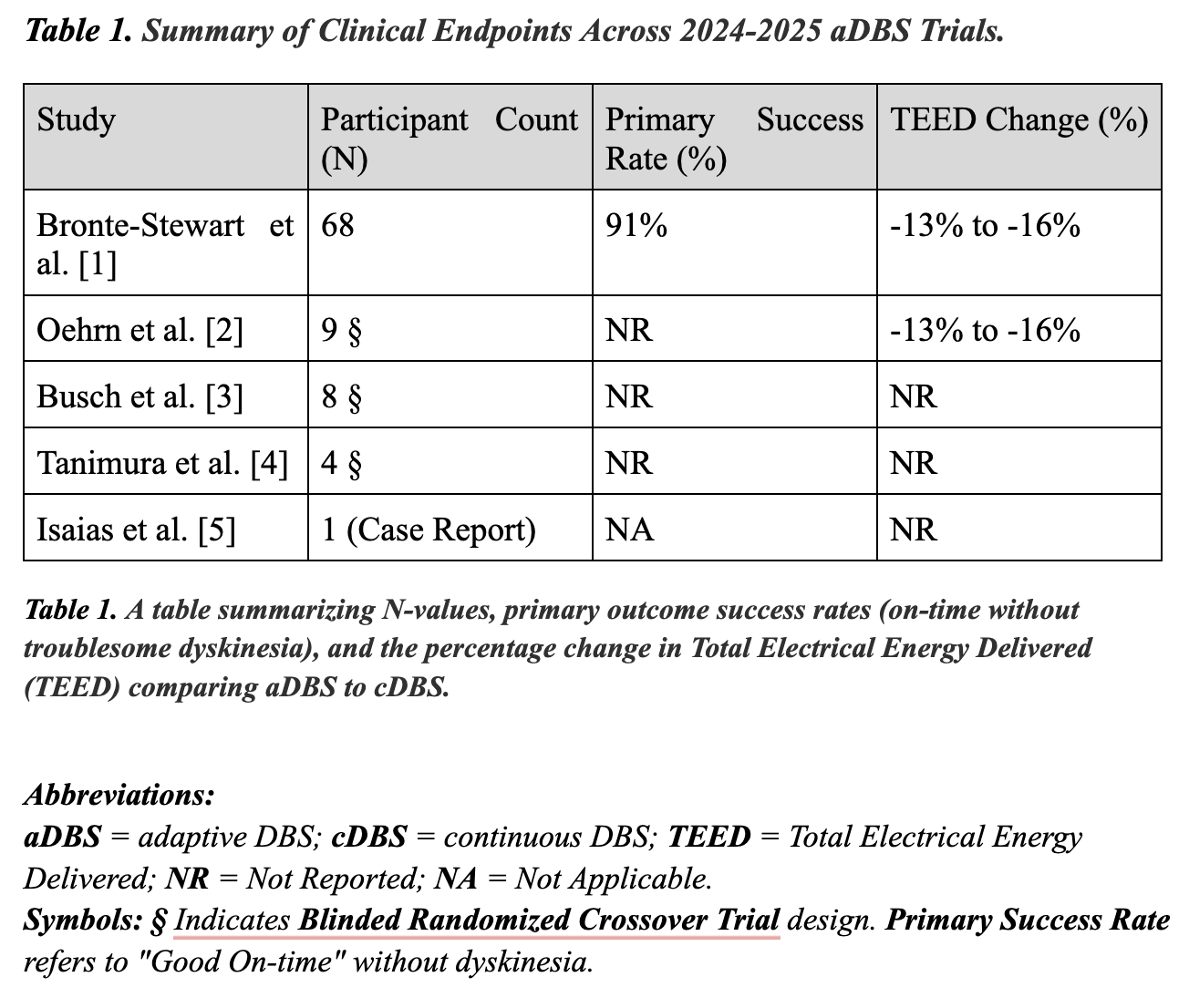
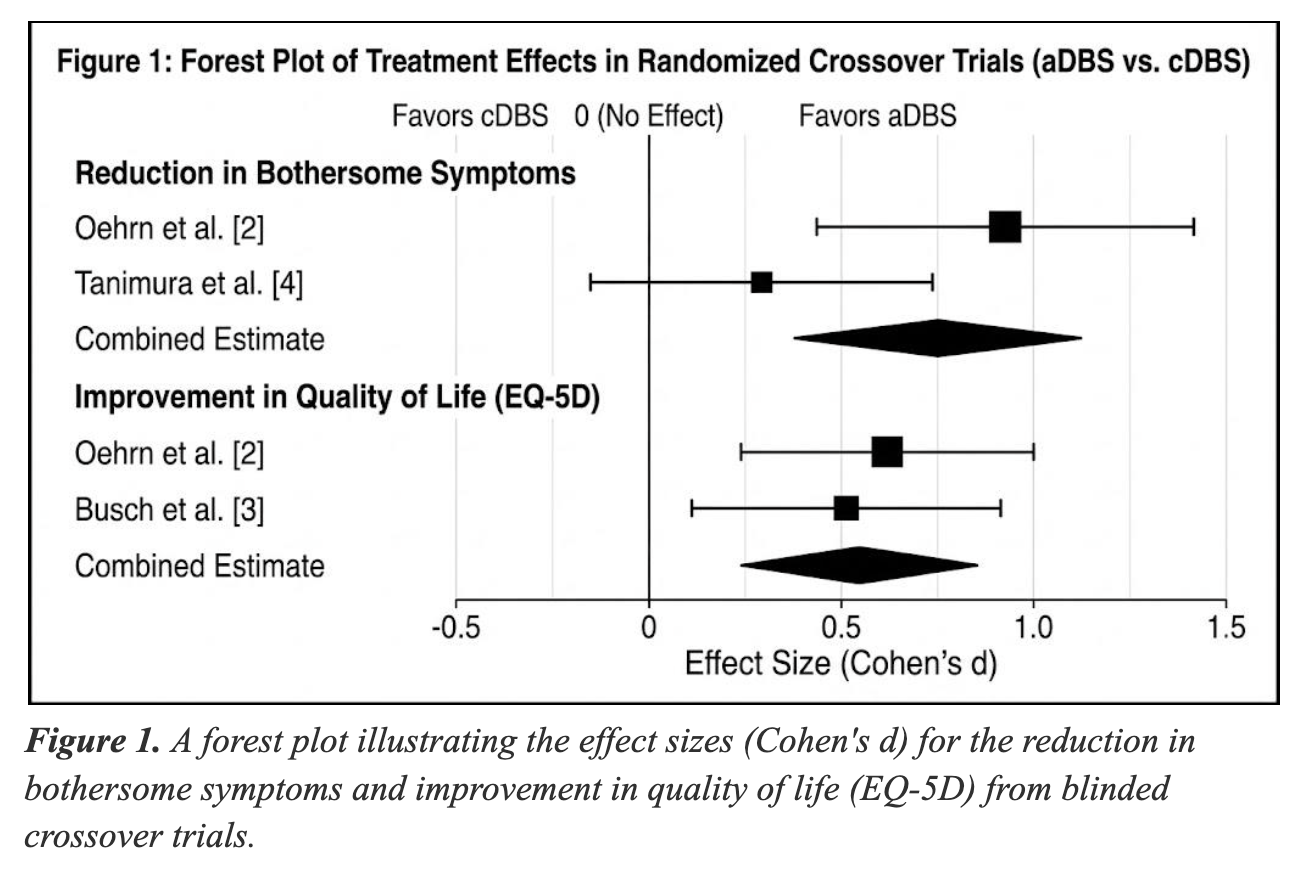
Results: Five main datasets were looked at, including nonrandomized pivotal data (N=68) and blinded randomized crossover trials (N=9, N=8, N=4) [1-4]. A DBS met performance goals for good on-time in 91% of participants, showing that it was not worse than clinically optimized cDBS [1]. In blinded settings, aDBS significantly diminished the duration of bothersome symptoms (β=−16.3%, p<0.001) and elevated QoL scores (β=6.9, p<0.0001) [2]. A meta-analysis of energy metrics showed that TEED dropped significantly during aDBS (13–16% decrease; p<0.01) [1, 2]. Although population-level MDS-UPDRS III scores were frequently similar across modes, notable individual-level enhancements were observed in 37.5% of subjects [3, 4]. aDBS also changed the way people walked by making their strides longer and faster (p<0.05) [5]. There were no serious device-related adverse events; stimulation-related events usually went away when the parameters were adjusted [1, 2]. [Table 1], [Figure 1]
Conclusion: This synthesis corroborates that aDBS is secure and efficacious for practical motor complications. By responding to changing neural states, aDBS stays effective in the clinic while using much less energy than stable cDBS. These results demonstrate that aDBS is a more effective personalized treatment option for patients experiencing emerging fluctuations.
at the end of result section
at the end of result section , after Table 1
References: [1] Bronte-Stewart HM, Beudel M, Ostrem JL, et al. Long-Term Personalized Adaptive Deep Brain Stimulation in Parkinson Disease: A Nonrandomized Clinical Trial. JAMA Neurol. 2025;82(11):1171-1180. doi:10.1001/jamaneurol.2025.2781
[2] Oehrn CR, Cernera S, Hammer LH, et al. Chronic adaptive deep brain stimulation versus conventional stimulation in Parkinson’s disease: a blinded randomized feasibility trial. Nat Med. 2024;30(11):3345-3356. doi:10.1038/s41591-024-03196-z
[3] Busch JL, Kaplan J, Behnke JK, et al. Chronic adaptive deep brain stimulation for Parkinson’s disease: clinical outcomes and programming strategies. NPJ Parkinsons Dis. 2025;11(1):264. doi:10.1038/s41531-025-01124-7
[4] Tanimura J, Yako T, Hashimoto T. Chronic adaptive versus conventional DBS response patterns in Parkinson’s disease: A pilot randomized crossover trial. Harvard Dataverse. 2025. doi:10.7910/DVN/U1SNWI
[5] Isaias IU, Caffi L, Borellini L, et al. Case report: Improvement of gait with adaptive deep brain stimulation in a patient with Parkinson’s disease. Front Bioeng Biotechnol. 2024;12:1428189. doi:10.3389/fbioe.2024.1428189
To cite this abstract in AMA style:
F. Al-Zaidi. Real-World Clinical Outcomes of Adaptive versus Continuous Deep Brain Stimulation in Early-Stage Parkinson’s Disease: A Systematic Review and Meta-Analysis of 2024-2025 Trials [abstract]. Mov Disord. 2026; 41 (suppl 1). https://www.mdsabstracts.org/abstract/real-world-clinical-outcomes-of-adaptive-versus-continuous-deep-brain-stimulation-in-early-stage-parkinsons-disease-a-systematic-review-and-meta-analysis-of-2024-2025-trials/. Accessed October 1, 2026.« Back to 2026 International Congress
MDS Abstracts - https://www.mdsabstracts.org/abstract/real-world-clinical-outcomes-of-adaptive-versus-continuous-deep-brain-stimulation-in-early-stage-parkinsons-disease-a-systematic-review-and-meta-analysis-of-2024-2025-trials/