
Category: Tremor
Objective: To evaluate the efficacy of stereotactic neurosurgery for Holmes tremor in a consecutive cohort and identify predictors of treatment outcome.
Background: Holmes tremor is a rare and often severely disabling movement disorder characterized by low-frequency rest and action tremor [1]. The most frequent etiology is an infratentorial or thalamic lesion. Unfortunately, medical management is ineffective for many patients, and in such cases, stereotactic neurosurgery – either via lesioning procedures or deep brain stimulation (DBS) – can be considered [2]. The outcomes of these are only documented in case-based literature. Prognostic factors for surgical outcomes in Holmes tremor have yet to be systematically evaluated.
Method: We reviewed our database for Holmes tremor patients who underwent stereotactic neurosurgery between 2000 and 2025. Patients aged ≥18 years, with preoperative MRI and video recordings available, were included if they met the 2018 MDS-consensus criteria for Holmes tremor, confirmed through video and health record reviews. Clinical data and lesion locations based on MRI were extracted from electronic health records. Treatment outcomes were categorized as either “good” or “poor” based on the Patient and Clinician Global Impression of Change scale. “Good” outcome was defined as a score of 1 or 2 (“very much improved” or “much improved”) concerning overall clinical condition. Potential predictors of outcome were examined using univariable logistic regression analyses.
Results: Seventeen patients were included in the study, 13 underwent DBS, three underwent lesioning procedures and one underwent one-sided lesioning and contralateral DBS [table 1]. Heterogeneity in clinical presentation, etiology, and lesion location was considerable. 44% (8/18 hemispheres) were classified as good responders after the first intervention. Of the poor responders, 5/10 hemispheres underwent a second intervention, with good outcome in two who underwent additional lesioning. Poorer outcomes were linked to older age (Odds ratio = 0.90, p = 0.047) and internal capsule lesions (OR = 0.14, p = 0.069), with the latter showing a trend.
Conclusion: In medication-refractory Holmes tremor, nearly half of treated hemispheres improved after the first intervention, rising to over half after additional treatment. Older age and internal capsule lesions may predict poorer outcomes.
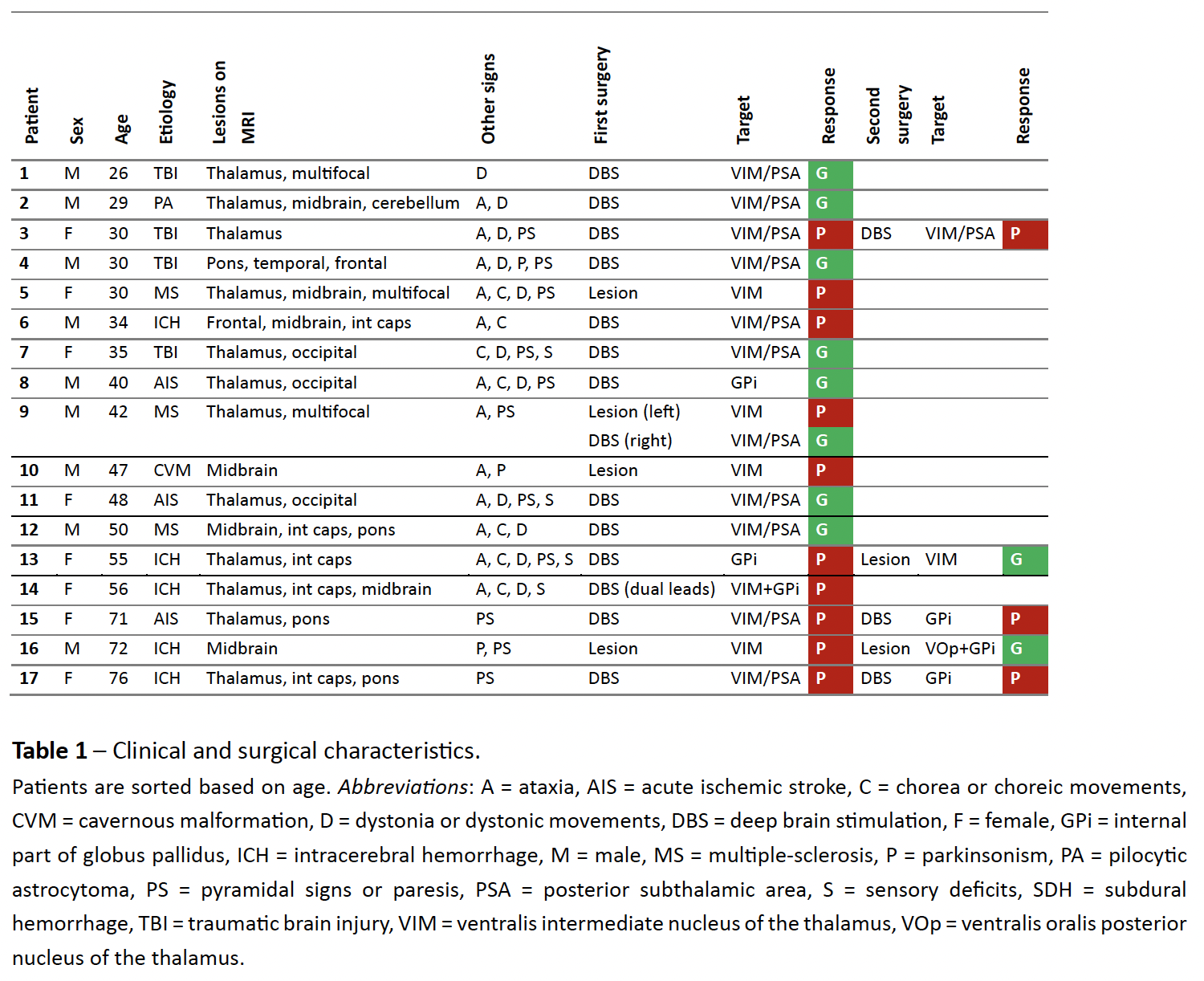
Table 1
References: [1] Bhatia KP, Bain P, Bajaj N, Elble RJ, Hallett M, Louis ED, et al. Consensus Statement on the
classification of tremors. from the task force on tremor of the International Parkinson and Movement Disorder Society. Movement Disorders. 2018 Jan 1;33(1):75–87.
[2] Wang KL, Wong JK, Eisinger RS, Carbunaru S, Smith C, Hu W, et al. Therapeutic Advances in the Treatment of Holmes Tremor: Systematic Review. Neuromodulation. 2022 Aug 1;25(6):796–803.
To cite this abstract in AMA style:
D. de Bont, V. Odekerken, R. de Bie, M. Bot, P. Munckhof, P. Schuurman, M. Beudel, A. Buijink. Stereotactic Neurosurgery for Holmes Tremor: a Retrospective Cohort Study [abstract]. Mov Disord. 2026; 41 (suppl 1). https://www.mdsabstracts.org/abstract/stereotactic-neurosurgery-for-holmes-tremor-a-retrospective-cohort-study/. Accessed October 1, 2026.« Back to 2026 International Congress
MDS Abstracts - https://www.mdsabstracts.org/abstract/stereotactic-neurosurgery-for-holmes-tremor-a-retrospective-cohort-study/