
Category: Huntington's Disease
Objective: To assess clinical outcomes and identify stimulation and structural connectivity patterns associated with motor improvement in Huntington’s Disease (HD) patients undergoing DBS.
Background: DBS is as a potential therapy for refractory chorea in HD. However, clinical outcomes remain variable, and the optimal stimulation target has not been established. Identifying stimulation sites and connectivity patterns associated with clinical benefit could help explain this variability and guide patient-specific targeting strategies.
Method: Two adult-onset HD (CAG 43 and 46) received bilateral GPi DBS. One juvenile-onset HD (CAG 72) underwent quadruple DBS (bilateral GPi + STN). Clinical follow-up and systematic monopolar reviews were performed 1 month and 1 year after DBS. Four stimulation conditions were tested following a 15-minute washout. Motor severity was assessed using UHDRS Total Motor Score (TMS together with functional and cognitive evaluations. Each stimulation condition (n = 12) was modeled independently using Lead-DBS to estimate the Volume of Tissue Activated (VTA). Voxel-wise sweet-spot analysis correlated VTA overlap with percentage motor improvement across conditions. White matter tract involvement was assessed using a normative structural connectome with fiber-based correlation analysis.
Results: Adult-onset patients showed improvement in TMS-UHDRS (21–31%), particularly in the chorea (35–57%) and dystonia (37–45%) items, with mild functional improvement. The juvenile-onset patient experienced mild dystonia improvement with GPi but no benefit with STN. No significant changes in cognition were observed.
Voxel-wise analysis identified a region in the postero-lateral GPe associated with greater improvement in TMS (r=0.58) and chorea (r=0.62). Fiber-based tractography showed that engagement of corticopallidal fibers from somatomotor regions controlling the proximal upper limbs, head and neck correlated with improvement in TMS (r=0.65) and chorea (r=0.80). No significant results were found for dystonia.
Conclusion: Motor improvement following DBS in HD may depend on engagement of specific pallidal subregions and their associated motor networks. Our results implicate the posterolateral GPe and related corticopallidal pathways as potential substrates of clinical benefit. While exploratory, these findings highlight the value of connectomic approaches to better understand and optimize DBS targeting in HD.
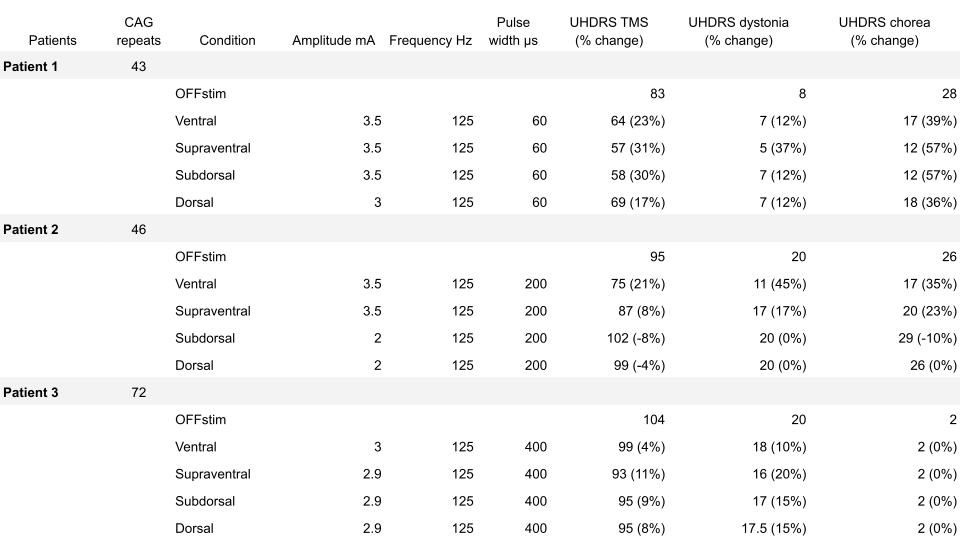
Summary of systematic monopolar reviews
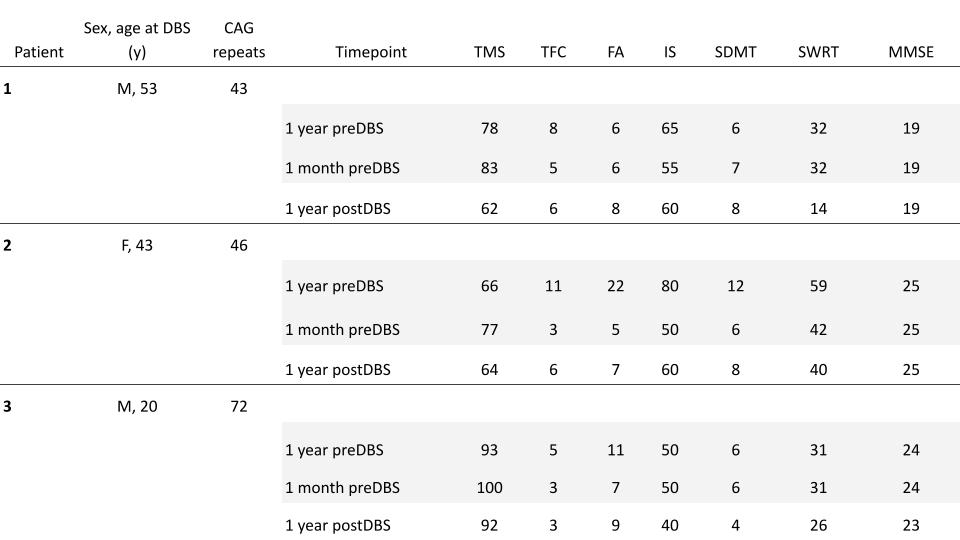
Motor, functional, and neuropsychological scores
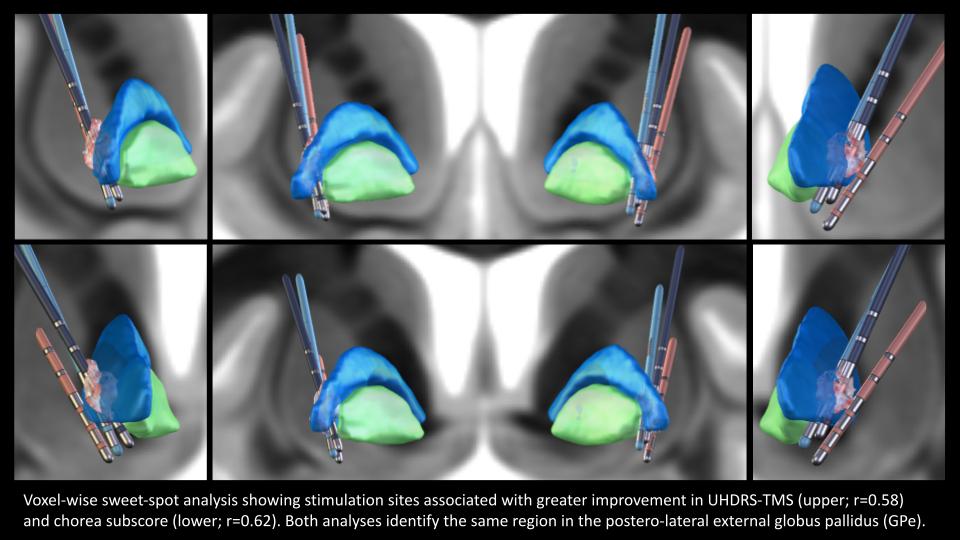
Voxel-wise sweet-spot analysis
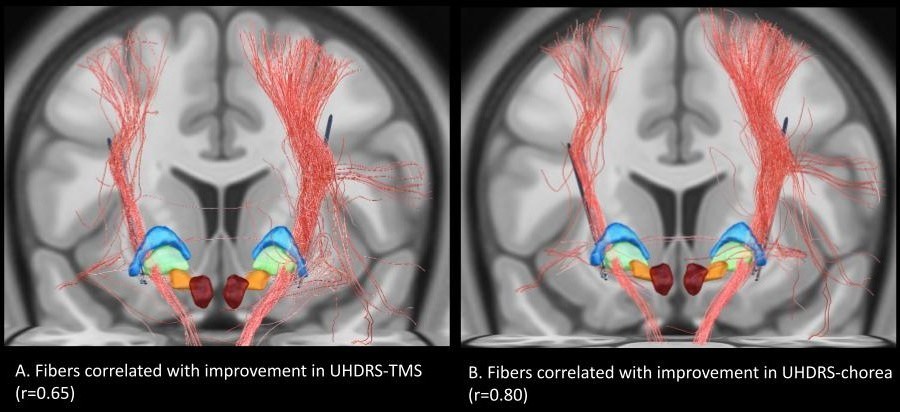
Fiber-based correlation analysis
To cite this abstract in AMA style:
M. Borrell-Pichot, G. Olmedo-Saura, A. Puig-Davi, C. Franch-Marti, S. Martínez-Horta, R. Rodríguez-Rodríguez, JA. Aibar-Duran, R. Martínez-Fernández, B. Pascual-Sedano, J. Kulisevsky, J. Pérez-Pérez, I. Aracil-Bolaños. Stimulation-Level Sweet-Spot and Connectivity Analysis of Pallidal DBS in Huntington’s Disease [abstract]. Mov Disord. 2026; 41 (suppl 1). https://www.mdsabstracts.org/abstract/stimulation-level-sweet-spot-and-connectivity-analysis-of-pallidal-dbs-in-huntingtons-disease/. Accessed October 1, 2026.« Back to 2026 International Congress
MDS Abstracts - https://www.mdsabstracts.org/abstract/stimulation-level-sweet-spot-and-connectivity-analysis-of-pallidal-dbs-in-huntingtons-disease/