
Objective: We aim to characterize the evolution and subtypes in the cognitive impairment in Parkinson’s disease (PD).
Background: Cognitive impairment (CI) is one of the non-motor symptoms that most impairs the quality of life in patients with PD. PD patients with CI appear to exhibit different patterns of cognitive domain impairment, and most studies identify that as anterior or posterior cortical symptoms. Besides, the dual syndrome hypothesis was proposed to account for this phenomenon. However, the classification definitions up to now could only describe the characteristics of CI at cross-sectional data which makes the definitions not robust enough. The current study has applied a unsupervised machine learning algorithm named Subtype and Stage Inference (SuStaIn) to identify distinct patterns in progression of cognitive impairment.
Method: 352 PD patients and 34 healthy controls were enrolled and completed comprehensive 10 cognitive scale assessments across five cognitive domains including attention and working memory, executive function, language, memory and visuospatial function. We allied SuStaIn to the assessments to find out the progression model and potential phenotypes of PD-CI.
Results: We can see PD-CI could be categorized into two clusters, with one of them encompassing most patients, which implies that PD-CI exhibits an overall development pattern with a small number of variants. Generally, cognitive impairment begins with language, attention and visuospatial function, followed by memory, and ultimately progresses to executive function. 20 percent of individuals, attention decline occurs later, while visuospatial and memory functions remain relatively preserved.
Conclusion: We describe the evolutionary trajectory of PD-CI which does not support distinguishing subtypes solely based on the characteristics of cognitive domain involvement at a single time point. A small subgroup exhibits relatively preserved visuospatial and memory functions with slower decline in cognition.
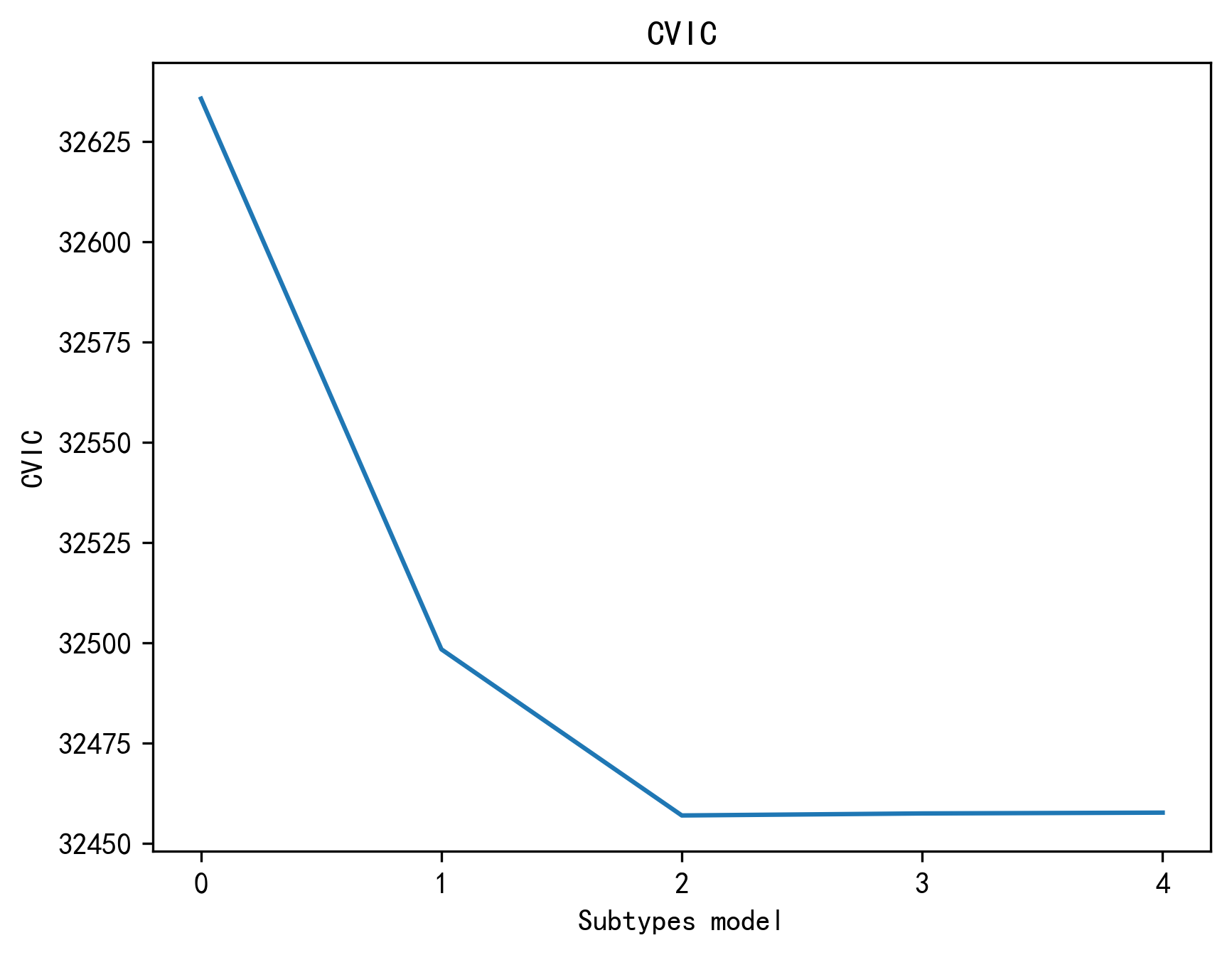
The CVIC under different number of subtypes.
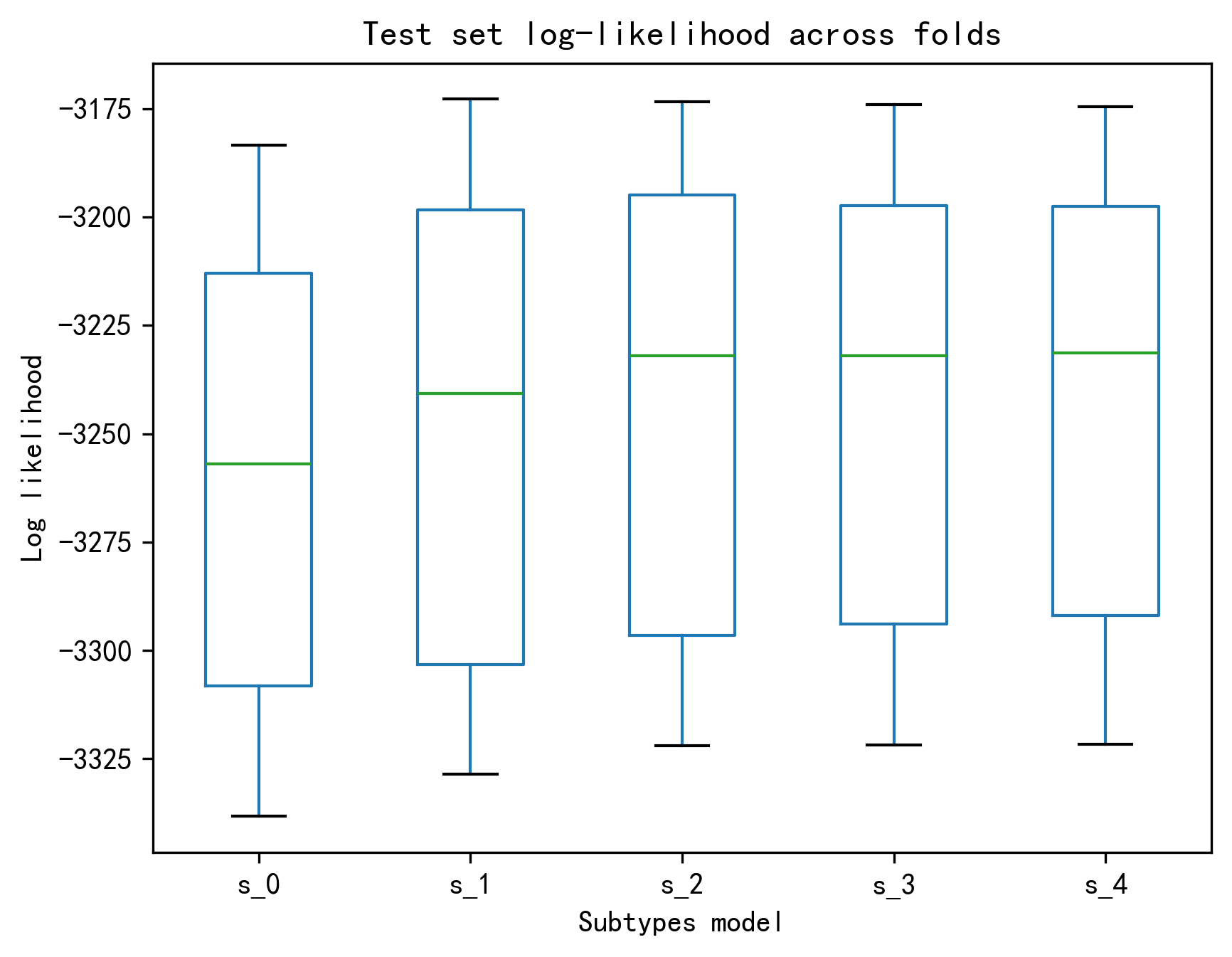
Log Likelihood across 10-fold cross-validation.
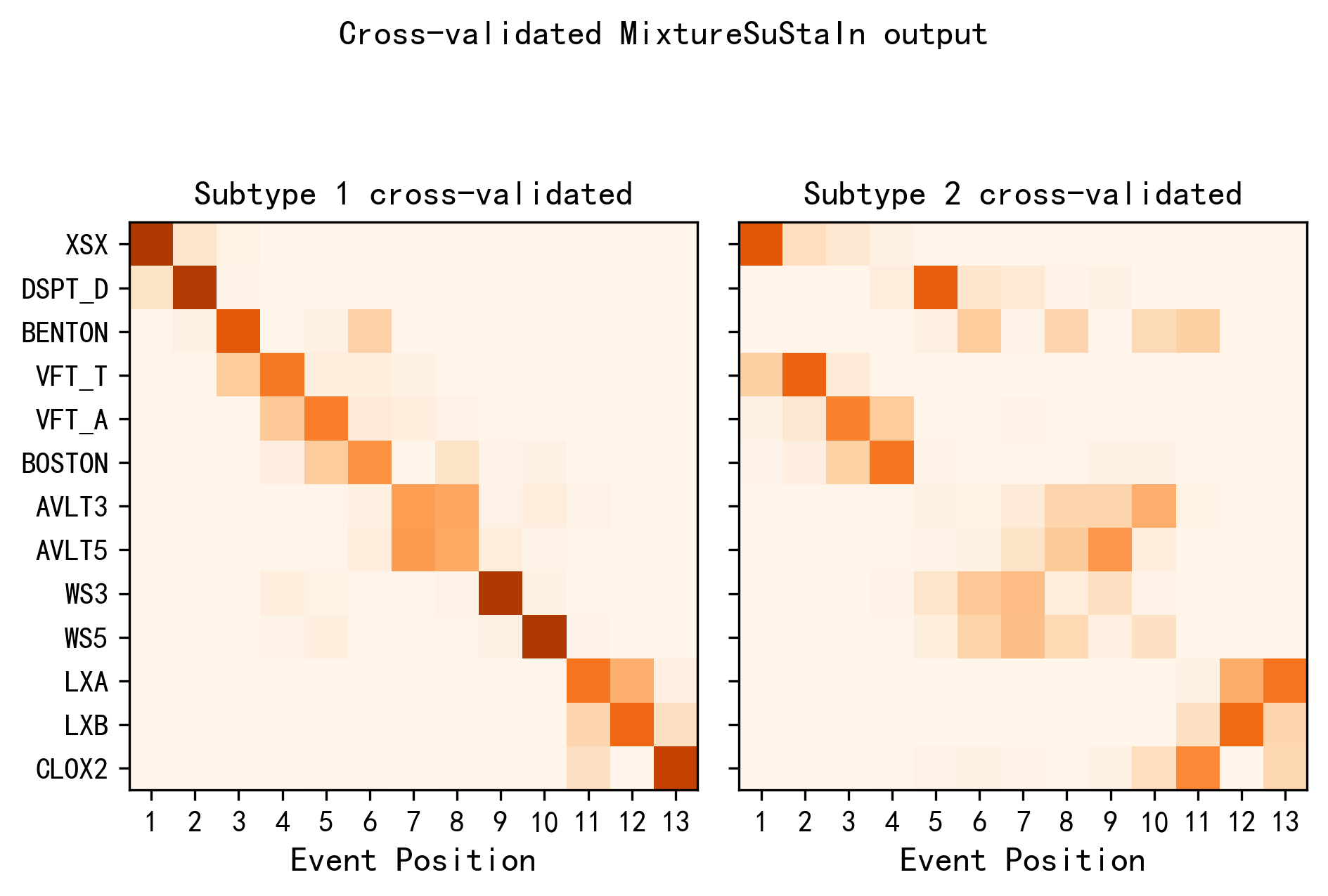
The positional density maps of two PD-CI subtypes.
References: [1] P. Oikonomou, F.H. Akhoundi, N. Olfati, I. Litvan, Characteristics and mechanisms of cognitive impairment in parkinson disease, Nat. Rev. Neurol. (2025). https://doi.org/10.1038/s41582-025-01163-x.
[2] A.A. Kehagia, R.A. Barker, T.W. Robbins, Cognitive impairment in parkinson’s disease: The dual syndrome hypothesis, Neurodegener. Dis. 11 (2013) 79–92. https://doi.org/10.1159/000341998.
[3] C. Nombela, J.B. Rowe, S.E. Winder-Rhodes, A. Hampshire, A.M. Owen, D.P. Breen, G.W. Duncan, T.K. Khoo, A.J. Yarnall, M.J. Firbank, P.F. Chinnery, T.W. Robbins, J.T. O’Brien, D.J. Brooks, D.J. Burn, ICICLE-PD study group, R.A. Barker, Genetic impact on cognition and brain function in newly diagnosed parkinson’s disease: ICICLE-PD study, Brain 137 (2014) 2743–2758. https://doi.org/10.1093/brain/awu201.
[4] L.M. Aksman, P.A. Wijeratne, N.P. Oxtoby, A. Eshaghi, C. Shand, A. Altmann, D.C. Alexander, A.L. Young, pySuStaIn: A python implementation of the subtype and stage inference algorithm, SoftwareX 16 (2021) 100811. https://doi.org/10.1016/j.softx.2021.100811.
[5] M.I. De Bartolo, A. Ojha, G. Leodori, C. Piervincenzi, G. Vivacqua, S. Pietracupa, M. Costanzo, F. D’Antonio, S. Barbetti, R. Margiotta, G. Bruno, A. Conte, A. Berardelli, G. Fabbrini, P. Pantano, D. Belvisi, Association of early fMRI connectivity alterations with different cognitive phenotypes in patients with newly diagnosed parkinson disease, Neurology 104 (2025) e210192. https://doi.org/10.1212/WNL.0000000000210192.
To cite this abstract in AMA style:
A. Huang, X. Xue, Z. Wu, S. Liu, E. Xu, P. Chan. The Evolutionary Pathway of Cognitive Impairment in Parkinson’s Disease: A SuStaIn Study [abstract]. Mov Disord. 2026; 41 (suppl 1). https://www.mdsabstracts.org/abstract/the-evolutionary-pathway-of-cognitive-impairment-in-parkinsons-disease-a-sustain-study/. Accessed October 1, 2026.« Back to 2026 International Congress
MDS Abstracts - https://www.mdsabstracts.org/abstract/the-evolutionary-pathway-of-cognitive-impairment-in-parkinsons-disease-a-sustain-study/