
Category: Drug-Induced Movement Disorders
Objective: To report a rare case of the Lentiform Fork Sign associated with acute parkinsonism in a patient with end-stage renal disease and metformin-associated lactic acidosis.
Background: The Lentiform Fork Sign is a rare neuroradiological finding characterized by bilateral T2/FLAIR hyperintensities in the basal ganglia outlining the internal and external capsules (1). It has been most commonly described in patients with end-stage renal disease and is typically associated with metabolic acidosis. The proposed mechanism involves cerebral acidosis leading to vasogenic and/or cytotoxic edema in metabolically vulnerable regions such as the basal ganglia (2).
Method: We report a 43-year-old man with end-stage renal disease on hemodialysis and type 2 diabetes mellitus who presented with acute-onset resting tremor in the right upper limb, slurred speech, and gait disturbance characterized by difficulty initiating and stopping gait during a hemodialysis session. He reported irregular “on-demand” use of metformin for hyperglycemia. Neurological examination revealed mild inattention, bradykinesia with reduced arm swing (more prominent on the right), and gait instability. Laboratory evaluation showed marked hyperlactatemia (44 mg/dL) with a compensated arterial pH (7.37), low bicarbonate (19.1 mEq/L), and reduced pCO₂ (33 mmHg), consistent with compensated lactic acidosis, likely related to metformin use in the setting of end-stage renal disease. Brain MRI demonstrated symmetrical hyperintensities in the basal ganglia with the characteristic Lentiform Fork Sign [Figure 1].
Results: Metformin was discontinued. At the 3-month follow-up, the patient showed significant clinical improvement, with only mild residual micrographia and a subtle tremor in the right leg.
Conclusion: This report describes a rare presentation of acute parkinsonism occurring during a hemodialysis session in a patient with end-stage renal disease and inappropriate metformin use. The presence of a compensated arterial pH (7.37) despite marked hyperlactatemia and characteristic neuroimaging findings supports the hypothesis that the Lentiform Fork Sign may reflect focal cerebral metabolic acidosis even in the absence of systemic acidemia (3). Recognition of this pattern may facilitate early diagnosis of potentially reversible causes of acute parkinsonism, particularly in the setting of metformin-associated metabolic toxicity.
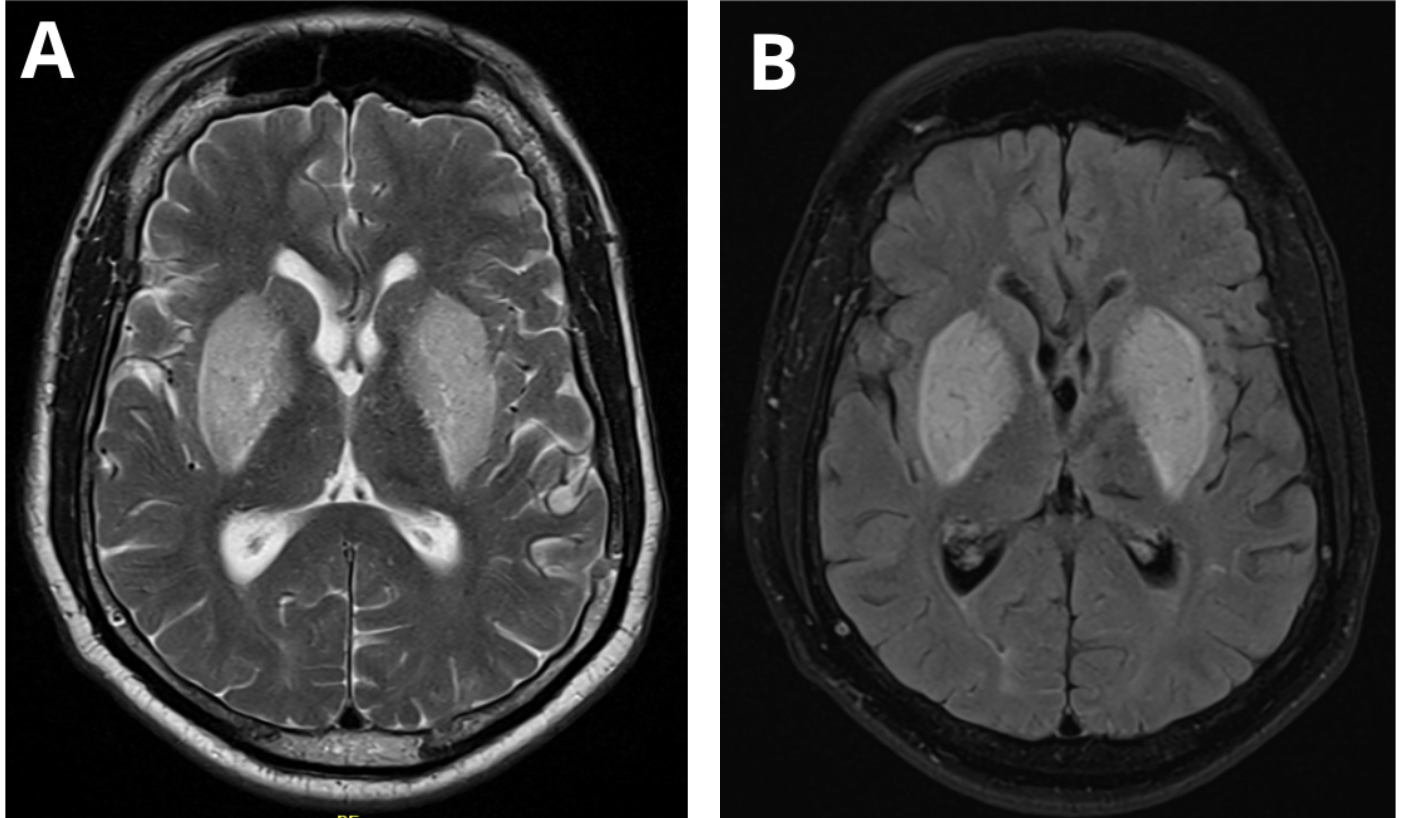
Lentiform Fork Sign on brain MRI (T2/FLAIR)
References: (1) Kumar G, Goyal MK. Lentiform Fork sign : A unique MRI picture . Is metabolic acidosis responsible? Clin Neurol Neurosurg. 2010;112(9):805-812. doi:10.1016/j.clineuro.2010.06.006
(2) Kim DM, Lee IH, Song CJ. Uremic Encephalopathy: MR Imaging Findings and Clinical Correlation. AJNR Am J Neuroradiol. 2016;37(9):1604-1609. doi:10.3174/ajnr.A4776
(3) Hanazono A, Takahashi Y, Sanpei Y, Kamada S, Sugawara M. Focal brain lactate accumulation in metformin-induced encephalopathy without systemic lactic acidosis: A case report suggesting mitochondrial vulnerability in lentiform fork sign. eNeurologicalSci. 2021 Nov 29;25:100383. doi: 10.1016/j.ensci.2021.100383. PMID: 34917782; PMCID: PMC8645906.
To cite this abstract in AMA style:
J. Haddad Labello, B. Souza Telho, J. Cavalcanti, R. Bernhart Carra, J. Bezerra Parmera. The Lentiform Fork Sign: Acute Parkinsonism in a Dialysis Patient with Metformin Misuse [abstract]. Mov Disord. 2026; 41 (suppl 1). https://www.mdsabstracts.org/abstract/the-lentiform-fork-sign-acute-parkinsonism-in-a-dialysis-patient-with-metformin-misuse/. Accessed October 1, 2026.« Back to 2026 International Congress
MDS Abstracts - https://www.mdsabstracts.org/abstract/the-lentiform-fork-sign-acute-parkinsonism-in-a-dialysis-patient-with-metformin-misuse/