
Objective: Our study is aimed to consider the relationship between PD and such factors as total calcium (Ca), calcium ionized (Ca2+), alkaline phosphatase (ALP), inorganic phosphorus (P), parathyroid hormone (PTH), vitamin D (VD).
Background: Parkinson’s disease (PD) is a multifactorial neurodegenerative disease. Last decades there is a growing interest to identify these factors. A number of studies have shown the effect of vitamin D (VD) on the course of PD. Some researchers report negative effects of VD deficiency on PD progression and cognitive function, others do not find a correlation between the severity of symptoms and overall cognitive function.
At the same time, more and more attention is being paid to other biochemical factors that are closely related to VD, taking into account their possible indirect effect on PD. A number of studies have shown the role of Ca in the severity of PD symptoms, as well as ALP, P and PTH.
Method: We performed an observational cross-sectional study. Serum levels of total calcium (Ca), calcium ionized (Ca2+), alkaline phosphatase (ALP), inorganic phosphorus (P), parathyroid hormone (PTH), vitamin D (VD) and disease severity (Hoehn-Yahr stage) and clinical symptoms (Unified Parkinson Disease Rating Scale), quality of life in PD patients (PDQ39), anxiety and depression (HADS), depression (Beck Depression Inventory), global cognitive function (MoCA) were evaluated in 138 patients with PD. Then, multiple linear regression method and student’s t-test were used.
Results: A statistically significant effect of calcium-phosphorus metabolism indicators on cognitive decline estimated by the MoCA scale and PDQ 39 “cognitive function ” subscale was revealed in patients with PD (Table 1). The number of MoCA scores (Figure 1) is significantly co-influenced by the levels of VD (β = 0.111, p = 0.002), ALP (β = -0.028, p = 0.027) and PTH (β = 0.02, p = 0.037). VD levels have an inverse, statistically significant (β = -0.904, p = 0.006) effect on the overall PDQ39 score (Table 2, Figure 2).
Conclusion: The results show that cognitive decline in patients with PD is directly related to the level of VD and PTH. At the same time, the lower the quality of life of patients with PD, the lower the serum levels of VD.
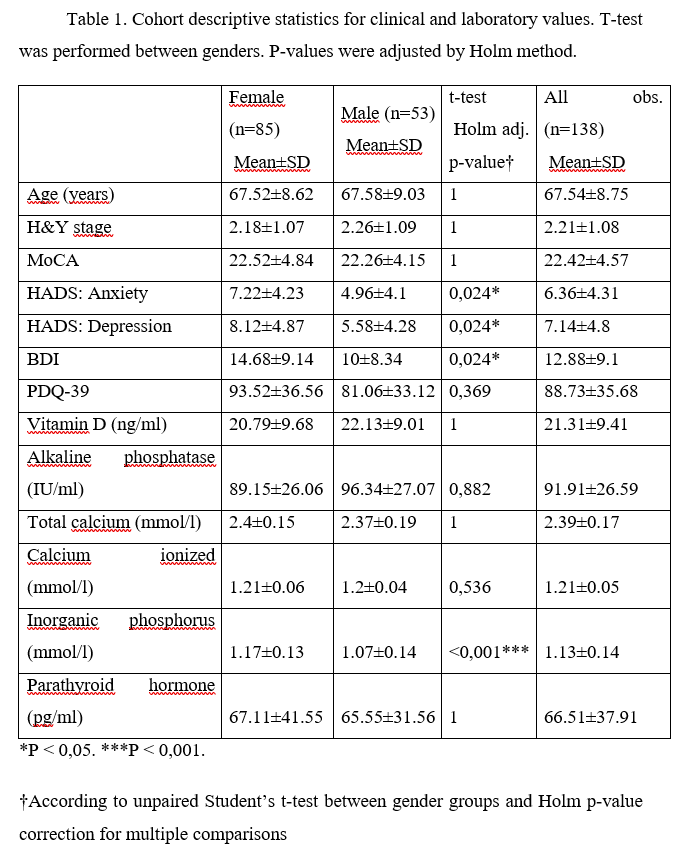
Cohort descriptive statistics
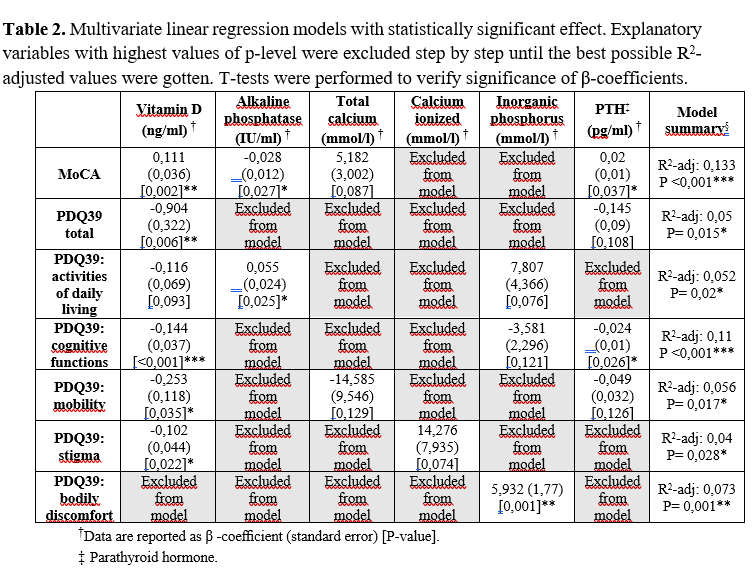
Multivariate linear regression models
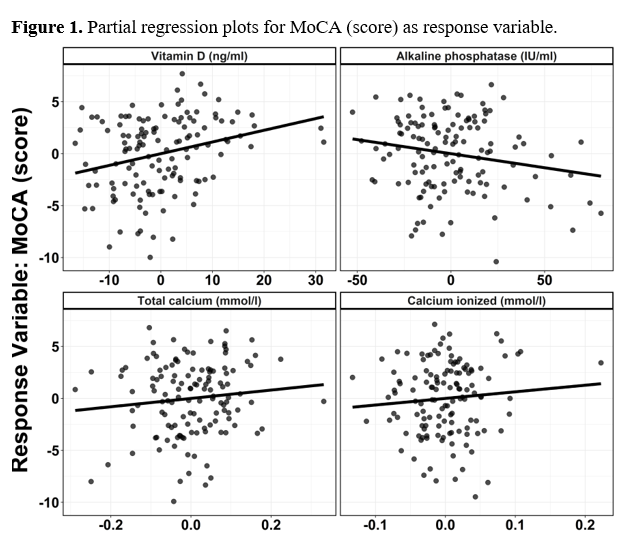
Partial regression plots MoCA
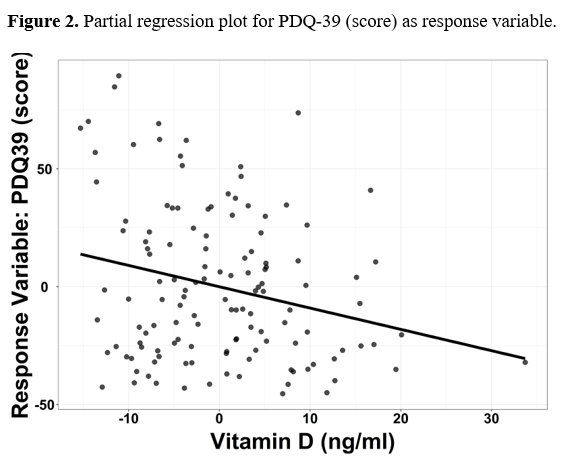
Partial regression plot for PDQ-39
References: 1. Understanding the role of “sunshine vitamin D” in Parkinson’s disease: A review. Behl T, Arora A, Singla RK, Sehgal A, Makeen HA, Albratty M, Meraya AM, Najmi A, Bungau SG. Front Pharmacol. 2022 Dec 19;13:993033. doi: 10.3389/fphar.2022.993033. eCollection 2022.
2. The effects of twenty-one nutrients and phytonutrients on cognitive function: A narrative review. Lewis JE, Poles J, Shaw DP, Karhu E, Khan SA, Lyons AE, Sacco SB, McDaniel HR. J Clin Transl Res. 2021 Aug 4;7(4):575-620. eCollection 2021 Aug 26.
3. Vitamin D-linked vulnerability and functional connectivity alterations in the superior frontal gyrus contributing to cognitive impairment in Parkinson’s disease.
Lv L, Qin L, Hu S, Tan C, Liao H, Zhang H, Ren F, Wang C. Front Aging Neurosci. 2025 Nov 19;17:1657723. doi: 10.3389/fnagi.2025.1657723. eCollection 2025.
4. Vitamin D and the nervous system. Bivona G, Gambino CM, Iacolino G, Ciaccio M. Neurol Res. 2019 Sep;41(9):827-835. doi: 10.1080/01616412.2019.1622872. Epub 2019 May 30.
To cite this abstract in AMA style:
D. Novotnyi, S. Shteimetz, A. Agasheva, N. Zhukova, L. Shperling, I. Zhukova, I. Shirokikh, M. Matveeva, O. Druzhinina. Vitamin D and cognitive dysfunction in patients with Parkinson’s disease [abstract]. Mov Disord. 2026; 41 (suppl 1). https://www.mdsabstracts.org/abstract/vitamin-d-and-cognitive-dysfunction-in-patients-with-parkinsons-disease/. Accessed October 1, 2026.« Back to 2026 International Congress
MDS Abstracts - https://www.mdsabstracts.org/abstract/vitamin-d-and-cognitive-dysfunction-in-patients-with-parkinsons-disease/