
Category: Parkinson's Disease: Cognitive functions
Objective: To describe the motor, cognitive and non-motor profiles in the early stage of PD using eMotion Kinect system, Moca Test and PD-CRS.
Background: The awareness of presence of non-motor symptoms (NMS) in PD patients is increasing because of the negative impact of quality of life. The heterogeneity of symptoms occurs through the course of the disease even in early stages. The relation of NMS with motor and cognition are been described but how the use of different cognition screening tools and gait assessment, has not be explored to find profiles related to NMS.
Method: Cross-sectional study. MDS-UPDRS part III and FOGQ were obtained. eMotion system (Kinect and accelerometers) was used to gait analysis. MoCA and PD-CRS test for global cognition and NMS-Quest for non-motor symptoms.Nonparametric U Mann-Whitney tests were applied to compare patients with and without NMS between gait variables, presence of NMS and cognitive tests (Moca and PD-CRS). Statistically significant difference was considered if the p-value was lower than 0.05.
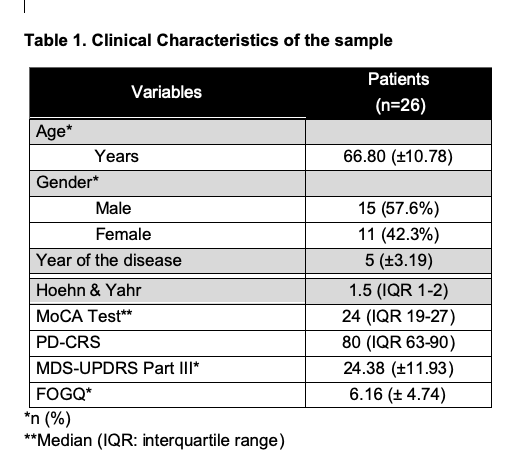
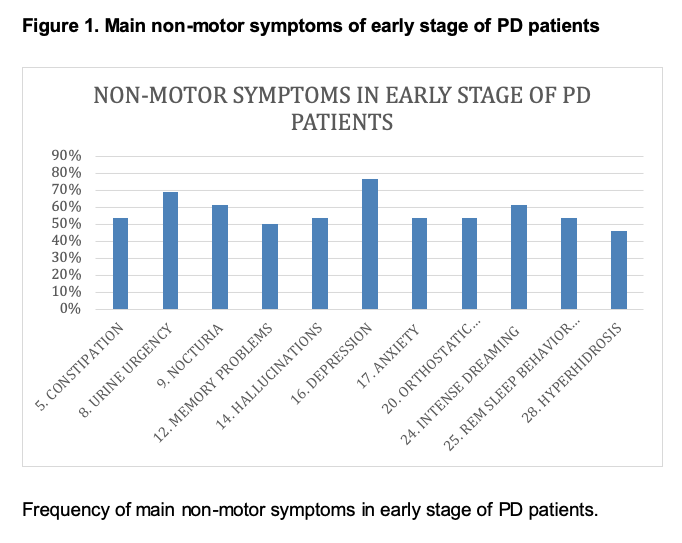
Results: Cross-sectional study. 26 patients with PD. 15 men (57.69%). Age 66.80 (SD 10.78), years of the disease 5(SD 3.19) and H&Y 1.5 (IQR 1-2) (Table 1). The most frequency of NMS were autonomic and sleep problems, mood and cognitive disorders (Figure 1). Significant differences were found for MoCA test in depression (p=0.02), REM behavior disorder (p=0.05); for PD-CRS in hallucinations (p=0.05) and global speed for REM behavior disorder (p<0.05).
Conclusion: found that PD patients had NMS even in the early stage. The performance in cognition screening tools was different between PD patients with the most frequency NMS (RBD, depression, and hallucinations). Global speed was lower in PD patients with RBD. The presence of NMS may be related to the performance in the cognitive screening tools.
To cite this abstract in AMA style:
B. Munoz Ospina, V. Quintana-Peña, D. Rincón, J. Valderrama, Y. Castaño-Pino, J. Orozco Velez, A. Navarro. What can tell us Non-Motor Symptoms about Cognition and Gait in the Early Stage of PD Patients [abstract]. Mov Disord. 2020; 35 (suppl 1). https://www.mdsabstracts.org/abstract/what-can-tell-us-non-motor-symptoms-about-cognition-and-gait-in-the-early-stage-of-pd-patients/. Accessed November 7, 2026.« Back to MDS Virtual Congress 2020
MDS Abstracts - https://www.mdsabstracts.org/abstract/what-can-tell-us-non-motor-symptoms-about-cognition-and-gait-in-the-early-stage-of-pd-patients/