
Category: Myoclonus
Objective: To report a case of a patient with lung cancer who developed lingual myoclonus, revealing brain metastases.
Background: Lingual myoclonus has been described associated with some cortical and subcortical brain diseases, including cerebral infarction, encephalitis, cerebral cavernoma, neurocysticercosis and glioma. The pathophysiology of lingual myoclonus remains unclear. In most cases an epileptic disorder is suggested.
Method: A 74-year-old man presented with progressive dysarthria for one month. He had a history of non-small cell lung cancer stage IIIA, treated with neoadjuvant chemotherapy followed by lobectomy. He complained of progressive slurred speech. He also presented paroxysmal episodes of clonic movements of the right side of his face lasting few seconds.
Results: The clinical examination discovered dysarthric speech and abnormal movements of his tongue, consisting of arrhythmic myoclonic jerking. The activity was more prominent when the tongue was protruded than resting on the floor of the oral cavity. Lingual myoclonus was continuous and showed isolated tongue involvement without simultaneous facial contractions. Myoclonic jerking was sensitive to touch but not to sound.
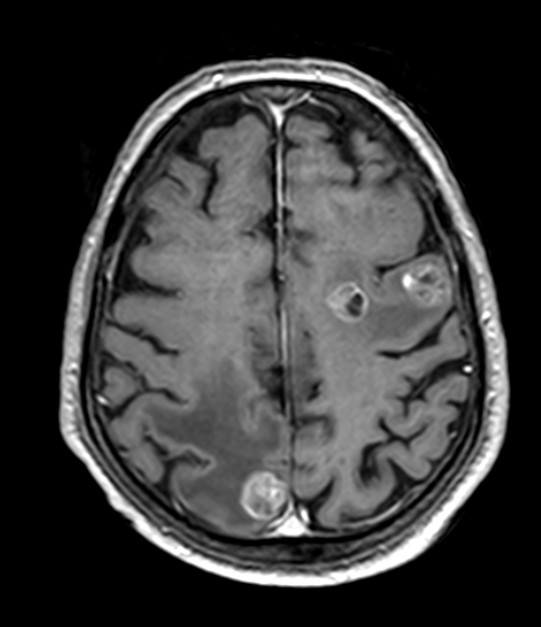
A brain CT scan showed three cortico-subcortical enhancing lesions with perilesional edema, one of them located in the left precentral gyrus, confirmed on MRI. The patient was started on 500 mg of levetiracetam intravenously at the emergency department and tongue movements were aborted. An EEG performed after antiepileptic drugs initiation did not show epileptiform activity.
Conclusion: To the best of our knowledge this is the first time that lingual myoclonus is associated with cerebral metastases. In this case, touch sensitive myoclonus suggests a cortical origin. The presence of a structural lesion close to the primary tongue motor cortex, the episodic clonic facial movements and the good response to antiepileptic drugs supports the epileptic origin.
To cite this abstract in AMA style:
G. Velilla Alonso, J. Soto Alsar, JJ. Rodríguez Irausquin, A. Sánchez Soblechero. Lingual myoclonus associated with brain metastasis located near the primary tongue motor cortex: case report. [abstract]. Mov Disord. 2021; 36 (suppl 1). https://www.mdsabstracts.org/abstract/lingual-myoclonus-associated-with-brain-metastasis-located-near-the-primary-tongue-motor-cortex-case-report/. Accessed November 11, 2026.« Back to MDS Virtual Congress 2021
MDS Abstracts - https://www.mdsabstracts.org/abstract/lingual-myoclonus-associated-with-brain-metastasis-located-near-the-primary-tongue-motor-cortex-case-report/