Objective: This meta-analysis evaluates the efficacy of glucagon-like peptide-1 receptor agonists (GLP-1 RAs) in patients with Parkinson’s disease (PD).
Background: Epidemiological studies suggest an increased risk of PD in individuals with diabetes, along with more severe and rapid motor and non-motor deterioration in diabetic PD patients compared to their non-diabetic counterparts. Notably, diabetic patients treated with GLP-1 RAs exhibit a lower risk of PD than those receiving other antidiabetic medications, suggesting potential neuroprotective effects.
Method: We systematically searched PubMed, Scopus, CENTRAL, Web of Science, and Embase for relevant randomized controlled trials (RCTs). The primary outcomes included motor function improvement (MDS-UPDRS Part III) and motor experiences of daily living (MDS-UPDRS Part II) compared to placebo or standard care. Data was extracted and analyzed using RevMan.
Results: Five RCTs (N = 580 participants) met our inclusion criteria, evaluating Exenatide (n=2), Liraglutide, NLY01, and Lixisenatide, with follow-up durations ranging from 44 to 60 weeks. GLP-1 RAs significantly improved MDS-UPDRS Part III scores in the ON state (MD = -2.88; 95% CI: -5.07 to -0.69; p = 0.01; I² = 30%, p = 0.23) (Fig. 1). Improvements in MDS-UPDRS Part II were observed but did not reach statistical significance (MD = -1.85; 95% CI: -3.72 to 0.02; p = 0.05) (Fig. 2).
Conclusion: GLP-1 RAs demonstrate promising effects on motor symptoms in PD, supporting their potential therapeutic role. Ongoing trials may provide critical insights into the clinical utility of these drugs for PD patients.
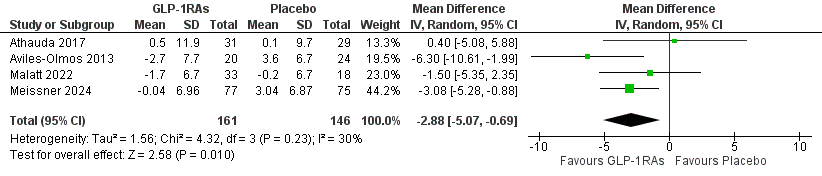
GLP-1RAs vs. placebo in MDS-UPDRS Part III Outcome
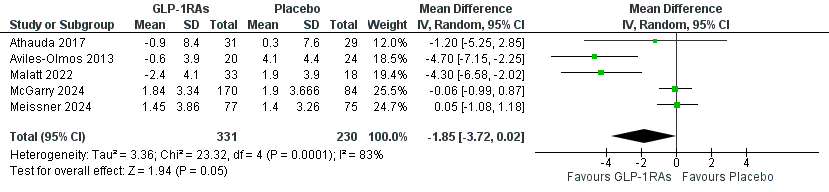
GLP-1RAs vs. placebo in MDS-UPDRS Part II Outcome
To cite this abstract in AMA style:
M. Helal, H. Aboushawareb, O. Hussein Abbas, R. Haddad, Y. Zain, A. S.A Osman, N. Hamam, A. Hassan. Neuroprotection on the Horizon: Are GLP-1 Receptor Agonists the Next Breakthrough in Parkinson’s Disease? [abstract]. Mov Disord. 2025; 40 (suppl 1). https://www.mdsabstracts.org/abstract/neuroprotection-on-the-horizon-are-glp-1-receptor-agonists-the-next-breakthrough-in-parkinsons-disease/. Accessed November 6, 2026.« Back to 2025 International Congress
MDS Abstracts - https://www.mdsabstracts.org/abstract/neuroprotection-on-the-horizon-are-glp-1-receptor-agonists-the-next-breakthrough-in-parkinsons-disease/