
Session Information
Date: Monday, June 20, 2016
Session Title: Surgical therapy: Parkinson's disease
Session Time: 12:30pm-2:00pm
Location: Exhibit Hall located in Hall B, Level 2
Objective: To explore the differences and similarities of oscillatory activity between subregions of the subthalamic nucleus (STN).
Background: In Parkinson’s disease (PD), treatment driven changes in bradykinesia and rigidity are associated with changes in exaggerated local field potential (LFP) beta (13-30 Hz) power. The power of these oscillations has recently successfully been applied as a biomarker for adaptive deep brain stimulation. However, it is not yet known where in the STN beta can be best recorded, and it remains unclear whether this activity correlates with OFF-state impairment, as opposed to changes in impairment with treatment.
Methods: In 39 patients with advanced PD who underwent MRI-guided and MRI-verified STN DBS surgery, 229 bipolar LFP’s were recorded in the postoperative week in the OFF dopaminergic state during rest. The location of the electrode in the visualized STN was divided into 5 subregions: superior, dorsolateral, central, anteromedial and inferior. LFP power spectra were obtained by using fast Fourier transformations and were sequentially normalised, log-transformed and divided into alpha (8 – 13 Hz) and beta band power.
Results: 95 (41%) of the LFP’s contacts had one or more contacts in the inferior part of the STN. For the anteromedial, central, dorsolateral and superior part of the STN these numbers were 15 (7%), 112 (49%), 66 (29%) and 92 (40%), respectively (Fig 1). 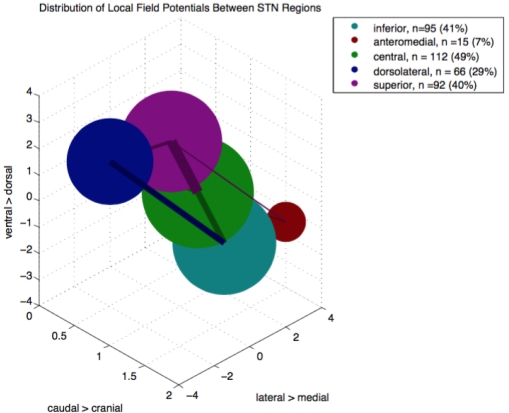 Maximum LFP beta power showed a significant correlation (r = 0.40, p < 0.0005) with the pre-operative assessment of contra-lateral bradykinesia and rigidity (Fig 2).
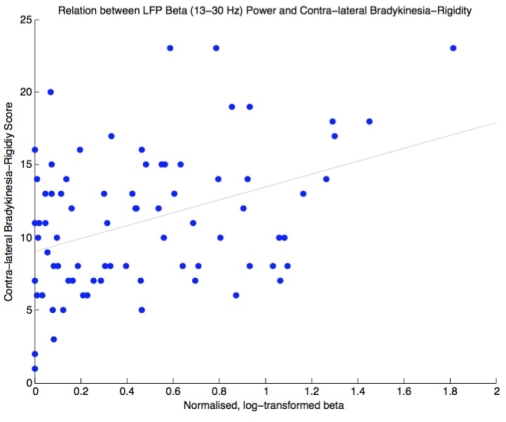 This was not the case for maximum alpha peak power (r = 0.03, p =0.89). Beta peak power (33 ± 38%) was significantly (Z = 7.89, p < 0.0001) higher than alpha peak (6 ± 10%) power. Neither activity predominated in one or more STN subregions (for beta Chi-sq 4,,370 = 6.01, p = 0.19, for alpha Chi-sq 4,,370 = 5.83, p = 0.21).
Conclusions: Normalised LFP beta power is robustly correlated with contra-lateral bradykinesia and rigidity but is not limited to the presumed dorsolateral STN.
To cite this abstract in AMA style:
M. Beudel, A. Oswal, A. Jha, T. Foltynie, L. Zrinzo, M. Hariz, P. Limousin, S. Derrey, H. Akram, L. Vladimir, P. Brown. Distribution of oscillatory activities in MRI confirmed subthalamic nucleus subregions [abstract]. Mov Disord. 2016; 31 (suppl 2). https://www.mdsabstracts.org/abstract/distribution-of-oscillatory-activities-in-mri-confirmed-subthalamic-nucleus-subregions/. Accessed November 4, 2026.« Back to 2016 International Congress
MDS Abstracts - https://www.mdsabstracts.org/abstract/distribution-of-oscillatory-activities-in-mri-confirmed-subthalamic-nucleus-subregions/