
Session Information
Date: Monday, June 5, 2017
Session Title: Surgical Therapy: Parkinson’s Disease
Session Time: 1:45pm-3:15pm
Location: Exhibit Hall C
Objective: To determine the impact of deep brain stimulation (DBS) during long term follow-up of post-operative weight changes in Parkinson’s disease (PD).
Background: PD patients have been observed to experience weight gain following DBS, however specific phenotypes of predisposed patients, specific target associations, and long-term follow-up has not been widely reported.
Methods: A retrospective chart review of PD DBS patients implanted at the University of Florida targeting subthalamic (STN) or globus pallidus interna (GPi) was conducted from January 2005 to December 2014. Clinical, demographic, and weight was recorded at baseline (pre-surgery) and at 6,12, 24, and 36 months postoperatively. A repeated measure analysis of variance (ANOVA) was performed to evaluate changes in mean weight at each of the targets across different time points, assuming a p=0.05 for statistical significance.
Results: Preliminary results revealed that 174 patients had unilateral DBS (96GPi and 78 STN) and 73.6% were male with mean age of 63.8±8.8 years. Seventy-eight patients (43 GPi and 35 STN) completed 3-years of follow-up. Both GPi and STN groups gained weight during the first 6 months post-surgery (2.3% increase for both GPi and STN, respectively). However, subsequent follow-up visits revealed opposite weight changes among targets, where a gradual average weight gain for the STN group (additional 1.3% weight gain) was observed contrasting with a subsequent gradual weight loss in the GPi group (3.4% weight loss) (p=0.035) at 3-year follow-up.
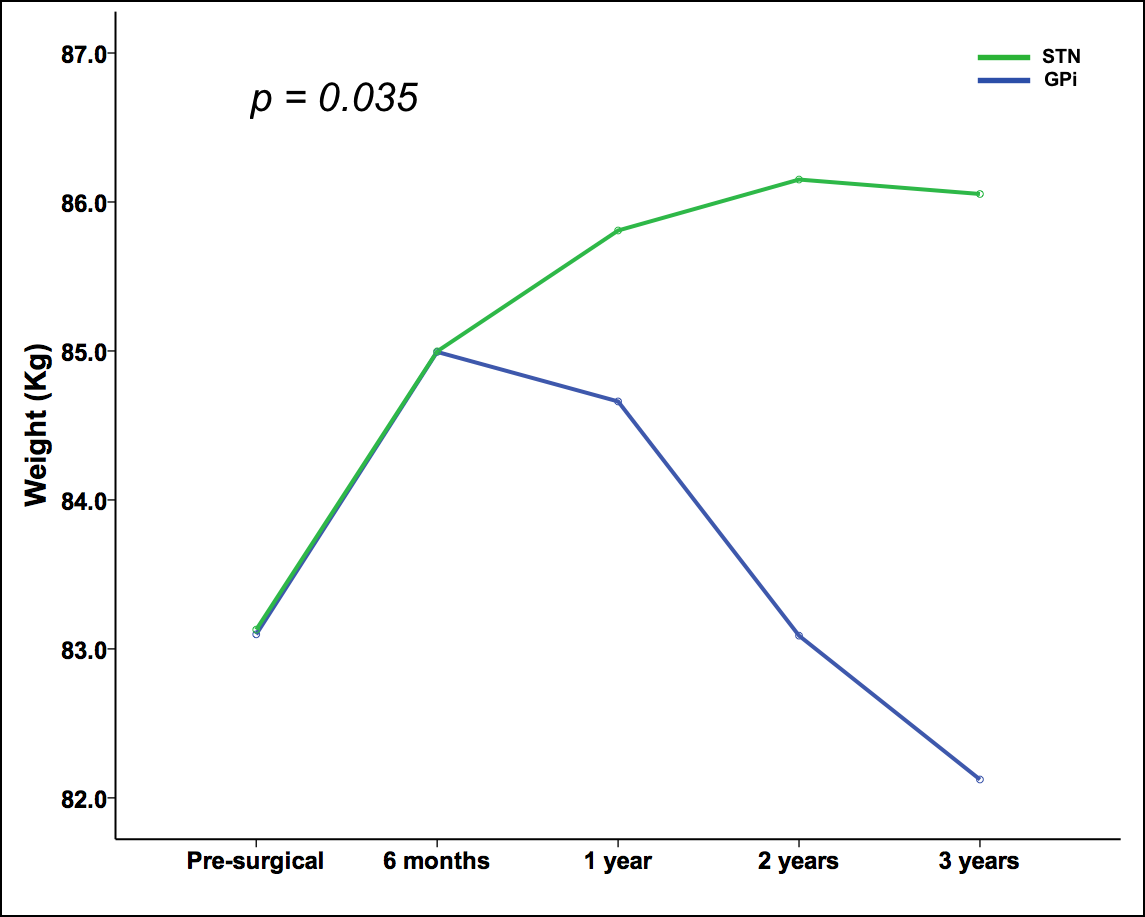
Conclusions: Our data suggest that DBS though initially leading to weight gain in both targets, may be associated with weight loss in GPi target at long-term follow-up. Possible contributing factors including patient’s characteristics, comorbidities, or disease phenotypes were not studied. Additionally, binge eating in STN DBS could have been a factor. Future prospective studies are needed to further clarify possible mechanisms.
References: Weight changes in subthalamic nucleus vs globus pallidus internus deep brain stimulation: results from the COMPARE Parkinson disease deep brain stimulation cohort.
Locke MC1, Wu SS, Foote KD, Sassi M, Jacobson CE, Rodriguez RL, Fernandez HH, Okun MS.
Mechanisms of Body Weight Gain in Patients With Parkinson’s Disease After Subthalamic Stimulation
C. Montaurier; B. Morio; S. Bannier; P. Derost; P. Arnaud; M. Brandolini-Bunlon; C. Giraudet; Y. Boirie; F. Durif
To cite this abstract in AMA style:
S. Shah, L. Almeida, A. Patterson, J. Hilliard, A. Wagle Shukla, K. Foote, M. Okun, D. Martinez-Ramirez, P. Zeilman. Weight Changes in STN and GPi Deep Brain Stimulation: Long Term Follow up [abstract]. Mov Disord. 2017; 32 (suppl 2). https://www.mdsabstracts.org/abstract/weight-changes-in-stn-and-gpi-deep-brain-stimulation-long-term-follow-up/. Accessed November 16, 2026.« Back to 2017 International Congress
MDS Abstracts - https://www.mdsabstracts.org/abstract/weight-changes-in-stn-and-gpi-deep-brain-stimulation-long-term-follow-up/