
Category: Parkinson's Disease: Non-Motor Symptoms
Objective: The aim of this study was to investigate the role of insomnia in relationship of disease severity with depression/anxiety in patients with Parkinson’s disease (PD).
Background: Depression and anxiety are common non-motor symptoms and complicating factors of Parkinson’s disease (PD). They markedly influence quality of life of PD patients. Sleep disorders, and specifically insomnia, are common complaints in PD patients and affect their quality of life.
Method: PD was diagnosed according to UK PDS Brain Bank clinical diagnostic criteria. Insomnia complaints were obtained from clinical interview. Hamilton rating scales were utilized for depression (HAMD) and anxiety (HAMA) assessment and modified H&Y scale was used to determine disease severity. We used Spearman’s correlation method for statistical analysis.
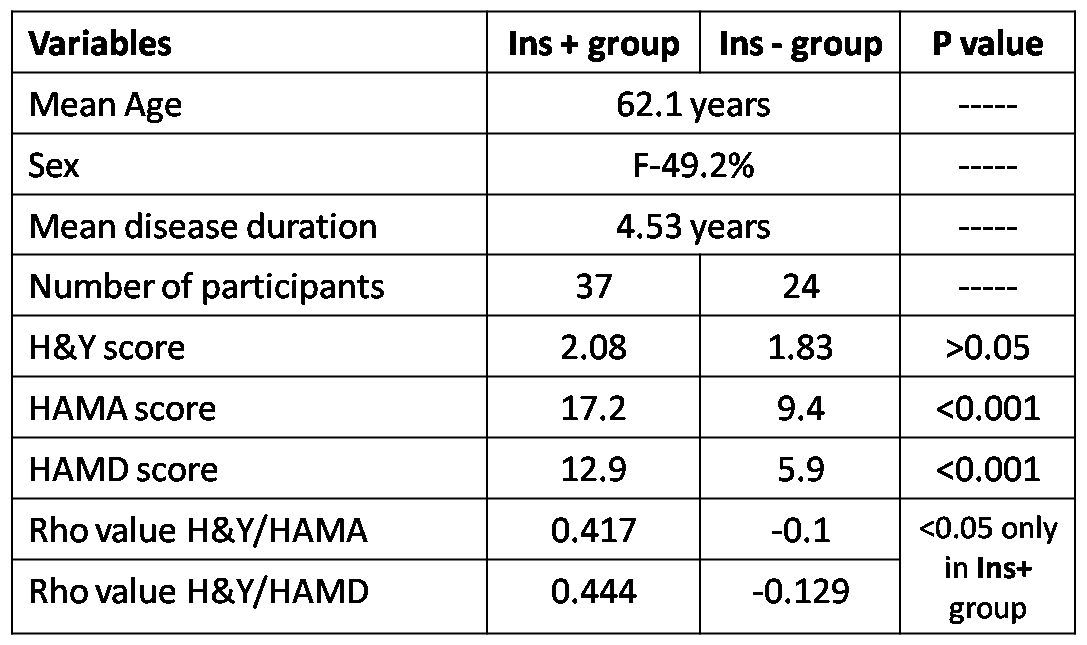
Results: Sixty-one PD patients (F-49.2%) from a tertiary movement disorders center were included. Mean age of patients was 62.1 years (43-79), and mean disease duration – 4.53 years (0.25-19). Based on insomnia complaints participants were divided into 2 groups: Ins+ (n=37) and Ins- (n=24). The means of H&Y scores in Ins+/Ins- groups had no significant difference: 2.08/1.83 (p>0.05). HAMA and HAMD scores in Ins+/Ins- groups were 17.2/9.4 (p<0.001) and 12.9/5.9 (p<0.001) respectively. The Spearman’s Rho correlation values between H&Y and HAMD scores in Ins+/Ins- groups were 0.444/-0.129 respectively, and between H&Y and HAMA scores in Ins+/Ins- groups were 0.417/-0.1 respectively (p<0.05 only for Ins+ group).[table1]
Conclusion: Overall, we report a strong correlation between disease severity and depression/anxiety only in PD patients with insomnia. The cause-effect relationship is unclear, but we showed that PD patients with more severe disease combined with insomnia have more severe depression and anxiety. Better understanding of this relationship can help with better management of advanced PD patients.
To cite this abstract in AMA style:
G. Yeganyan, S. Khachatryan, Z. Tavadyan. Insomnia may have a mediating role in linking Parkinson’s disease severity to depression and anxiety [abstract]. Mov Disord. 2020; 35 (suppl 1). https://www.mdsabstracts.org/abstract/insomnia-may-have-a-mediating-role-in-linking-parkinsons-disease-severity-to-depression-and-anxiety/. Accessed November 5, 2026.« Back to MDS Virtual Congress 2020
MDS Abstracts - https://www.mdsabstracts.org/abstract/insomnia-may-have-a-mediating-role-in-linking-parkinsons-disease-severity-to-depression-and-anxiety/