
Category: Parkinson's Disease: Neuroimaging
Objective: The purpose of this study is to evaluate possible differences in the DAT-SCAN ratios in patients with and without dysautonomia and RBD at diagnosis.
Background: Recently it has been suggested that there are two distinct subtypes of Parkinson’s disease, brain-first (BR) and body-first (BO). In BR, the accumulation of a-synuclein (a-syn) starts in the brain and spreads to the enteric nervous system (ENS). In contrast, BO shows early autonomic dysfunction and RBD, and α-syn accumulation originates in the ENS, with more symmetrical nigrostriatal degeneration.1
Method: We retrospectively analyzed 56 PD patients undergoing 123I-FP-CIT SPECT (DAT-SCAN) at the time of diagnosis. We divided the patients into two groups: BO, those who already had RBD, dysautonomia at the time of diagnosis, and BR. We analyzed, DAT-SCAN specific binding ratio (SBR) striatal asymmetry index (SAI) evaluating any differences between the two groups by t-test or Chi-square.
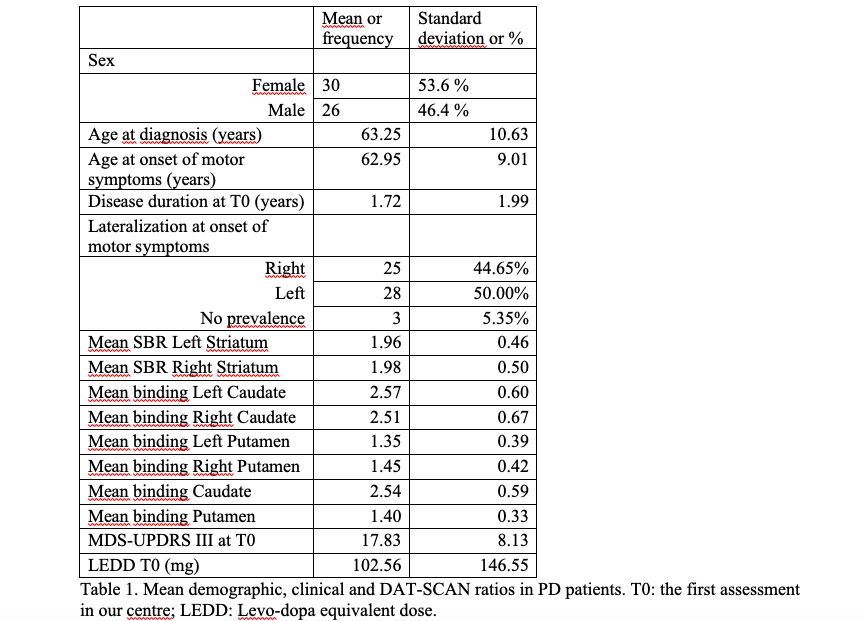
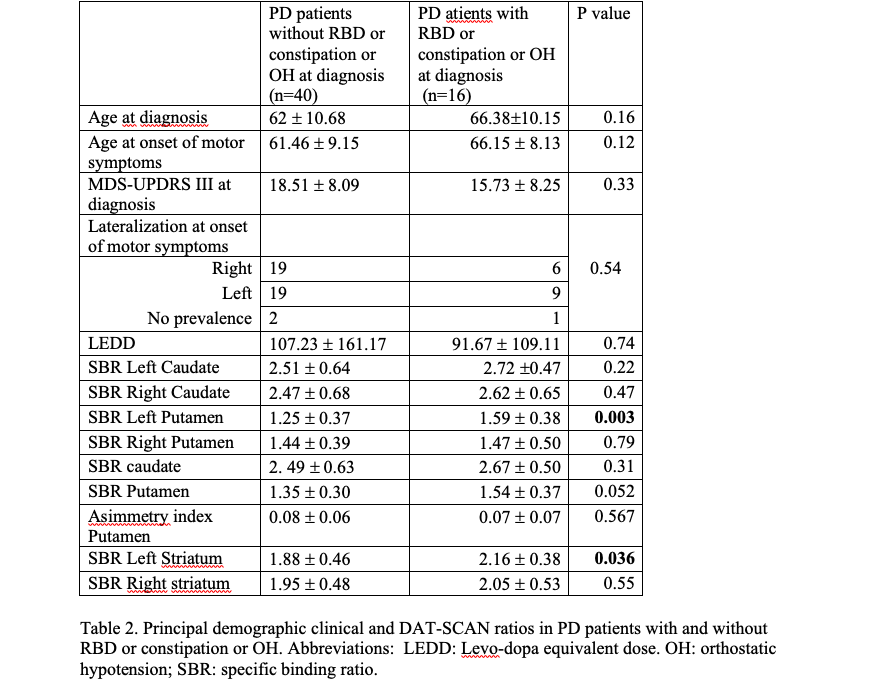
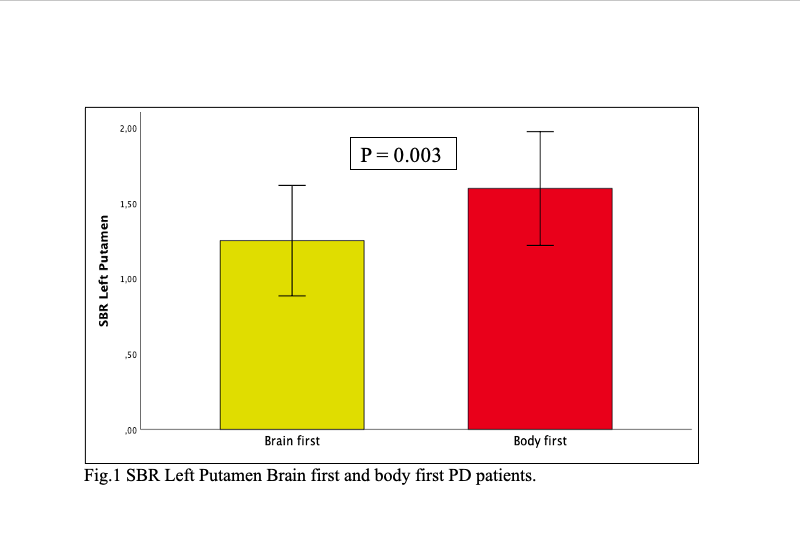
Results: In table 1 and 2 we reported the mean demographic, clinical and DAT-SCAN data The two groups were homogeneous in terms of age at the time of DAT-SCAN, Levo-dopa equivalent dose, lateralization and severity of motor symptoms. SAI revealed no significant differences in the two groups, while SBR at the left putamen and left striatum level were significantly reduced in BR patients compared to BO patients (p=0.003 and p=0.036 respectively, table 2, fig 1).
Conclusion: We found significant reduction in BR patients at the level of the left striatum, particularly the putamen, compared to the BO group at the onset of the disease. However, there are no differences in SAI.
References: 1. Horsager J, Andersen KB, Knudsen K, Skjærbæk C, Fedorova TD, Okkels N, Schaeffer E, Bonkat SK, Geday J, Otto M, Sommerauer M, Danielsen EH, Bech E, Kraft J, Munk OL, Hansen SD, Pavese N, Göder R, Brooks DJ, Berg D, Borghammer P. Brain-first versus body-first Parkinson’s disease: a multimodal imaging case-control study. Brain. 2020 Oct 1;143(10):3077-3088. doi: 10.1093/brain/awaa238. PMID: 32830221.
To cite this abstract in AMA style:
G. Bellini, G. Palermo, D. Frosini, E. Benevento, E. Del Prete, M G. Tedeschi, S. Visinoni, A. Francesconi, R. Ceravolo. Brain first-body first: is the dat-scan useful? [abstract]. Mov Disord. 2023; 38 (suppl 1). https://www.mdsabstracts.org/abstract/brain-first-body-first-is-the-dat-scan-useful/. Accessed November 8, 2026.« Back to 2023 International Congress
MDS Abstracts - https://www.mdsabstracts.org/abstract/brain-first-body-first-is-the-dat-scan-useful/