Category: Genetics (Non-PD)
Objective: To identify novel genes in autosomal recessive Primary Familial Brain Calcifications (PFBC).To identify novel genes in autosomal recessive Primary Familial Brain Calcifications (PFBC).
Background: PFBC is a monogenic disorder characterized by bilateral calcifications in the basal ganglia and other brain regions. Although six genes have been identified as causative genes for PFBC, the genetic basis remains unknown in over half of the patients, indicating the possible existence of additional causative genes.
Method: We performed whole-genome scans, homozygosity mapping and whole-genome sequencing on a Chinese consanguineous family with three siblings diagnosed with PFBC. We assessed the impact of a variant on the protein level through western blot, immunofluorescence, and co-immunoprecipitation. Additionally, a knock-out (KO) mice model was constructed to confirm the phenotype.
Results: We identified a homozygous variant of c.460_461del (p.D154Lfs*113) in NAA60. Functional assays showed that this variant disrupts NAA60 protein localization and accelerates protein degradation. The mutant NAA60 protein alters its interaction with the PFBC-related proteins PiT2 and XPR1, affecting cellular phosphate transport. Moreover, brain sections from a 19-month-old Naa60 KO mouse showed calcification in the cerebellum.
Conclusion: Our study introduces NAA60 as a novel gene associated with early-onset autosomal recessive PFBC, broadening the disorder’s genetic spectrum. We demonstrate the variant leads to loss-of-function in NAA60. The interaction with PiT2 and XPR1 further supports the identification of a third PFBC causative gene associated with the pathogenic mechanism underlying phosphate transport dysfunctions.
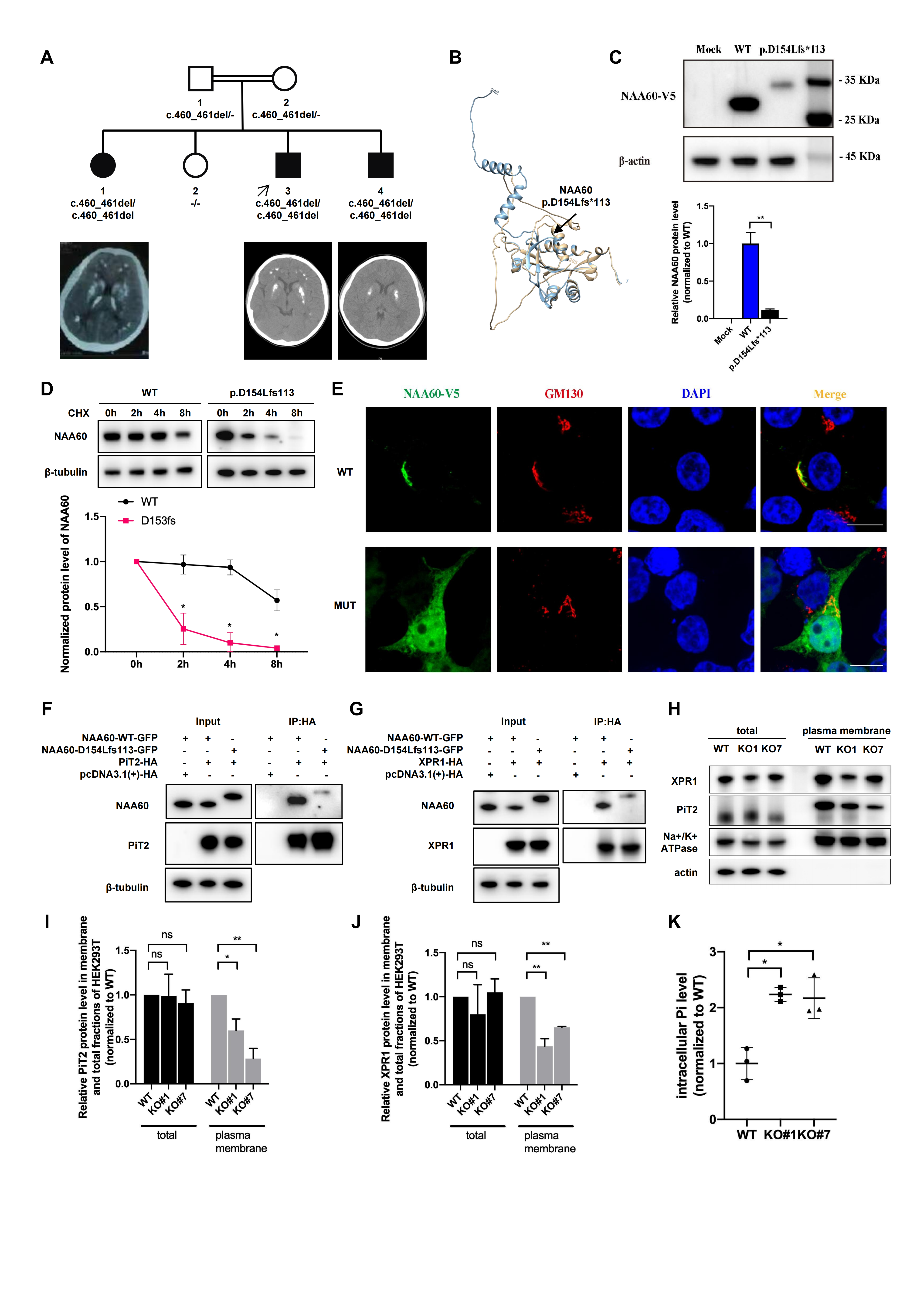
Figure 1
To cite this abstract in AMA style:
X. Chen, Y. Shi, F. Fu, L. Wang, D. Yang, X. Wang, C. Ying, H. Wang, Z. Lin, H. Wang, F. Zhang, X. Zheng, Y. Guo, Y. Wang, Y. Zeng, M. Zhao, Y. Chen, J. Li, H. Xia, J. Chen, B. Wang, S. Wu, F. Xie, J. Feng, Z. Cen, W. Luo. A Homozygous Variant in NAA60 is Associated with Primary Familial Brain Calcification [abstract]. Mov Disord. 2024; 39 (suppl 1). https://www.mdsabstracts.org/abstract/a-homozygous-variant-in-naa60-is-associated-with-primary-familial-brain-calcification/. Accessed November 8, 2026.« Back to 2024 International Congress
MDS Abstracts - https://www.mdsabstracts.org/abstract/a-homozygous-variant-in-naa60-is-associated-with-primary-familial-brain-calcification/